Chemical Bull
228
01-Aug-2026
Quick Answer
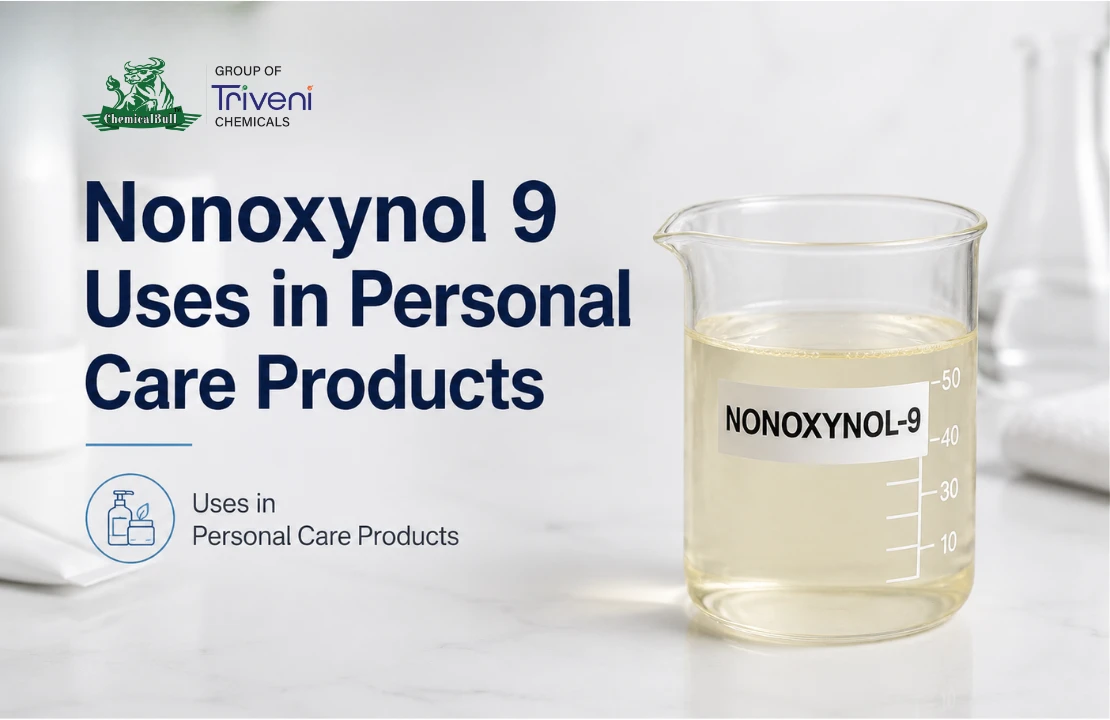
Nonoxynol-9 (CAS 26027-38-3) is a nonionic surfactant from the nonylphenol ethoxylate (NPE) family. It is used in personal care products as an emulsifier, wetting agent, dispersing agent, solubilizer, and cleansing ingredient. It helps improve emulsion stability and cleansing performance in creams, lotions, shampoos, and liquid cleansers. Manufacturers should verify regional regulatory requirements before using it in new formulations.
Introduction
Surfactants are important ingredients in personal care formulations, helping improve product stability, texture, cleansing performance, and ingredient compatibility. Nonoxynol-9 is a nonionic surfactant widely used for its emulsifying, wetting, dispersing, and solubilizing properties in cosmetic and specialty formulations.
It is used in applications such as creams, lotions, shampoos, liquid cleansers, and other personal care products where effective surface activity and formulation stability are required. Manufacturers sourcing this ingredient often look for a reliable Nonoxynol-9 supplier that can provide consistent quality, technical documentation, and product support.
As regulatory requirements and sustainability expectations continue to evolve, formulators need to evaluate both the functional benefits and compliance aspects of Nonoxynol-9 before selecting it for new product development.
This guide explains the properties, applications, benefits, formulation considerations, regulatory status, and sourcing factors of Nonoxynol-9.
What Is Nonoxynol-9?
Nonoxynol-9 is a nonionic surfactant produced by ethoxylating nonylphenol with approximately nine moles of ethylene oxide. Its balanced hydrophilic and lipophilic properties make it effective as an emulsifier and surface-active ingredient.
Unlike ionic surfactants, Nonoxynol-9 has no electrical charge, allowing compatibility with various formulation ingredients.
Key Functions:
- Emulsifies oil and water phases
- Reduces surface tension
- Improves wetting and dispersion
- Helps solubilize fragrances and oils
- Supports cleansing performance
Chemical Properties of Nonoxynol-9
|
Property |
Value |
|
Chemical Name |
Nonoxynol-9 |
|
CAS Number |
26027-38-3 |
|
Chemical Family |
Nonylphenol Ethoxylate (NPE) |
|
Molecular Formula |
C₃₃H₆₀O₁₀ |
|
Molecular Weight |
Approximately 616.8 g/mol |
|
Appearance |
Colorless to pale yellow viscous liquid |
|
Ionic Character |
Nonionic |
|
HLB Value |
Approximately 13 |
|
Solubility |
Soluble in water and many organic solvents |
|
Primary Functions |
Surfactant, Emulsifier, Wetting Agent, Solubilizer |
How Does Nonoxynol-9 Work?
Reduces Surface Tension
Helps liquids spread evenly and improves interaction between oil and water phases.
Stabilizes Emulsions
Reduces separation between oil and water, improving product stability.
Improves Wetting & Solubilization
Helps disperse powders, pigments, fragrances, and oil-soluble ingredients.
Benefits and Limitations
Understanding both the strengths and limitations of Nonoxynol-9 helps formulators select the most appropriate surfactant for a given application.
|
Benefits |
Limitations |
|
Excellent emulsification performance |
Environmental concerns associated with nonylphenol ethoxylates |
|
Good wetting and dispersing properties |
Regulatory restrictions in certain regions |
|
Effective cleansing performance |
May not be preferred for sustainability-focused formulations |
|
Compatible with many formulation ingredients |
Alternative surfactants may be required for some export markets |
|
Stable across a broad pH range |
Compliance requirements vary by country |
|
Cost-effective for many industrial applications |
Requires careful evaluation for new product development |
Nonoxynol-9 Uses in Personal Care Products
Nonoxynol-9 is valued in personal care manufacturing because a single ingredient can perform multiple formulation functions. As a nonionic surfactant, it reduces surface tension, stabilizes emulsions, improves ingredient compatibility, and enhances the overall performance of creams, lotions, cleansers, and other cosmetic products.
Below are the most common applications of Nonoxynol-9 in personal care formulations.
1. Emulsifying Agent
One of the primary uses of Nonoxynol-9 is as an oil-in-water (O/W) emulsifier. Cosmetic products often contain both oil-based and water-based ingredients, which naturally separate over time. Nonoxynol-9 helps maintain a stable emulsion by reducing interfacial tension between these phases.
Common Applications
- Face creams
- Body lotions
- Moisturizing creams
- Cosmetic emulsions
- Hair conditioning products
- Sunscreen formulations (where permitted)
Benefits
- Improved product stability
- Smooth texture
- Uniform consistency
- Reduced phase separation
- Better shelf-life performance
2. Cleansing Agent
Nonoxynol-9 is widely recognized for its cleansing ability. It helps remove oils, dirt, makeup residues, and other contaminants from the skin or hair by surrounding oily particles and allowing them to be rinsed away with water.
Common Products
- Facial cleansers
- Body washes
- Hand cleansers
- Liquid soaps
- Cleansing creams
Advantages
- Efficient oil removal
- Stable foam
- Improved cleaning performance
- Compatible with other surfactants
3. Wetting Agent
Many cosmetic raw materials are naturally difficult to disperse because they repel water. Nonoxynol-9 improves wetting by lowering surface tension, allowing powders and active ingredients to hydrate more quickly.
Typical Uses
- Pigment dispersion
- Mineral-based cosmetics
- Clay masks
- Powder ingredients
- Botanical extracts
Benefits
- Faster mixing
- Uniform ingredient distribution
- Reduced agglomeration
- Improved manufacturing efficiency
4. Solubilizing Agent
Many fragrances, essential oils, vitamins, and oil-soluble ingredients have poor water solubility. Nonoxynol-9 helps disperse these ingredients into water-based systems.
Suitable Ingredients
- Fragrance oils
- Essential oils
- Oil-soluble vitamins
- Botanical oils
- Perfuming agents
Advantages
- Improved clarity
- Better fragrance distribution
- Stable formulations
- Reduced separation
5. Dispersing Agent
Nonoxynol-9 promotes even distribution of insoluble particles throughout cosmetic formulations, improving appearance and product consistency.
Examples
- Titanium dioxide
- Zinc oxide
- Color pigments
- Mineral powders
- Functional fillers
6. Foam Modifier
Although it is not primarily a high-foaming surfactant, Nonoxynol-9 can improve foam quality when combined with other surfactants.
It is commonly blended with:
- Sodium Laureth Sulfate (SLES)
- Cocamidopropyl Betaine (CAPB)
- Sodium Lauryl Sulfate (SLS)
Benefits include:
- Creamier foam
- Better foam stability
- Improved cleansing feel
- Enhanced consumer experience
7. Historical Spermicidal Application
Nonoxynol-9 has also been used as an active ingredient in certain spermicidal products. This pharmaceutical application is regulated separately from its cosmetic use.
Nonoxynol-9 vs Other Personal Care Surfactants
Selecting the right surfactant depends on formulation goals, product type, target market, and regulatory requirements. While Nonoxynol-9 has long been valued for its emulsifying and wetting performance, formulators often compare it with other nonionic surfactants when developing new cosmetic products or reformulating existing ones.
The table below highlights key differences between commonly used surfactants.
|
Surfactant |
Type |
Primary Function |
Typical Applications |
Regulatory Considerations |
|
Nonoxynol-9 |
Nonionic |
Emulsifier, Wetting Agent, Cleansing Agent |
Creams, Lotions, Cleansers |
Restricted in certain regions due to environmental concerns |
|
Nonionic |
Solubilizer & Emulsifier |
Skin Care, Hair Care, Pharmaceuticals |
Broadly accepted worldwide |
|
|
Ceteareth-20 |
Nonionic |
Oil-in-Water Emulsifier |
Creams, Lotions |
Widely accepted in cosmetics |
|
Nonionic |
Solubilizer |
Fragrances, Essential Oils |
Commonly used in cosmetic formulations |
|
|
Octoxynol-9 |
Nonionic |
Wetting & Emulsifying Agent |
Specialty Formulations |
Similar regulatory considerations |
|
Laureth-9 |
Nonionic |
Cleansing & Wetting Agent |
Personal Care Products |
Regulations vary by market |
Why Choose ChemicalBull as Your Nonoxynol-9 Supplier?
At ChemicalBull, we understand the quality, documentation, and consistency requirements of cosmetic and industrial manufacturers. We support customers by providing reliable sourcing solutions for specialty chemicals and surfactants used across personal care and related industries.
Our Advantages
- High-quality raw materials
- Consistent batch-to-batch supply
- COA, TDS, and SDS documentation
- Bulk and export packaging options
- Worldwide shipping support
- Technical assistance for product selection
- Responsive customer service
- Reliable sourcing for B2B customers
Whether you require evaluation quantities or bulk orders, our team can assist in identifying the appropriate grade and supplying the necessary documentation to support your procurement and quality processes.
FAQS
-
What is Nonoxynol-9 used for?
Nonoxynol-9 is a nonionic surfactant used as an emulsifier, wetting agent, solubilizer, and cleansing agent in personal care products such as creams, lotions, shampoos, and liquid soaps. -
Is Nonoxynol-9 safe for cosmetics?
Nonoxynol-9 can be used in cosmetic formulations where permitted by local regulations. Manufacturers should verify current regional requirements and conduct appropriate safety assessments. -
What is the CAS number of Nonoxynol-9?
The CAS number of Nonoxynol-9 is 26027-38-3. -
What are the main benefits of Nonoxynol-9?
Nonoxynol-9 helps stabilize emulsions, improve ingredient dispersion, enhance cleansing performance, and solubilize oils and fragrances in personal care formulations. -
What products contain Nonoxynol-9?
Nonoxynol-9 may be found in creams, lotions, facial cleansers, shampoos, body washes, liquid soaps, and other personal care formulations, depending on regional regulations.
Conclusion
Nonoxynol-9 is a versatile nonionic surfactant used as an emulsifier, wetting agent, solubilizer, and cleansing ingredient in a variety of personal care products. Its multifunctional performance makes it valuable for creams, lotions, shampoos, and liquid cleansers. As regulations continue to evolve, manufacturers should consider regional compliance alongside formulation performance. Choosing a reliable Nonoxynol-9 supplier with consistent quality and technical documentation helps support efficient product development and sourcing.

Comment Section