Chemical Bull
327
11-Aug-2026
Mono Methyl Ethanolamine For Industrial Applications
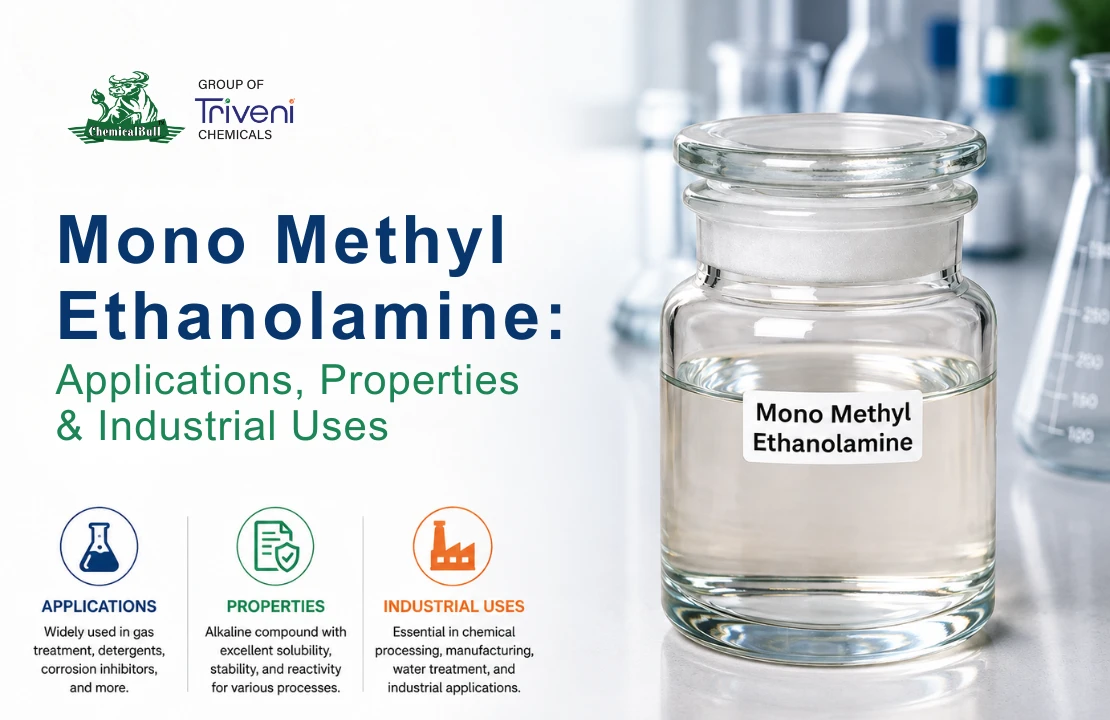
Mono Methyl Ethanolamine (MMEA), also known as N-Methylethanolamine, is a bifunctional amino alcohol that combines both an amine group (-NH) and a hydroxyl group (-OH) in a single molecule. The CAS number is 109-83-1. The molecular formula is C3H9NO. It's a transparent, colorless, hydrophilic liquid that is completely miscible in water and can be used with a range of organic solvents. This dual functional group architecture gives MMEA a chemical reactivity profile that is genuinely versatile: it can act as a base, a nucleophile, a ligand, a surfactant precursor, and a chemical building block depending on the reaction conditions and application context.
MMEA is used industrially as a gas treatment solvent, corrosion inhibitor intermediate, polymer and resin synthesis monomer, surfactant precursor, pH regulator, metalworking fluid additive, and chemical synthesis building block across the oil and gas, chemical processing, water treatment, textile, agricultural, and specialty chemicals industries. For industrial-grade MMEA with COA, MSDS, and reliable bulk supply, Chemical Bull is a trusted mono methyl ethanolamine supplier serving chemical manufacturers, industrial formulators, and specialty chemical buyers across India and global export markets.
Chemical Identity and Physical Properties
|
Property |
Details |
|
Chemical Name |
Mono Methyl Ethanolamine |
|
IUPAC Name |
2-(Methylamino)ethanol |
|
Synonyms |
MMEA, N-Methylethanolamine, Methylethanolamine |
|
CAS Number |
109-83-1 |
|
Molecular Formula |
C3H9NO |
|
Molecular Weight |
75.11 g/mol |
|
Physical Form |
Clear, colorless liquid |
|
Boiling Point |
196°C |
|
Melting Point |
-12°C |
|
Flash Point |
83°C |
|
Solubility |
Miscible with water |
|
Functional Groups |
Secondary amine (-NH) and primary hydroxyl (-OH) |
|
pKa (amine) |
Approximately 9.9 (moderately basic) |
What Makes MMEA Chemically Unique
The combination of amine and hydroxyl functional groups in a single small molecule (MW 75.11 g/mol) is the defining chemical feature of MMEA and the basis of all its industrial utility.
The secondary amine group (-NH):
- Acts as a moderate Brønsted base (pKa approximately 9.9), making it effective for pH regulation and neutralization of acidic gases
- Participates in reactions with epoxides, isocyanates, acids, and aldehydes as a nucleophile
- Forms coordination complexes with metal ions, giving it corrosion inhibition properties
- Is moderately reactive compared to primary amines, offering a balance between reactivity and selectivity in synthesis
The hydroxyl group (-OH):
- Provides water miscibility and hydrogen-bonding capacity
- Participates in esterification and urethane-forming reactions with isocyanates
- Contributes to the surface-active character of MMEA in aqueous systems
- Provides a second reaction site for creating bifunctional derivatives and crosslinked polymer networks
This combination means MMEA can react at both functional sites independently or simultaneously, depending on conditions. This is what makes it a more versatile building block than simple amines or simple alcohols.
Application 1: Gas Treatment and Acid Gas Removal
One of the largest industrial applications of MMEA and related alkanolamines is in the treatment of natural gas, refinery gas, and industrial process gas streams to remove acidic impurities. This process is called acid gas removal or gas sweetening.
How MMEA functions in gas sweetening:
Natural gas as well as many industrial gas streams have substantial amounts of hydrogen sulfide (H2S) as well as carbon dioxide (CO2). These gases, which are acidic, can be corrosive for pipelines and other equipment. They are harmful to people and have to be eliminated prior to the gas being suitable to sell or for further processing.
MMEA reacts selectively with H2S and CO2 in an absorber column:
- The amine group of MMEA reacts with the acidic gases, forming water-soluble amine salts that are absorbed into the liquid phase.
- The treated gas exits the absorber stripped of acidic components.
- The amine solution is regenerated by heating in a stripper column, releasing the acidic gases and recovering the MMEA for reuse.
Why MMEA is used in gas treatment systems:
- Its moderate basicity gives it selectivity for H2S removal compared to CO2 in mixed acid gas streams (selective H2S removal)
- Lower regeneration energy requirement compared to primary amine systems such as MEA (monoethanolamine) in certain applications
- Water miscibility allows use in aqueous amine solution systems at appropriate concentrations.
- Can be blended with other alkanolamines (MEA, DEA, MDEA) to optimize selectivity and capacity for specific gas compositions
Application 2: Corrosion Inhibition
MMEA is an important intermediate and active component in corrosion inhibitor formulations for metal surfaces in aqueous and acid environments. Its dual functional group structure gives it the ability to:
- Adsorb onto metal surfaces through coordination of the amine nitrogen with metal atoms, forming a protective molecular film
- Provide alkaline buffering that raises and maintains pH in the corrosive environment, reducing the rate of metal oxidation.
- Act as a precursor in the synthesis of imidazoline-based and amide-based corrosion inhibitors through condensation reactions with fatty acids.
Industrial corrosion inhibition applications:
|
Application |
Role of MMEA |
|
Metalworking fluids (cutting oils, coolants) |
pH buffer and mild corrosion inhibitor for ferrous metals |
|
Boiler water treatment |
Alkalinity builder and corrosion inhibitor for steam systems |
|
Oil and gas pipeline protection |
Component in corrosion inhibitor additive packages |
|
Acid pickling inhibitors |
Reduces metal dissolution during acid cleaning operations |
|
Cooling water treatment |
pH regulator and component in mixed inhibitor systems |
Application 3: Polymer and Resin Synthesis
MMEA serves as a bifunctional monomer and building block in the synthesis of specialty polymers and resins. Its two reactive functional groups allow it to participate in chain extension, crosslinking, and functionalization reactions in multiple polymer chemistry platforms.
Polyurethane synthesis:
MMEA's hydroxyl group reacts with isocyanates to form urethane linkages, while the amine group can participate in urea formation under different conditions. This dual reactivity allows MMEA to be incorporated as a chain extender, crosslinker, or functionality modifier in polyurethane formulations, providing:
- Improved flexibility and toughness in polyurethane coatings and adhesives
- Increased hydrophilicity in polyurethane systems for waterborne formulations
- Amine functionality for post-reaction modification of polyurethane networks
Epoxy resin curing:
The amine group of MMEA reacts with epoxy groups in a ring-opening reaction, functioning as a reactive curing agent in epoxy resin systems. MMEA-cured epoxy systems produce flexible, tough films with good adhesion to metal substrates.
Specialty resin synthesis:
MMEA is used as an intermediate in the production of specialty resins including morpholine (produced by dehydration cyclization of MMEA), oxazolidine resins, and various nitrogen-containing polymer architectures.
Application 4: Surfactant Production
The combination of the polar amine group and the hydroxyl group with a carbon chain makes MMEA a useful building block in surfactant synthesis. It is used in the production of:
Fatty acid amide and amine oxide surfactants:
MMEA reacts with fatty acids (typically C12 to C18) under heat to form fatty acid amides with residual amine and hydroxyl functionality. Further oxidation produces amine oxide surfactants with foam-boosting and viscosity-modifying properties used in cleaning products.
Amphoteric surfactants:
MMEA-based intermediates are used in the synthesis of amphoteric surfactant systems where the combination of amine and hydroxyl groups contributes to the zwitterionic character of the final surfactant.
Emulsifiers for agricultural formulations:
MMEA-derived emulsifiers are used in the formulation of herbicide and pesticide emulsifiable concentrates and suspension concentrates, where their combination of oil and water compatibility improves the stability and performance of agrochemical products.
Application 5: pH Regulation and Neutralization
MMEA's moderate basicity (pKa approximately 9.9) makes it an effective pH regulator and neutralizing agent in industrial formulations where controlled alkalinity is required.
Industrial pH regulation applications:
- Textile dyeing and finishing: MMEA buffers the pH of dye baths for acid dye and reactive dye systems, promoting level dyeing and consistent color yield
- Coating formulations: pH regulator in waterborne coating systems where maintaining alkaline pH stabilizes the dispersion and prevents premature crosslinking
- Water treatment: Alkalinity builder and pH adjuster in water treatment chemical formulations
- Cleaning formulations: Mild alkalinity source in neutral and mildly alkaline industrial cleaning concentrates
- Agricultural formulations: pH adjustment in pesticide and herbicide formulations to maintain API stability
Application 6: Metalworking Fluids
In metalworking fluid formulation, MMEA contributes as:
- Corrosion inhibitor: Adsorbs on ferrous metal surfaces, providing short-term corrosion protection between machining operations
- pH buffer: Maintains the alkaline pH (pH 8.5 to 9.5) required in water-miscible metalworking fluids to prevent microbial growth and corrosion
- Emulsification support: MMEA-based fatty acid salts contribute to the emulsification of oil-phase components in semi-synthetic metalworking fluids
- Biostability support: Alkaline pH maintained by MMEA retards the growth of bacteria and fungi in metalworking fluid sump systems, extending the useful life of the fluid
Application 7: Chemical Synthesis Intermediate
MMEA is a versatile intermediate in organic synthesis and specialty chemical manufacturing:
- Morpholine synthesis: Cyclodehydration of MMEA with diethanolamine produces morpholine, a widely used industrial solvent and chemical intermediate
- Oxazolidine synthesis: Condensation of MMEA with aldehydes produces oxazolidines, used as latent curing agents in coatings and adhesives.
- Pharmaceutical intermediates: MMEA is used in the synthesis of pharmaceutical intermediates and active pharmaceutical ingredients where the combination of amine and hydroxyl functionality is required
- Dye and pigment synthesis: Used as an intermediate in the production of certain dye types and as a coupling component in specialty colorant synthesis
MMEA vs Related Alkanolamines
|
Property |
MMEA (N-Methylethanolamine) |
MEA (Monoethanolamine) |
DEA (Diethanolamine) |
|
CAS Number |
109-83-1 |
141-43-5 |
111-42-2 |
|
Amine type |
Secondary amine |
Primary amine |
Secondary amine |
|
Molecular weight |
75.11 g/mol |
61.08 g/mol |
105.14 g/mol |
|
Boiling point |
196°C |
170°C |
271°C |
|
Basicity (pKa) |
~9.9 |
~9.5 |
~8.9 |
|
Hydroxyl groups |
1 |
1 |
2 |
|
Key advantage |
Balanced reactivity; good selectivity |
High reactivity; lower MW |
Lower basicity; reduced degradation |
|
Gas treatment |
Selective H2S removal |
H2S and CO2 removal |
Selective CO2 removal |
Frequently Asked Questions
1. What is Mono Methyl Ethanolamine used for industrially?
MMEA is used in gas sweetening (acid gas removal), corrosion inhibitor production, polymer and resin synthesis, surfactant manufacturing, pH regulation, metalworking fluids, and as a chemical synthesis intermediate.
2. What is the CAS number for Mono Methyl Ethanolamine?
CAS 109-83-1, molecular formula C3H9NO, molecular weight 75.11 g/mol. Also known as MMEA and N-Methylethanolamine.
3. How does MMEA work in gas treatment?
The amine group of MMEA reacts with acidic gases (H2S, CO2) in absorber columns, forming soluble amine salts that remove the gases from the gas stream. The amine solution is then regenerated by heating and reused.
4. Is MMEA the same as monoethanolamine (MEA)?
No. MMEA is N-Methylethanolamine (secondary amine), while MEA is 2-aminoethanol (primary amine). They have different reactivity profiles and different selectivity in gas treatment applications.
5. What is the flash point of MMEA?
83°C. MMEA is classified as a flammable liquid and must be stored and handled with appropriate fire safety precautions.
6. Why must MMEA containers be kept sealed?
MMEA is hygroscopic (absorbs moisture) and reacts with atmospheric CO2, which can form carbamate salts that reduce chemical purity and affect performance in sensitive applications.
7. What documentation is available for industrial MMEA procurement?
Standard documentation includes COA, MSDS, and Technical Data Sheet. Request these from your supplier before procurement and confirm purity, water content, and colour specifications.
Conclusion
Mono Methyl Ethanolamine is a bifunctional amino alcohol whose secondary amine and hydroxyl groups give it a uniquely versatile industrial chemistry profile. From acid gas removal in oil and gas processing to corrosion inhibitor synthesis, polyurethane and resin chemistry, surfactant production, pH regulation, and metalworking fluid formulation, MMEA delivers reliable chemical performance as both a functional chemical and a building block for more complex molecules and formulations.
For bulk industrial-grade Mono Methyl Ethanolamine with COA, MSDS, purity confirmation, and supply chain support for chemical manufacturers, industrial formulators, and research applications, connect with ChemicalBull, a trusted mono methyl ethanolamine supplier serving industrial buyers across India and global export markets.

Comment Section