Chemical Bull
1133
09-Dec-2025
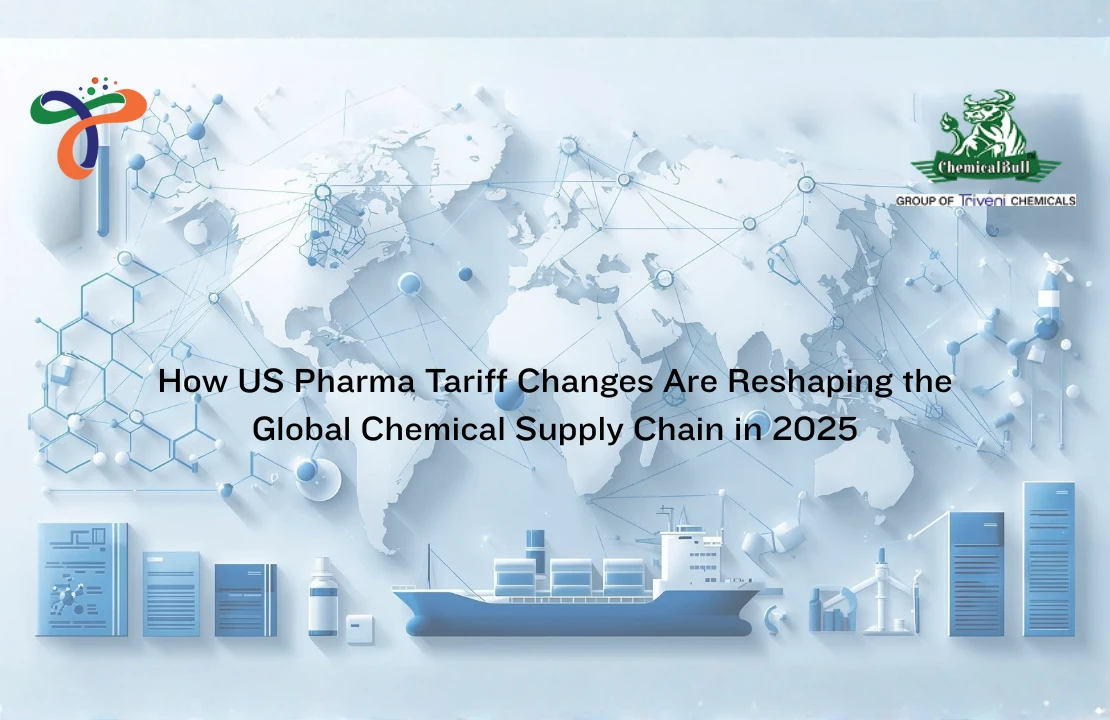
Understanding the 2025 US Pharma Tariff Changes
The updated US pharmaceutical tariffs have introduced new cost and sourcing challenges for global manufacturers. These tariff shifts apply to APIs, intermediates, solvents, aroma chemicals, and speciality ingredients used across the pharmaceutical and chemical industries. As a result, companies must reassess their sourcing models to maintain stability in a changing market.
How Tariff Changes Create Supply Chain Disruption
The tariff updates have led to several visible disruptions across the chemical supply chain. Manufacturers now face higher expenses, stricter import requirements, and delays that affect downstream production.
Major disruption areas include:
- Rising raw material costs are driven by increased import duties.
- Delays in customs processing due to tighter compliance checks.
- Instability in sourcing from regions heavily affected by tariff revisions.
- Higher production costs are impacting pharmaceutical manufacturing efficiency.
Supply Chain Trends Emerging in 2025
Global supply chain trends show a clear move toward diversification and compliance-heavy sourcing strategies. These trends reflect the growing need for stability amid rising geopolitical and economic pressures.
Key trends include:
- Diversified chemical sourcing across multiple regions.
- India's rapid emergence as a preferred global chemical supplier.
- Increased documentation and traceability requirements for US-bound shipments.
Before and After: Impact of US Tariffs
The table below highlights major industry changes resulting from the tariff updates:
|
Area Impacted |
Before Tariffs |
After Tariffs |
|
API Pricing |
Stable |
Higher due to duties |
|
Chemical Sourcing |
China-Dominant |
Shift to India/ASEAN |
|
Raw Material Costs |
Moderate |
Significant increase |
|
Supply Chain Stability |
Improving |
New disruptions |
|
Manufacturing Costs |
Predictable |
Higher batch costs |
Understanding Pharmaceutical Intermediates
Pharmaceutical intermediates are essential building blocks used during the synthesis of APIs. They significantly influence final drug purity, processing efficiency, and regulatory compliance. Due to tariff shifts, companies are increasingly evaluating cost‑effective intermediate suppliers, especially from India.
Chemical Categories Most Affected
Different chemical product groups are affected at varying levels:
|
Category |
Tariff Sensitivity |
Market Impact |
|
APIs |
Very High |
Major price increases |
|
Intermediates |
High |
Shift to India |
|
Aroma Chemicals |
Moderate |
Solvent-linked inflation |
|
Specialty Chemicals |
Medium |
Global price adjustments |
|
Excipients |
Low |
Minimal cost effect |
How Chemicalbull Pvt. Ltd. Helps Buyers Adapt
Chemicalbull Pvt. Ltd. supports global buyers by offering stable sourcing options and tariff‑efficient alternatives. The company’s agility and strong documentation systems make it a dependable choice in an evolving global landscape.
Key advantages include:
- Offering tariff‑smart product alternatives to reduce cost exposure.
- Ensuring a reliable supply even during global disruptions.
- Maintaining competitive pricing supported by efficient operations.
- Providing complete export documentation and regulatory compliance.
Recommendations for Companies in 2025
Companies can mitigate tariff challenges by adopting proactive sourcing and compliance strategies. Diversification and supplier evaluation are crucial steps in strengthening supply resilience.
- Diversify suppliers across multiple regions.
- Build safety stock for sensitive chemicals.
- Review tariff classifications regularly.
- Partner with Indian manufacturers for cost stability.
- Strengthen documentation and quality traceability.
Future Outlook for the Global Chemical Supply Chain
The future of the chemical supply chain shows a shift toward multi‑region sourcing, digital compliance systems, and deeper supplier collaborations.
Short-Term Outlook:
- Moderate price fluctuations.
- Extended import lead times.
- Continued supply chain disruption.
Medium-Term Outlook:
- Stronger Indian chemical export positioning.
- Expansion of Western API manufacturing.
- Improved digital tracking across supply chains.
Long-Term Outlook:
- Multi-region sourcing will become standard.
- Tariff‑adaptive procurement will be essential.
- Strategic partnerships will redefine sourcing models.
Conclusion
The 2025 US pharma tariff changes have significantly altered how companies manage global sourcing, cost planning, and chemical procurement. With tariff increases ranging from 5% to 25% on selected pharmaceutical intermediates and API-linked materials, businesses now face higher operational expenses and increased supply chain complexity.
Recent data shows the scale of this shift:
- Raw material costs may rise 12–18% for tariff-sensitive categories.
- Lead times may extend by 7–14 days due to enhanced customs inspections.
- Global sourcing diversification is expected to rise by 40% as companies shift away from single-region dependence.
Chemicalbull Pvt. Ltd. — Strengthening Global Supply Chains with Reliable, Cost-Efficient Solutions
Chemicalbull Pvt. Ltd. continues to support global buyers through tariff-driven challenges with dependable supply strategies, competitive pricing, and broad product expertise.
Measurable advantages Chemicalbull provides:
- 18–22% average cost reduction by switching to tariff-smart product alternatives.
- 98.5% on-time delivery performance, even during global disruptions.
- 200+ pharmaceutical intermediates and aroma chemicals supplied with complete COA, MOA, and regulatory documentation.
- Multi-region sourcing and strong domestic backup to ensure uninterrupted supply.
As global regulatory and tariff environments continue to evolve, companies that adopt flexible, diversified, and technology-driven sourcing strategies will achieve the greatest resilience. In this shifting landscape, Chemicalbull Pvt. Ltd. stands as a trusted partner—offering stability, quality, and long-term value for chemical and pharmaceutical businesses worldwide.

Comment Section