Chemical Bull
572
30-Jul-2026
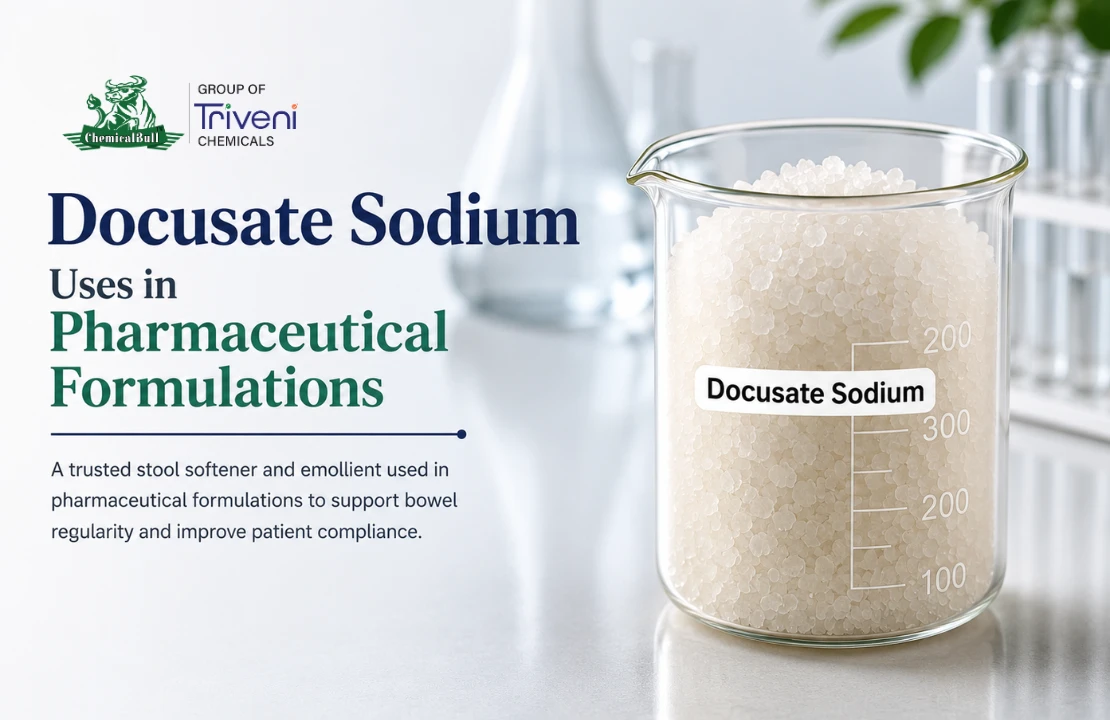
Docusate Sodium in Pharmaceutical Formulations: Uses, Functions and Manufacturing Considerations
Pharmaceutical manufacturers require ingredients that deliver consistent performance during processing, storage and administration. Docusate Sodium uses in pharmaceutical formulations extend from its established role as a stool-softening active ingredient to its technological use as a surface-active and wetting agent in selected dosage forms. Manufacturers beginning product development should first confirm the required grade, specification, intended function and regulatory classification with a reliable Docusate Sodium supplier.
Docusate Sodium is used in oral liquids, softgel capsules, tablets and other pharmaceutical products. Its suitability depends on the intended dosage form, concentration, purity requirements and applicable pharmacopoeial standard. Buyers can request the product specification, Certificate of Analysis, Safety Data Sheet, packing information and current commercial availability before procurement.
Quick Answer
Docusate Sodium is an anionic surface-active compound primarily used as an active ingredient in stool-softener medicines. It lowers surface tension and allows water and lipids to penetrate and mix with stool, producing a softer consistency. Official drug labels identify Docusate Sodium USP as the active ingredient in oral softgel products intended for occasional constipation.
Its surface-active properties can also support powder wetting and dispersion in selected pharmaceutical formulations. The exact role must be established during formulation development because Docusate Sodium may function as an active pharmaceutical ingredient in one product and as an excipient or formulation aid in another.
What Is Docusate Sodium?
Docusate Sodium is the sodium salt of docusate and is commonly known as Dioctyl Sodium Sulfosuccinate. It belongs to the sulfosuccinate class of anionic surfactants.
Its molecular formula is C₂₀H₃₇NaO₇S, and its molecular weight is approximately 444.56 g/mol. The USP monograph defines Docusate Sodium as containing between 99.0% and 100.5% of the stated compound when calculated on an anhydrous basis.
The molecule contains both hydrophilic and lipophilic regions. This structure enables it to reduce tension at interfaces between water, oils and solid materials, explaining its pharmaceutical activity and formulation behaviour.
Technical Specifications
|
Parameter |
Details |
|
Product name |
Docusate Sodium |
|
CAS number |
577-11-7 |
|
Molecular formula |
C₂₀H₃₇NaO₇S |
|
Molecular weight |
444.56 g/mol |
|
Chemical class |
Anionic sulfosuccinate surfactant |
|
Main use |
Stool-softener API and wetting agent |
|
Common forms |
Softgels, tablets, capsules and oral liquids |
|
Documents |
COA, SDS and specification |
How Does Docusate Sodium Work?
Docusate Sodium decreases surface tension and supports the emulsification of water and lipid materials. In stool-softener medicines, this allows water to penetrate the stool and helps produce a softer consistency.
In formulation systems, the same surface-active behaviour may improve contact between an aqueous phase and poorly wetted particles. This can be useful when hydrophobic powders remain on the liquid surface, form agglomerates or disperse unevenly.
The final effect depends on the concentration, particle characteristics, pH, solvent system, processing conditions and other ingredients in the formulation. Manufacturers should therefore demonstrate the required wetting or dispersion performance through laboratory testing rather than assuming the same result in every dosage form.
Main Docusate Sodium Uses in Pharmaceutical Formulations
Stool-Softener Medicines
The most widely recognised pharmaceutical application of Docusate Sodium is as an active ingredient in stool-softener medicines intended for temporary relief from occasional constipation.
Unlike stimulant laxatives, Docusate Sodium acts mainly through surface activity and moisture penetration. It may be formulated alone or alongside another laxative ingredient, depending on the product’s intended mechanism and regulatory approval.
Softgel Capsule Formulations
Softgel capsules are a common dosage form for Docusate Sodium because they can contain liquid or semi-liquid fill systems. Development requires careful control of the active ingredient’s compatibility with the fill vehicle and gelatin shell.
Manufacturers must assess fill homogeneity, capsule sealing, moisture transfer, leakage, shell deformation and drug-release behaviour. The formulation should remain stable throughout manufacturing and the proposed shelf life.
Commercially labelled Docusate Sodium softgels may contain excipients such as gelatin, glycerin, polyethylene glycol, propylene glycol, sorbitol solution and purified water. These examples demonstrate common formulation approaches but should not be treated as a standard formula for every product.
Oral Liquid Formulations
Docusate Sodium can also be formulated into oral liquids where flexible administration is required. Liquid development must address active concentration, dose uniformity, taste, pH, viscosity, preservation and microbiological stability.
Its surface-active character can create foam during mixing, pumping or filling. Excessive foam may interfere with batch-volume measurements and filling accuracy. Processing teams may need to adjust mixing speed, addition order and deaeration time to achieve consistent production.
Taste and mouthfeel also require attention because an effective medicine must remain acceptable to the intended patient population. Flavour and sweetener systems should be selected without affecting active stability or preservative efficacy.
Tablet and Capsule Formulations
Docusate Sodium may be incorporated into solid oral dosage forms as an active ingredient or, in selected products, as an inactive formulation component. FDA-approved drug labelling provides examples of tablets in which Docusate Sodium appears among the inactive ingredients.
In tablets and hard capsules, its surface activity may influence powder wetting, granulation and dissolution. Formulators should examine blend uniformity, moisture sensitivity, compression behaviour, disintegration, assay and release performance.
The USP also maintains a monograph for Docusate Sodium Tablets, specifying an acceptable range around the labelled drug content.
Combination Pharmaceutical Products
Docusate Sodium may be included in combination medicines where more than one mechanism is required. In such products, each active ingredient must have a clearly defined role.
Development teams should assess chemical compatibility, impurity formation, dose uniformity, release behaviour and stability. A combination product may require a different formulation strategy from a single-active stool softener because interactions between the actives can affect processing and shelf life.
Docusate Sodium as a Wetting and Dispersion Agent
Poor powder wetting can create floating particles, clumps and inconsistent drug distribution. Because Docusate Sodium reduces interfacial tension, it may help an aqueous phase spread more effectively across hydrophobic particle surfaces.
In selected pharmaceutical systems, this behaviour may support faster powder incorporation and more uniform dispersion. It can also affect dissolution by improving liquid contact with the solid surface.
However, an increased concentration does not always produce a better formulation. Excess surfactant may change foam, taste, viscosity, drug release, preservative activity or biological performance. Formulators must determine the lowest effective concentration through controlled studies.
Pharmaceutical-Grade Quality Requirements
Raw-material quality can influence finished-product performance, regulatory acceptance and manufacturing consistency. Pharmaceutical manufacturers should define their required grade before requesting a quotation.
The specification may cover identity, assay, water content, related substances, residual solvents, elemental impurities, pH and microbiological quality. Requirements should be based on the applicable pharmacopoeial monograph, the route of administration and the finished-product dossier.
The USP monograph for Docusate Sodium confirms the chemical formula, molecular weight and assay range, providing an established quality reference for pharmaceutical material.
Buyers should compare the supplier’s specification with their approved internal requirements instead of relying only on the product name.
Compatibility with Other Ingredients
Docusate Sodium should be evaluated with every important component of the final formula. Compatibility may vary with active ingredients, fillers, binders, preservatives, solvents, gelatin shells, coating materials and packaging.
Because it is an ionic surfactant, it may interact with other charged formulation materials. These interactions can alter clarity, solubility, viscosity, dispersion and release behaviour.
Compatibility studies should examine physical appearance, pH, assay, impurities and performance under accelerated storage conditions. Early testing can prevent stability or processing failures during pilot and commercial scale-up.
Processing and Foaming Control
Surface-active materials can introduce air during high-speed mixing. Foam may reduce usable vessel capacity, delay processing and affect filling accuracy.
The processing response depends on impeller design, mixing speed, batch size, temperature and addition sequence. A procedure that performs well in a small laboratory beaker may produce significantly more foam in a commercial vessel.
Manufacturers should observe foaming during scale-up and establish appropriate mixing and deaeration controls. Any antifoaming strategy must be compatible with the medicine and acceptable under the applicable regulatory requirements.
Stability and Storage Considerations
Raw Docusate Sodium should be stored according to the supplier’s approved specification and current SDS. Moisture, temperature and contamination must be controlled to preserve material quality.
Finished-product stability requirements depend on the dosage form. Softgel products require monitoring for shell leakage, brittleness, moisture migration and deformation. Oral liquids require evaluation of pH, microbial quality, viscosity, appearance and preservative effectiveness. Tablets and capsules require continued monitoring of assay, impurities, disintegration and dissolution.
DailyMed-labelled softgel products commonly specify tightly closed containers and controlled room-temperature storage, although manufacturers must establish storage conditions for their own approved product.
Quality Control During Pharmaceutical Manufacturing
Quality control begins with raw-material identification and continues through in-process testing and finished-product release.
The incoming Docusate Sodium batch should comply with the approved specification and Certificate of Analysis. Production testing may include pH, viscosity, blend uniformity, fill weight, mixing consistency and capsule integrity, depending on the dosage form.
Finished-product testing may include assay, content uniformity, dissolution, microbial limits, appearance, leakage and packaging compatibility. The exact programme should reflect the product’s dosage form, intended use and regulatory approval.
What Buyers Should Check Before Sourcing
Before sourcing pharmaceutical-grade Docusate Sodium, buyers should define its intended function as an API or excipient. This decision affects the required specification, documentation and regulatory support.
The supplier documentation should be checked for assay, purity, applicable pharmacopoeial status, batch consistency, storage conditions, retest period and packing. The COA, SDS and product specification should be reviewed by the quality and technical teams before commercial approval.
Procurement teams should also provide the required grade, quantity, dosage-form application, packing preference and delivery destination. This helps the supplier offer accurate availability and pricing instead of a general quotation.
Frequently Asked Questions
-
What is Docusate Sodium used for in pharmaceutical formulations?
Docusate Sodium is primarily used as the active ingredient in stool-softener medicines. Its surface-active properties may also support wetting and dispersion when it is used as a formulation aid in selected pharmaceutical products. -
Is Docusate Sodium an API or an excipient?
Docusate Sodium functions as an API when used for stool-softening activity. It may function as an excipient when used only for a technological purpose such as wetting. Its classification depends on the intended function and applicable regulations. -
In which dosage forms is Docusate Sodium used?
Docusate Sodium is used in softgel capsules, tablets, hard capsules, oral liquids and selected combination medicines. DailyMed and USP records confirm its use in oral softgels and tablets. -
How does Docusate Sodium work?
Docusate Sodium lowers surface tension and helps water and lipids penetrate and mix with stool. This supports its established function as a stool-softening active ingredient. -
What should buyers check before sourcing Docusate Sodium?
Buyers should review the intended use, pharmaceutical grade, assay, purity, pharmacopoeial compliance, COA, SDS, packaging and batch consistency before procurement. -
Can Docusate Sodium be purchased in bulk?
Bulk supply depends on the required grade, specification, packing, quantity and delivery destination. Pharmaceutical buyers should submit their complete technical requirements when requesting current pricing.
Conclusion
Docusate Sodium is an established pharmaceutical ingredient used mainly in stool-softener medicines. It is commonly formulated into softgels, tablets, capsules and oral liquids. Its ability to reduce interfacial tension also makes it relevant as a wetting or dispersion aid in selected pharmaceutical systems.
Successful formulation depends on correct regulatory classification, grade selection, compatibility testing, foam control and dosage-form-specific stability studies. Manufacturers should confirm the applicable pharmacopoeial requirements and approve the raw-material documentation before production.
For commercial sourcing, buyers can share the required grade, quantity, intended dosage form, packing preference and delivery destination to receive specification, documentation, availability and quotation support.

Comment Section