Chemical Bull
244
30-Jul-2026
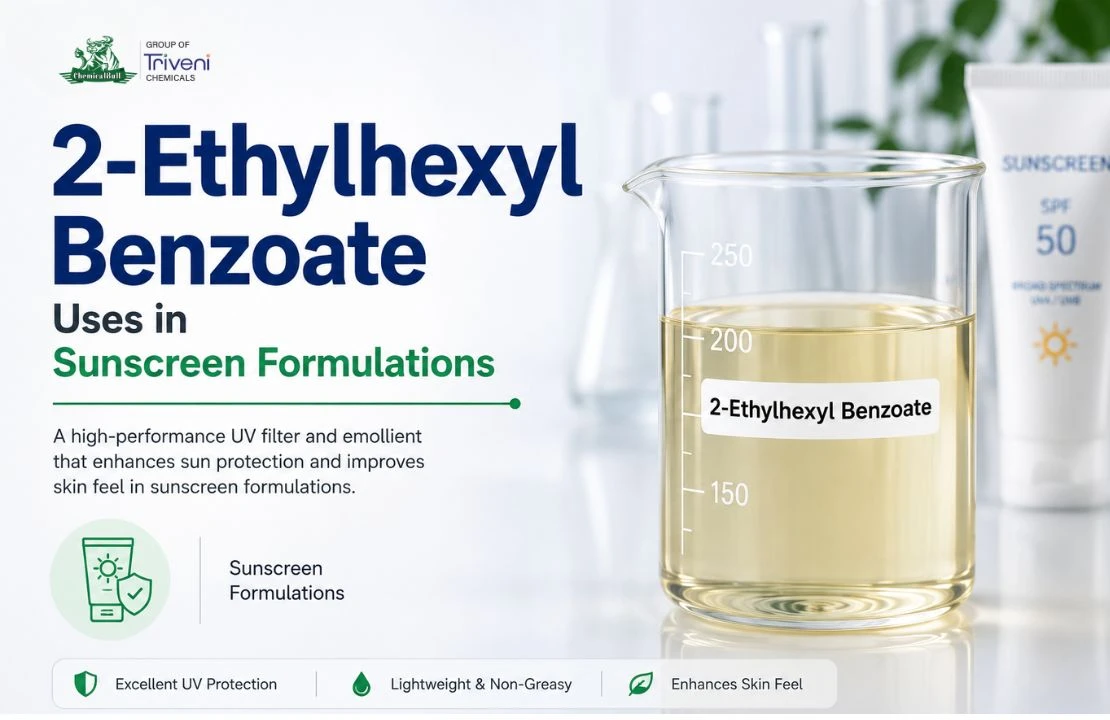
2-Ethylhexyl Benzoate Uses in Sunscreen Formulations
2-Ethylhexyl Benzoate (CAS 5444-75-7) is a lightweight ester used in sunscreen formulations primarily to dissolve solid organic UV filters like avobenzone and improve spreadability and shine. ChemicalBull is a bulk 2-Ethylhexyl Benzoate supplier for sun care and personal care manufacturers.
Its strong solvency for crystalline UV filters and low viscosity make it a practical choice when a sunscreen formulation needs to keep avobenzone fully dissolved and stable. Looking for 2-Ethylhexyl Benzoate for your formulation? Contact ChemicalBull for a quote today.
Quick Answer
2-Ethylhexyl Benzoate is used in sunscreen formulations as a solvent for solid organic UV filters, most notably avobenzone, which is otherwise difficult to dissolve and keep dissolved at usable concentrations. As a light, low-viscosity ester with a high refractive index, it also contributes spreadability, a glossy after-feel, and improved sensory profile in sunscreen lotions and sprays, making it a common component in both chemical and hybrid (chemical + mineral) sun care formulations.
2-Ethylhexyl Benzoate Uses
What is 2-Ethylhexyl Benzoate used for? It functions primarily as a UV filter solvent and emollient in sun care:
- UV filter solubilization — dissolves solid organic filters like avobenzone that don't dissolve easily in other emollients
- Sunscreen sprays — low viscosity supports spray formulation and nozzle performance
- Sunscreen lotions and creams — contributes spreadability and a glossy, non-greasy after-feel
- Hair care — used in select serums for shine enhancement
- Fragrance and personal care carrier — solvency for fragrance oils in select formulations
Across these uses, its defining trait is strong solvency for ingredients that resist dissolving in typical cosmetic oils, paired with a light sensory profile.
Role of 2-Ethylhexyl Benzoate in Sunscreen Formulations
2-Ethylhexyl Benzoate solves a specific formulation problem: avobenzone, one of the most widely used UV-A filters, is a solid crystalline material with limited solubility in most common cosmetic esters. If avobenzone isn't fully dissolved, it can recrystallize in the finished product, causing grittiness, reduced UV protection, and an unstable formulation. 2-Ethylhexyl Benzoate has unusually strong solvency for avobenzone specifically, which is why it appears so consistently across sunscreen formulations that use this filter, even when the rest of the formulation's emollient system is built around other esters.
What Is 2-Ethylhexyl Benzoate?
2-Ethylhexyl Benzoate is the ester formed by reacting 2-ethylhexanol (a branched-chain fatty alcohol) with benzoic acid. Unlike fatty acid esters such as 2-Ethylhexyl Cocoate or Ethylhexyl Palmitate, its acid component is aromatic (benzoic acid) rather than a fatty acid chain, which is what gives it its distinctively strong solvency for aromatic and polycyclic compounds like avobenzone, along with a notably high refractive index that contributes visible shine.
Why Is 2-Ethylhexyl Benzoate Used in Sunscreen Formulations?
Formulators select this ester for three practical reasons:
- Avobenzone solvency — dissolves and helps keep avobenzone in solution more effectively than most standard cosmetic esters.
- Low viscosity — supports spray, mist, and lightweight lotion formats without adding drag.
- High refractive index — contributes a glossy, non-matte finish, useful in formulations positioned for cosmetic appeal alongside sun protection.
2-Ethylhexyl Benzoate Technical Specifications
|
Property |
Typical Value |
|
CAS Number |
5444-75-7 |
|
Chemical Formula |
C15H22O2 |
|
Molecular Weight |
234.34 g/mol |
|
Appearance |
Colorless to pale yellow liquid |
|
Density (25°C) |
~1.00–1.01 g/cm³ |
|
Viscosity (25°C) |
~9–11 cSt |
|
Refractive Index |
~1.497 |
|
Flash Point |
~113°C |
|
Solubility |
Oil-soluble; insoluble in water |
|
Purity (typical commercial grade) |
≥99% |
How Is 2-Ethylhexyl Benzoate Manufactured?
2-Ethylhexyl Benzoate is produced through the esterification of benzoic acid with 2-ethylhexanol, typically using an acid catalyst under controlled temperature, followed by purification to remove unreacted starting materials and reaction byproducts. Residual free benzoic acid and unreacted alcohol are controlled tightly during purification, since even small amounts can affect formulation pH and long-term stability in sunscreen products.
Reputable manufacturers verify acid value and purity on every batch, since these specs directly influence how reliably the ester dissolves and holds UV filters like avobenzone in solution over the product's shelf life.
Safety, Handling, and Storage Guidelines
- Storage — store in tightly sealed containers away from direct heat and light exposure to minimize oxidation over time.
- Material compatibility — compatible with most standard cosmetic processing equipment (stainless steel, HDPE, glass-lined tanks).
- Light sensitivity — while the raw material itself is relatively stable, minimizing UV/light exposure during bulk storage is good general practice for ester raw materials used in photostability-sensitive sunscreen formulations.
- Shelf life — properly sealed and stored 2-Ethylhexyl Benzoate typically maintains stable specifications for 1–2 years.
Applications in Sunscreen and Personal Care Formulations
1. UV Filter Solubilization
How Does 2-Ethylhexyl Benzoate Help Dissolve Avobenzone?
Avobenzone's solid, crystalline structure makes it prone to falling out of solution if the surrounding emollient system doesn't have strong enough solvency. 2-Ethylhexyl Benzoate's aromatic ester structure interacts favorably with avobenzone's own aromatic rings, giving it noticeably stronger solvency for this specific filter than typical fatty acid esters — which is why it's included even in formulations where most of the emollient system is built around other, lighter esters.
2. Sunscreen Sprays and Mists
Its low viscosity supports clean atomization and consistent spray pattern in aerosol and pump-spray sunscreen formats, where higher-viscosity emollients can clog nozzles or produce uneven spray patterns.
3. Sunscreen Lotions and Creams
Contributes spreadability and a glossy, cosmetically elegant after-feel, supporting sunscreen products positioned for both protection and everyday wearability.
4. Hair Care Applications
Used in select hair serums and shine-enhancing products, leveraging its high refractive index for visible shine without heaviness.
Typical 2-Ethylhexyl Benzoate Usage Levels
|
Application |
Typical Usage Level (wt%) |
Primary Function |
|
Sunscreen lotions/creams (with avobenzone) |
5–15% |
UV filter solvency, spreadability |
|
Sunscreen sprays/mists |
5–20% |
UV filter solvency, low viscosity for spray |
|
Hair serums |
1–5% |
Shine, light conditioning |
|
General emollient systems |
2–10% |
Spreadability, gloss |
Actual usage levels depend on the avobenzone concentration and overall emollient system — our technical team can help align dosage with your formulation's UV filter loading.
Advantages of 2-Ethylhexyl Benzoate in Formulation
- Strong avobenzone solvency — helps prevent UV filter recrystallization and maintains formulation stability.
- Low viscosity — supports spray, mist, and lightweight lotion product formats.
- High refractive index — contributes visible gloss and cosmetic elegance.
- Broad compatibility — works well alongside both chemical and mineral UV filter systems.
- Non-greasy sensory profile — supports modern lightweight sunscreen positioning.
- Established sun care track record — long history of use in commercial sunscreen formulations.
Formulator's Note: Best Practices for Avobenzone Stability
A detail experienced sun care formulators watch closely: avobenzone solvency isn't a fixed property you can calculate from the emollient blend on paper — it needs to be verified through actual saturation testing at your specific formulation's temperature range, because avobenzone's solubility in 2-Ethylhexyl Benzoate drops as temperature falls, and a formulation that looks clear at room temperature can develop fine crystals after a cold-chain shipment or winter storage. Running a cold-temperature stability check (not just accelerated heat aging) is essential for any avobenzone-containing formulation, since heat stability testing alone won't catch this failure mode.
A second point worth flagging: 2-Ethylhexyl Benzoate's strong solvency, while useful for avobenzone, can also pull other formulation components into solution differently than expected, occasionally shifting SPF booster performance when the emollient system is reformulated. Any change to the ester ratio in an existing sunscreen formulation, even a small one, generally warrants a fresh in vitro SPF check rather than assuming the original SPF value still holds.
Difference Between 2-Ethylhexyl Benzoate and 2-Ethylhexyl Cocoate?
Both are branched-chain esters of 2-ethylhexanol, but they differ in the acid component — 2-Ethylhexyl Benzoate uses aromatic benzoic acid, while 2-Ethylhexyl Cocoate uses a blend of coconut-derived fatty acids — and this difference drives very different formulation roles. 2-Ethylhexyl Benzoate's aromatic structure gives it strong solvency for aromatic UV filters like avobenzone and a higher refractive index for shine, while 2-Ethylhexyl Cocoate is chosen primarily for its light, fast-absorbing emollience rather than UV filter solvency. The two are often used together in sunscreen formulations, each contributing a different functional role. For more on 2-Ethylhexyl Cocoate's broader personal care applications, see our 2-Ethylhexyl Cocoate Uses in Cosmetics and Personal Care guide.
2-Ethylhexyl Benzoate vs. Other Sun Care Emollients
|
Ingredient |
Structure |
Key Strength |
Typical Use Case |
|
2-Ethylhexyl Benzoate |
Aromatic ester |
Avobenzone solvency, shine |
Sunscreen UV filter solvent |
|
Fatty acid ester (coconut blend) |
Light emollience, fast absorption |
Sunscreen carrier, lightweight lotions |
|
|
Aromatic ester (longer chain) |
Broad UV filter solvency |
Sunscreen and general emollient use |
|
|
Fatty acid ester (myristic acid) |
Light, fast-spreading |
General emollient, pigment dispersion |
Other Uses and Applications of 2-Ethylhexyl Benzoate
Beyond mainstream sun care, 2-Ethylhexyl Benzoate is also used in:
- Color cosmetics — as a pigment-wetting and gloss-contributing agent in select formulations
- Fine fragrance and personal care carriers — as a solvent component in select formulation types
- Anhydrous cosmetic formulations — contributing shine and spreadability in wax-based products
Consistent purity, acid value, and refractive index from batch to batch matter directly to formulation performance, since drift in any of these specs can affect UV filter solvency and finished product stability in ways that are difficult to trace back to the raw material after stability failures occur.
Frequently Asked Questions
-
What is 2-Ethylhexyl Benzoate used for?
It is used primarily as a solvent for solid organic UV filters like avobenzone in sunscreen formulations, and as an emollient contributing spreadability and shine in sun care and personal care products. -
What is the CAS number of 2-Ethylhexyl Benzoate?
The CAS number is 5444-75-7. -
Why does avobenzone need a special solvent like 2-Ethylhexyl Benzoate?
Avobenzone is a solid, crystalline UV filter with limited solubility in typical cosmetic esters, and if it isn't fully dissolved, it can recrystallize, causing grittiness and reduced UV protection. 2-Ethylhexyl Benzoate has notably stronger solvency for it than most standard esters. -
What is the difference between 2-Ethylhexyl Benzoate and 2-Ethylhexyl Cocoate?
2-Ethylhexyl Benzoate is an aromatic ester chosen for its strong avobenzone solvency and high shine, while 2-Ethylhexyl Cocoate is a fatty acid ester chosen for light, fast-absorbing emollience; the two are often used together in sunscreen formulations. -
Can 2-Ethylhexyl Benzoate be used in mineral (physical) sunscreen formulations?
Yes, it can be used as a general emollient in hybrid or mineral sunscreen formulations even without avobenzone present, contributing spreadability and gloss, though its primary formulation advantage is specific to solubilizing organic UV filters.
Conclusion
2-Ethylhexyl Benzoate solves a specific, well-defined problem in sun care formulation: keeping avobenzone fully dissolved and stable, while contributing spreadability and shine to the finished product. Whether it's a spray sunscreen that needs low viscosity or a lotion that needs a glossy, cosmetically elegant finish, its performance comes down to that combination of strong aromatic solvency and light sensory profile. For formulators weighing it against lighter fatty acid esters like 2-Ethylhexyl Cocoate, the choice generally comes down to whether the formulation needs UV filter solvency or general emollience.
Comment Section