Chemical Bull
535
30-Jul-2026
Cocamidopropyl Dimethylamine For Industrial Applications
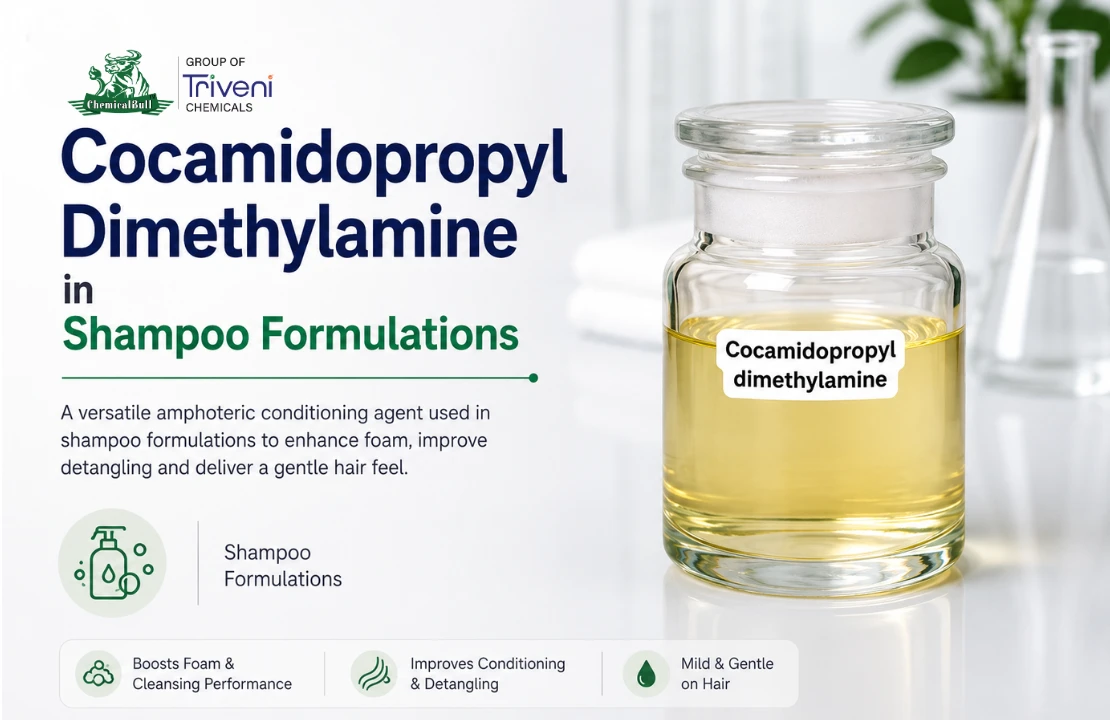
Modern shampoos are expected to cleanse without leaving hair rough, tangled or difficult to manage. Formulators increasingly combine cleansing surfactants with ingredients that support conditioning, static reduction and a smoother after-wash feel. Manufacturers developing anti-frizz, conditioning or colour-care shampoos can review available grades and technical documents from a reliable Cocamidopropyl Dimethylamine Supplier before beginning formulation trials.
Cocamidopropyl Dimethylamine is a coconut fatty-acid-derived amidoamine used in shampoo and hair-care systems. It can support conditioning, antistatic performance, emulsification and secondary cleansing when correctly neutralised. Buyers evaluating the ingredient for commercial production can share their required quantity, preferred specification and delivery location to receive packing, availability and quotation details.
Quick Answer
Cocamidopropyl Dimethylamine is used in shampoo formulations to improve hair manageability, reduce static, support wet combability and help distribute oil-compatible ingredients. Under acidic formulation conditions, it develops a stronger positive charge that can improve its interaction with negatively charged areas of the hair surface.
It is not the same as Cocamidopropyl Betaine. Cocamidopropyl Betaine is mainly selected for mild cleansing, foam enhancement and viscosity support, while Cocamidopropyl Dimethylamine is more closely associated with conditioning and antistatic performance.
What Is Cocamidopropyl Dimethylamine?
Cocamidopropyl Dimethylamine is an amidoamine derived from coconut fatty acids and dimethylaminopropylamine chemistry. It contains a fatty chain that interacts with oil-based materials and an amine group that can become positively charged after neutralisation with a suitable acid.
This behaviour is important in hair care. Damaged, bleached or chemically treated hair often contains negatively charged areas. A properly neutralised amidoamine can interact with these areas and support smoother hair feel, lower friction and easier combing.
Its performance is influenced by:
- Final formulation pH
- Degree of neutralisation
- Active concentration
- Surfactant combination
- Processing sequence
- Hair type and condition
- Rinsing conditions
Formulators should evaluate the ingredient within the complete shampoo system instead of treating it as a direct replacement for every amphoteric surfactant or conditioning agent.
How It Supports Shampoo Performance
Conditioning Without Excessive Heaviness
One of the main reasons for using Cocamidopropyl Dimethylamine in shampoo is its ability to provide conditioning support without creating the heavy feel associated with some traditional conditioning systems.
When appropriately formulated, it may help improve:
- Wet combability
- Dry combability
- Hair alignment
- Smoothness
- Manageability
- After-wash feel
This makes it relevant to conditioning shampoos, anti-frizz products, dry-hair shampoos, colour-care systems and mild daily cleansers.
Static and Flyaway Control
Hair may develop static after washing, brushing or exposure to dry conditions. Cocamidopropyl Dimethylamine can help reduce this effect by supporting charge balance on the hair surface.
Lower static may contribute to:
- Less flyaway
- Easier styling
- Reduced tangling
- Improved hair alignment
- A smoother appearance
This function is especially useful in anti-frizz and conditioning shampoo formulations.
Emulsification and Ingredient Distribution
Shampoos may contain fragrance oils, conditioning oils, emollients, silicones or other oil-compatible ingredients. Cocamidopropyl Dimethylamine can support emulsification and improve the distribution of these materials in suitable systems.
However, it may not independently solubilise every fragrance or oil. Formulators may still require a dedicated emulsifier, solubiliser or deposition aid depending on the oil load and desired product clarity.
Secondary Cleansing Support
The ingredient may contribute to cleansing, but it is generally not used as the only primary surfactant in a conventional shampoo. Its main value comes from combining secondary cleansing with conditioning and antistatic performance.
It may be used with:
- Anionic surfactants
- Amphoteric surfactants
- Nonionic surfactants
- Amino acid-based surfactants
- Conditioning polymers
- Emollients and silicones
Compatibility testing is important because the surfactant combination can influence foam, clarity, viscosity, deposition and storage stability.
Use in Different Shampoo Types
Conditioning Shampoos
Conditioning shampoos must remove oil and buildup while reducing the rough feel that can follow cleansing. Cocamidopropyl Dimethylamine may help improve combability and after-wash softness without requiring a heavy conditioning base.
It is often evaluated with conditioning polymers, mild surfactants and lightweight emollients.
Anti-Frizz Shampoos
In anti-frizz systems, the ingredient can support static reduction and smoother hair alignment. It may be especially useful when the formulation is designed for dry, porous or humidity-sensitive hair.
Its performance should be confirmed through combing, anti-static and humidity-control testing.
Colour-Care Shampoos
Colour-treated hair may be more porous and prone to roughness. Cocamidopropyl Dimethylamine can support manageability and smoother feel in mild colour-care formulations.
The complete formula should also control pH, cleansing strength and surfactant harshness to minimise unnecessary colour loss.
Sulphate-Free Shampoos
In sulphate-free shampoo systems, Cocamidopropyl Dimethylamine may be evaluated alongside mild anionic, amphoteric or amino acid-based surfactants.
It can support conditioning and static control, but viscosity and foam behaviour must be tested carefully because sulphate-free systems often respond differently to salt, fragrance and conditioning materials.
Two-in-One Shampoos
Two-in-one shampoos aim to combine cleansing and conditioning in a single product. Cocamidopropyl Dimethylamine may contribute to the conditioning side of this balance while primary surfactants provide cleansing and foam.
Deposition, clarity and rinse feel should be evaluated before commercial production.
Benefits for Hair
The phrase Cocamidopropyl Dimethylamine for hair usually refers to its conditioning and antistatic role rather than any hair-growth or therapeutic effect.
In an appropriately designed shampoo, it may help support:
- Improved wet combability
- Reduced tangling
- Lower static
- Smoother hair feel
- Better manageability
- Softer after-wash perception
The ingredient may be especially useful in formulas for dry, frizz-prone, bleached or colour-treated hair. Any performance claims should be supported through laboratory, salon or consumer testing.
Skin Contact and Safety
Consumers often ask, “Is Cocamidopropyl Dimethylamine safe for skin?” because shampoos and rinse-off products come into contact with the scalp, face and hands.
The ingredient is mainly used in rinse-off formulations. Its suitability depends on raw-material purity, concentration, finished-product pH, exposure conditions and the overall mildness of the formula.
When evaluating Cocamidopropyl Dimethylamine for skin-contact products, manufacturers should review:
- Raw-material specification
- Residual amine limits
- Recommended use level
- Final formulation pH
- Irritation and sensitisation data
- Rinse-off exposure conditions
- Finished-product safety assessment
It should not be promoted as a moisturising, soothing or therapeutic ingredient unless the finished formulation has supporting evidence.
Possible Side Effects
Potential Cocamidopropyl Dimethylamine side effects may include redness, itching, scalp discomfort, irritation or allergic contact reactions in sensitive individuals.
The likelihood of a reaction can be influenced by:
- Ingredient purity
- Residual impurities
- Use concentration
- Formulation pH
- Exposure duration
- Individual sensitivity
This does not mean every shampoo containing the ingredient will cause irritation. Proper impurity control, appropriate formulation design and finished-product testing are important for reducing risk.
Manufacturers should avoid broad claims such as “completely non-irritating” or “safe for every skin type.” A more accurate approach is to describe the ingredient as suitable for properly formulated rinse-off products when purity, concentration and pH are appropriately controlled.
Cocamidopropyl Dimethylamine vs Cocamidopropyl Betaine
Cocamidopropyl Dimethylamine and Cocamidopropyl Betaine have similar names, but their functions in shampoo are different.
|
Factor |
Cocamidopropyl Dimethylamine |
Cocamidopropyl Betaine |
|
Ingredient type |
Fatty-acid amidoamine |
Amphoteric surfactant |
|
Main role |
Conditioning and antistatic support |
Mild cleansing and foam support |
|
Charge behaviour |
More cationic after acid neutralisation |
Amphoteric depending on pH |
|
Foam contribution |
Usually secondary |
Commonly used as a foam booster |
|
Conditioning effect |
More targeted |
Generally mild and secondary |
|
Typical use |
Conditioning and acidic hair-care systems |
Shampoos, body washes and facial cleansers |
Cocamidopropyl Dimethylamine is more suitable when conditioning, static reduction and hair feel are the main priorities. Cocamidopropyl Betaine is more commonly selected when mild cleansing, foam enhancement and viscosity support are required.
Some shampoo systems may use both ingredients because they perform different functions.
Choosing a Suitable Alternative
The right Cocamidopropyl Dimethylamine alternative depends on the function that needs to be replaced.
For conditioning and static control, formulators may evaluate:
- Stearamidopropyl Dimethylamine
- Behenamidopropyl Dimethylamine
- Cationic guar derivatives
- Polyquaternium conditioning polymers
- Suitable quaternary conditioning agents
For mild cleansing and foam, possible alternatives include:
- Cocamidopropyl Betaine
- Sodium Cocoamphoacetate
- Disodium Cocoamphodiacetate
- Sodium Cocoyl Glycinate
- Sodium Lauroyl Sarcosinate
For emulsification or deposition support, formulators may consider nonionic emulsifiers, cationic emulsifiers, conditioning polymers or fatty alcohol-based systems.
No substitute should be selected only because its name or raw-material origin appears similar. The alternative must be tested for:
- pH compatibility
- Clarity
- Viscosity
- Foam performance
- Hair deposition
- Stability
- Preservative compatibility
- Sensory profile
Important Formulation Considerations
Neutralisation
Cocamidopropyl Dimethylamine generally requires controlled neutralisation with a suitable acid to develop the desired water compatibility and conditioning behaviour.
The acid type and neutralisation level may affect:
- Product clarity
- Viscosity
- Ingredient charge
- Hair deposition
- Sensory performance
- Storage stability
Acid should be added gradually with proper mixing and pH monitoring.
Final pH
The target pH influences charge behaviour, compatibility and conditioning performance. It should be selected according to the complete shampoo system and supplier recommendations.
An incorrect pH may reduce ingredient effectiveness or create problems with clarity, stability or scalp comfort.
Addition Sequence
Improper addition order can cause cloudiness, uneven neutralisation or instability. Manufacturers should follow technical guidance and confirm the sequence during pilot-scale development.
Surfactant Compatibility
The ingredient may interact with anionic and amphoteric surfactants. These interactions can influence:
- Foam volume
- Foam texture
- Viscosity
- Clarity
- Deposition
- Conditioning performance
Compatibility should be assessed in the final system rather than only in a simplified laboratory blend.
Electrolytes, Fragrance and Oils
Salt, fragrance and conditioning oils may significantly affect viscosity and product clarity. These ingredients should be added gradually during formulation development.
Stability and Performance Testing
A shampoo containing Cocamidopropyl Dimethylamine should be evaluated through appropriate stability and performance testing.
Recommended checks include:
- Accelerated stability
- Freeze–thaw cycles
- Centrifuge testing
- pH monitoring
- Viscosity monitoring
- Colour and odour evaluation
- Packaging compatibility
- Wet and dry combability
- Foam assessment
- Sensory testing
Testing should be carried out using the final packaging and intended storage conditions wherever possible.
What Manufacturers Should Check Before Sourcing
Raw materials sold under the same INCI name can vary in active content, colour, odour and impurity profile. Buyers should evaluate technical consistency and documentation instead of comparing price alone.
Important sourcing parameters include:
- Active matter
- Appearance
- Colour value
- Odour
- pH specification
- Residual dimethylaminopropylamine
- Water content
- Batch consistency
- Microbiological quality
- Packaging format
- COA, SDS and technical-data availability
These factors can affect shampoo clarity, fragrance profile, pH adjustment, conditioning performance and finished-product stability.
Related Hair-Care Ingredients
Formulators developing shampoo and cleansing systems can also review related ingredient guides:
- Cocamidopropyl Betaine uses in shampoo formulations
- Cocamidopropylamine Oxide in personal-care products
- PEG-7 Glyceryl Cocoate in shampoo and body wash
- conditioning ingredients for hair-care formulations
Frequently Asked Questions
-
What is Cocamidopropyl Dimethylamine used for?
It is used in shampoos and selected personal-care products for hair conditioning, static control, emulsification and secondary cleansing. -
Is Cocamidopropyl Dimethylamine safe for skin?
It may be suitable in properly formulated rinse-off products when concentration, pH, raw-material purity and residual impurities are appropriately controlled. Safety should be assessed in the finished formulation. -
Is Cocamidopropyl Dimethylamine good for hair?
It may help improve combability, reduce static and support smoother, more manageable hair in appropriately formulated shampoos. -
Can Cocamidopropyl Dimethylamine cause side effects?
Sensitive individuals may experience irritation or allergic contact reactions. Product purity, concentration, pH and finished-formula testing are important risk-control factors. -
Is Cocamidopropyl Dimethylamine the same as Cocamidopropyl Betaine?
No. Cocamidopropyl Dimethylamine is mainly used for conditioning and antistatic support, while Cocamidopropyl Betaine is mainly used for mild cleansing, foam and viscosity support.
Conclusion
Cocamidopropyl Dimethylamine can help formulators develop shampoos that combine cleansing with conditioning, static reduction and improved hair manageability. It is particularly relevant to anti-frizz, colour-care, dry-hair and conditioning shampoo systems.
Successful use depends on correct neutralisation, pH control, surfactant compatibility and raw-material purity. Manufacturers should review impurity limits and technical documentation, then validate the ingredient through stability, safety and hair-performance testing.
For commercial sourcing, share the required quantity, intended shampoo application, preferred specification, packing requirement and delivery destination to receive current product documents, availability and quotation support.

Comment Section