Chemical Bull
1115
31-Jul-2026
Dichloromethane Uses in Pharmaceutical Manufacturing
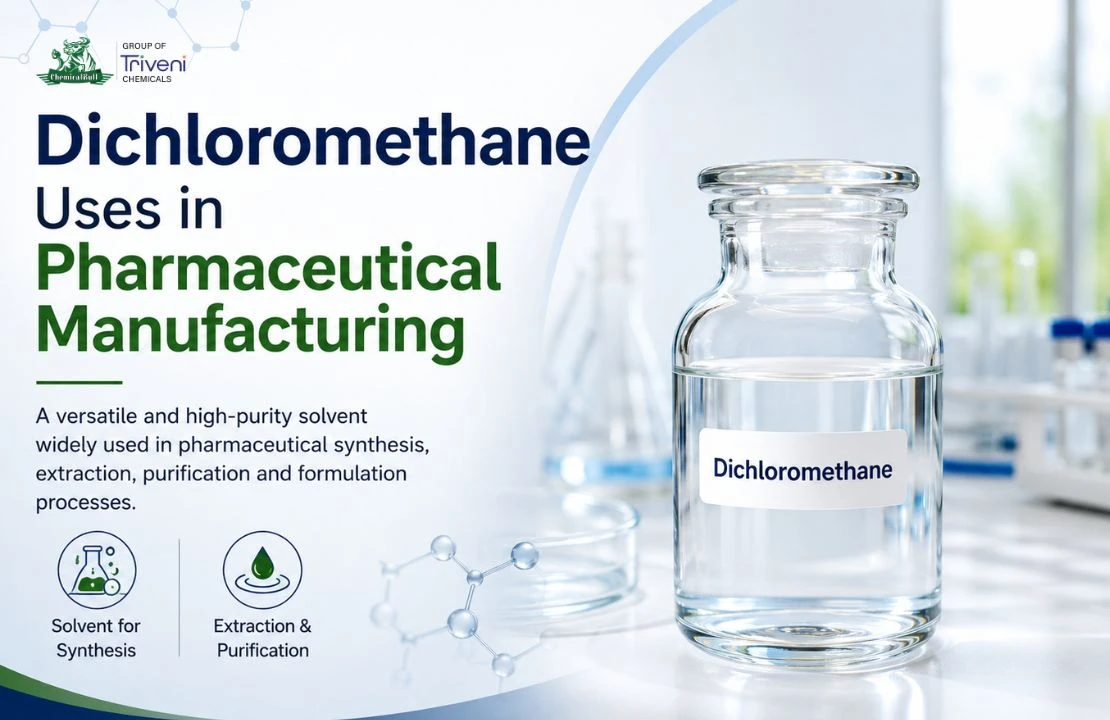
Dichloromethane, also known as methylene chloride, has been a workhorse solvent in pharmaceutical manufacturing for decades. Its combination of low boiling point, non-flammability under normal handling conditions, and strong solvency for a wide range of organic molecules makes it valuable across API synthesis, purification, and formulation steps. This guide covers where and how DCM is used in pharma, its regulatory limits, technical specifications, and what formulators should know before specifying it in a process.
Need dichloromethane for your pharma process? ChemicalBull is a trusted dichloromethane supplier offering pharma-grade material with full documentation and CoAs. Request a quote or ask our team for residual solvent data today.
Quick Answer
Dichloromethane (DCM), CAS 75-09-2, is used in pharmaceutical manufacturing mainly as an extraction and reaction solvent for active pharmaceutical ingredients (APIs), a film-coating solvent for tablets, and a recrystallization solvent for API purification. It is classified as an ICH Q3C Class 2 residual solvent, with a permitted daily exposure (PDE) of 6.0 mg/day and a concentration limit of 600 ppm in finished drug products. Its low boiling point (39.6°C), high volatility, and strong solvency for organic compounds make it easy to remove from the final product while still being effective at low process temperatures.
What Is Dichloromethane?
Dichloromethane is a chlorinated hydrocarbon solvent, colorless, with a mild sweet odor and high volatility. It is miscible with most organic solvents and is non-flammable under standard storage and handling conditions, which is one reason it remains common in pharmaceutical and fine chemical plants where flammable-solvent handling adds cost and complexity.
Key Properties
|
Property |
Value |
|
CAS Number |
75-09-2 |
|
Molecular Formula |
CH₂Cl₂ |
|
Molecular Weight |
84.93 g/mol |
|
Boiling Point |
39.6°C |
|
Density |
1.32–1.33 g/cm³ (25°C) |
|
Vapor Pressure |
435 mmHg (20°C) |
|
Water Solubility |
~13 g/L (20°C) |
|
Flash Point |
Non-flammable (no flash point by standard test methods) |
|
ICH Solvent Class |
Class 2 |
|
PDE (Permitted Daily Exposure) |
6.0 mg/day |
|
Concentration Limit (Option 1) |
600 ppm |
Dichloromethane Uses in Pharmaceutical Manufacturing
1. API Extraction and Reaction Solvent
DCM is widely used to extract active pharmaceutical ingredients from reaction mixtures during synthesis. Its low boiling point allows easy solvent recovery by distillation without exposing thermally sensitive APIs to high heat, and its favorable partition behavior in liquid-liquid extraction helps separate the target compound from aqueous by-products and salts.
2. Tablet and Pellet Film Coating
In film coating, DCM has historically been used (often in combination with methanol or other co-solvents) to dissolve polymers such as cellulose derivatives for spray coating of tablets and pellets. Its fast evaporation rate supports efficient coating cycles, though many manufacturers have shifted toward aqueous coating systems where feasible for solvent-emission and safety reasons.
3. Recrystallization and API Purification
DCM is used as a recrystallization solvent to purify APIs and intermediates, removing process impurities and controlling crystal form. Because it evaporates readily and leaves minimal residue when properly processed, it supports tight impurity and residual solvent specifications.
4. Extraction of Natural Products and Excipients
DCM is also used to extract active constituents from plant material during the manufacture of certain natural-origin excipients and APIs, owing to its ability to dissolve a broad range of lipophilic organic compounds without requiring high process temperatures.
5. Cleaning and Equipment Rinsing
In some facilities, DCM is used as a rinse solvent for reactors and processing equipment between batches, helping remove residual organic material before the next production run.
Formulator's Note: Best Practices for Stability and Handling
A detail that often gets missed in generic write-ups: DCM's evaporation rate is fast enough that inconsistent drying conditions between batches can cause variable residual solvent readings even when the same process parameters are used on paper. In practice, tighter control of drying chamber airflow and dwell time — not just temperature — is what keeps batch-to-batch residual DCM levels consistent against the 600 ppm ICH limit. It's also worth stabilizing drums with the correct headspace nitrogen blanket during storage, since DCM can slowly hydrolyze to form trace HCl in the presence of moisture, which is a common root cause of unexpected corrosion complaints in downstream stainless-steel equipment.
Regulatory and Safety Considerations
- ICH Q3C classification: DCM is a Class 2 residual solvent, meaning its use should be limited due to inherent toxicity, with documented PDE-based justification in regulatory filings.
- Occupational exposure: DCM requires controlled ventilation and monitoring in manufacturing areas per applicable occupational exposure limits (OELs), which vary by region.
- Residual solvent testing: Finished APIs and drug products using DCM in manufacturing require GC-based residual solvent testing to confirm compliance with the 600 ppm limit (or the PDE-based limit for high-dose products).
- Alternative solvent trend: Regulatory and environmental pressure has pushed many formulators toward Class 3 solvents (ethanol, ethyl acetate) or aqueous processes where DCM's properties aren't strictly required — worth evaluating early in process development.
Dichloromethane vs. Other Pharma-Grade Solvents
|
Solvent |
ICH Class |
PDE (mg/day) |
Boiling Point |
Typical Pharma Use |
|
Dichloromethane (DCM) |
Class 2 |
6.0 |
39.6°C |
Extraction, coating, recrystallization |
|
Class 3 |
50 (general limit) |
77°C |
Extraction, recrystallization |
|
|
Tetrahydrofuran (THF) |
Class 2 |
7.2 |
66°C |
Reaction solvent, extraction |
|
Class 2 |
8.9 |
111°C |
Reaction solvent, recrystallization |
Looking at related raw materials for your formulation? See our notes on propylene glycol for cosolvent and humectant applications, or ethyl acetate if you're comparing Class 3 alternatives for extraction steps.
Storage and Handling
- Container type: Store in tightly closed, corrosion-resistant containers (drums/IBCs rated for chlorinated solvents)
- Location: Keep in a cool, well-ventilated area, away from direct sunlight and heat sources
- Incompatibilities: Avoid storage near strong oxidizers, which can react with DCM
- Transfer operations: Perform in closed systems or under local exhaust ventilation to limit worker exposure to vapors
- Headspace protection: Use a nitrogen blanket where possible to reduce moisture ingress and slow hydrolysis
- Handling area: Ensure adequate ventilation and vapor monitoring in areas where DCM is dispensed or used
Environmental and Disposal Guidelines
DCM is classified as a hazardous waste solvent in most jurisdictions and cannot be discharged to drain or general waste streams. Standard practice includes:
- Solvent recovery: Many manufacturing sites recover and redistill DCM in-house for reuse in non-critical steps, reducing both cost and hazardous waste volume.
- Licensed disposal: Waste DCM that isn't recovered must go to a licensed hazardous waste handler for incineration or approved treatment — check local pollution control board requirements before disposal.
- VOC reporting: DCM is a regulated volatile organic compound (VOC) in many regions; facilities using it above threshold quantities may have air emission reporting obligations.
- Green chemistry shift: Given disposal costs and tightening emission norms, several formulators are piloting Class 3 solvents or aqueous processes for steps where DCM's properties (fast evaporation, strong solvency) aren't strictly essential to the reaction or coating outcome.
Frequently Asked Questions
-
Is dichloromethane still used in pharmaceutical manufacturing?
Yes. DCM remains in use for select extraction, coating, and purification steps, though its use has declined in some applications as manufacturers shift toward Class 3 solvents and aqueous processes. -
What is the ICH limit for dichloromethane in drug products?
Under ICH Q3C, dichloromethane has a permitted daily exposure (PDE) of 6.0 mg/day, corresponding to a concentration limit of 600 ppm under the standard Option 1 calculation. -
Why is dichloromethane used in tablet coating instead of water?
DCM's fast evaporation and strong solvency for coating polymers historically made it efficient for organic-solvent film coating, though aqueous coating systems are now preferred where the polymer and process allow it. -
Is dichloromethane flammable?
No, dichloromethane is non-flammable under standard test conditions, which is one reason it has remained in use in some solvent-handling environments where flammability is a major process concern. -
What is the CAS number for dichloromethane?
The CAS number for dichloromethane (methylene chloride) is 75-09-2.
Comment Section