Chemical Bull
152
04-Sep-2026
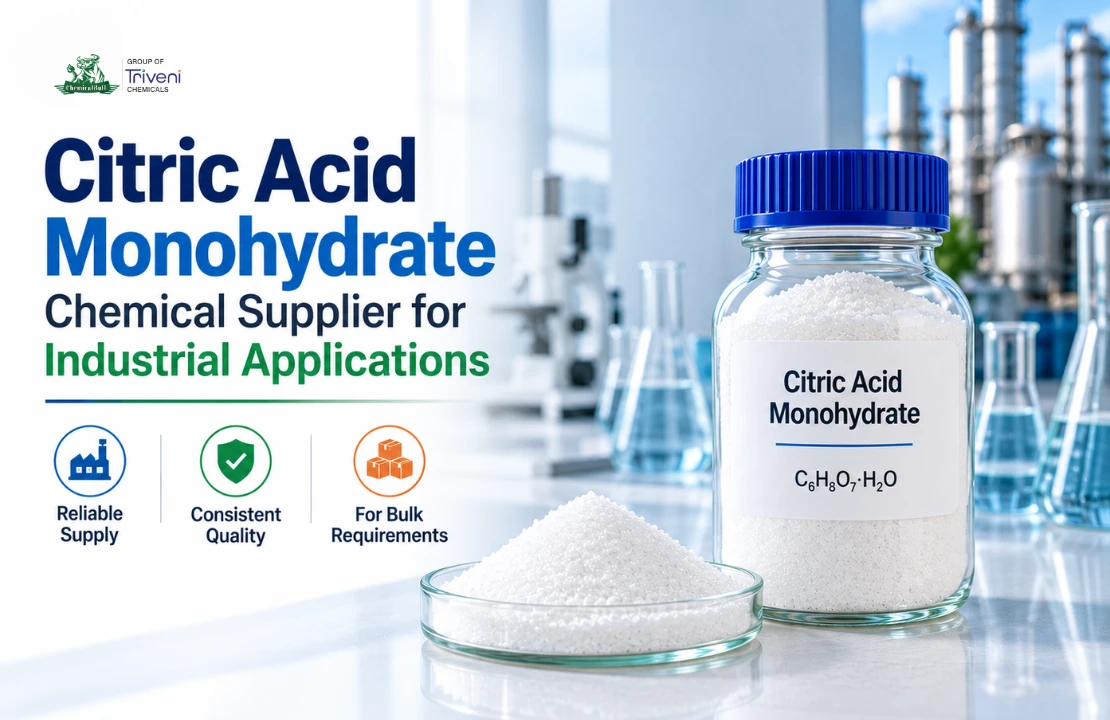
Citric Acid Monohydrate Chemical Supplier for Industrial Applications
Citric Acid Monohydrate is a widely used organic acid found across food processing, pharmaceuticals, cosmetics, personal care, detergents, cleaning products, water treatment, metal processing, and industrial chemical formulations. Its acidity, water solubility, buffering behavior, and ability to interact with metal ions make it useful in a wide range of manufacturing and processing applications.
For businesses evaluating a citric acid monohydrate supplier, ChemicalBull supports B2B sourcing requirements by helping buyers evaluate product specifications, grade, packaging, quantity, documentation, and application requirements.
Quick Answer: What Is Citric Acid Monohydrate Used For?
Citric Acid Monohydrate is primarily used as an acidulant, pH regulator, buffering component, chelating agent, cleaning ingredient, and formulation aid. Its major applications include food and beverage processing, pharmaceutical formulations, cosmetics and personal care, detergents and cleaners, water treatment, metal cleaning, and industrial chemical manufacturing.
The appropriate grade and specification depend on the intended application, formulation, processing conditions, and regulatory requirements.
What Is Citric Acid Monohydrate?
Citric Acid Monohydrate is the hydrated form of citric acid, containing one molecule of water of crystallization for each molecule of citric acid.
Its chemical formula is C₆H₈O₇·H₂O, and its CAS number is 5949-29-1. It is commonly supplied as a white crystalline solid and is highly soluble in water.
Citric acid is a multifunctional organic acid. In industrial formulations, it can provide acidity, help control pH, contribute to buffering systems, and interact with certain metal ions through its chelating properties.
These characteristics explain why Citric Acid Monohydrate is used across such diverse industries.
Key Properties of Citric Acid Monohydrate
|
Property |
General Description |
|
Chemical name |
Citric Acid Monohydrate |
|
CAS Number |
5949-29-1 |
|
Chemical formula |
C₆H₈O₇·H₂O |
|
Chemical family |
Organic acid |
|
Physical form |
White crystalline solid |
|
Molecular weight |
210.14 g/mol |
|
Water solubility |
Highly soluble |
|
Functional character |
Acidic and chelating |
|
Common functions |
Acidification, pH adjustment, buffering, chelation and cleaning |
|
Major industries |
Food, pharmaceutical, personal care, cleaning, water treatment and industrial processing |
What Affects Citric Acid Monohydrate Bulk Price?
The bulk price of Citric Acid Monohydrate can vary depending on several commercial and technical factors. Buyers should compare quotations based on the complete supply specification rather than price alone.
Key factors that can influence bulk pricing include:
- Grade and purity: Food, pharmaceutical, and industrial grades may have different specifications and pricing.
- Order quantity: Larger commercial quantities may have different pricing structures than smaller orders.
- Packaging: Bag size, liner requirements, palletization, and other packaging specifications can affect the final cost.
- Product specifications: Assay, moisture, particle size, impurity limits, and other quality requirements may influence pricing.
- Supply availability: Market availability and supplier inventory can affect quotations.
- Delivery location: Freight, transportation distance, and delivery terms can influence the landed cost.
- Import or export requirements: International orders may involve additional logistics, documentation, and handling costs.
- Order frequency: Regular or repeat requirements may be quoted differently from one-time purchases.
For an accurate commercial comparison, buyers should provide the required grade, quantity, packaging, delivery location, and specification when requesting a quotation.
Major Industrial Applications of Citric Acid Monohydrate
Citric Acid Monohydrate has broad industrial utility because its chemical properties can perform different functions depending on the formulation and process.
1. Food and Beverage Industry
Citric Acid Monohydrate is widely used in food and beverage formulations as an acidulant and acidity regulator.
It can be used to:
-
Adjust acidity and pH
-
Provide tart or sour taste
-
Support flavor systems
-
Contribute to product stability
-
Act as a component of buffering systems
-
Assist with controlling certain metal-ion-related effects
It is found in applications involving beverages, confectionery, processed foods, sauces, powders, and other food formulations where controlled acidity is required.
The required food-grade specification should be confirmed according to the intended application and applicable regulations.
2. Pharmaceutical Industry
In pharmaceutical manufacturing, Citric Acid Monohydrate can be used for pH adjustment, buffering, and formulation purposes.
Applications may include:
-
Effervescent formulations
-
Oral preparations
-
Buffer systems
-
pH adjustment
-
Pharmaceutical processing
-
Formulations where controlled acidity is required
For pharmaceutical applications, buyers should confirm the required pharmacopeial or manufacturer specification rather than assuming that all commercial Citric Acid Monohydrate grades are interchangeable.
3. Cosmetics and Personal Care
Citric Acid Monohydrate is used in cosmetics and personal care formulations where pH adjustment and chelation are required.
Potential applications include:
-
Skin-care formulations
-
Hair-care products
-
Shampoos and conditioners
-
Cleansing products
-
Bath formulations
-
Personal-care preparations
Formulators generally need to consider the target pH, concentration, compatibility with other ingredients, and stability of the finished formulation.
4. Detergents and Cleaning Products
One of the important industrial applications of citric acid is in cleaning formulations.
Citric Acid Monohydrate can contribute to:
-
Acid-based cleaning systems
-
Descaling formulations
-
Mineral-deposit removal
-
Bathroom and surface cleaners
-
Household and institutional cleaning products
-
Metal-ion control in selected formulations
Its acidic nature makes it useful where mineral deposits or alkaline residues need to be addressed.
5. Water Treatment
Citric acid is used in selected water-treatment and equipment-cleaning applications, particularly where mineral deposits and scale-related residues are concerns.
Potential applications include:
-
Equipment cleaning
-
Membrane cleaning
-
Descaling
-
Mineral-deposit removal
-
Cleaning of process-water equipment
The suitability of Citric Acid Monohydrate depends on the equipment material, deposit composition, concentration, contact time, and cleaning procedure.
6. Industrial Chemical Manufacturing
Citric Acid Monohydrate can serve as a raw material, formulation component, acidifying agent, or processing aid in different chemical manufacturing processes.
Its combination of acidity, water solubility, and chelating characteristics allows it to be incorporated into specialty chemical formulations and industrial processes.
7. Metal Cleaning and Surface Treatment
Citric acid is also used in selected metal-cleaning and surface-treatment applications.
Depending on the metal and process, it may help with:
-
Removal of mineral residues
-
Cleaning
-
Surface preparation
-
Control of metal-ion contamination
-
Selected metal-treatment processes
The exact process conditions should be established according to the substrate, contamination type, concentration, temperature, and required surface finish.
Citric Acid Monohydrate vs. Citric Acid Anhydrous
Citric Acid Monohydrate and Citric Acid Anhydrous perform many similar functions, but they differ in their physical composition because the monohydrate contains water of crystallization.
|
Characteristic |
Citric Acid Monohydrate |
Citric Acid Anhydrous |
|
Form |
Hydrated citric acid |
Water-free citric acid |
|
Water of crystallization |
Present |
Not present |
|
Typical physical form |
Crystalline solid |
Crystalline solid |
|
Main functions |
Acidification, buffering, chelation and cleaning |
Acidification, buffering, chelation and cleaning |
|
Moisture consideration |
Hydrated form |
Lower inherent water content |
|
Selection factors |
Grade, moisture, assay and application |
Grade, moisture, assay and application |
|
Common applications |
Food, pharmaceutical, personal care, cleaning and industrial formulations |
Food, pharmaceutical, personal care, cleaning and industrial formulations |
Citric Acid Monohydrate Grade Considerations
The correct grade depends on the intended application.
Common considerations include:
-
Food grade – for food and beverage applications
-
Pharmaceutical or compendial grade – where applicable specifications are required
-
Technical or industrial grade – for suitable industrial processes
-
Purity and assay
-
Moisture content
-
Residue on ignition
-
Impurity profile
-
Heavy-metal limits where applicable
-
Microbiological requirements where relevant
-
Particle size
-
Packaging requirements
A technical-grade material should not automatically be treated as suitable for food, pharmaceutical, or other regulated applications.
Technical Specifications Buyers Should Check
Before purchasing Citric Acid Monohydrate in commercial quantities, procurement teams should review the technical documentation carefully.
|
Specification |
Why It Matters |
|
Chemical identity |
Confirms the intended material |
|
CAS number |
Helps identify the chemical substance |
|
Assay |
Indicates chemical content |
|
Moisture |
Important because the product is a hydrate |
|
Appearance |
Confirms physical conformity |
|
Purity |
Relevant to formulation and process requirements |
|
Particle size |
Can affect handling and dissolution |
|
Impurity profile |
Important for application-specific requirements |
|
Grade |
Determines suitability for the intended use |
|
COA |
Provides batch-specific analytical information |
|
SDS |
Provides handling and safety information |
|
Packaging |
Influences storage, handling and logistics |
For industrial procurement, the COA should be reviewed against the buyer's required specification, rather than checking only the product name.
How to Select Citric Acid Monohydrate for an Industrial Application
Choosing the right material starts with defining the actual application.
1. Identify the Intended Use
Determine whether the material will be used in food, pharmaceutical, personal care, cleaning, water treatment, metal processing, or another industrial process.
2. Define the Required Specification
Specify the required grade, assay, moisture range, particle size, impurity limits, and other application-specific parameters.
3. Review Product Documentation
Request the relevant:
-
Technical Data Sheet
-
Certificate of Analysis
-
Safety Data Sheet
-
Product specification
-
Grade information
4. Check Packaging Requirements
Packaging should match the required quantity, transportation conditions, storage environment, and handling method.
5. Evaluate Supply Consistency
For recurring industrial requirements, buyers should consider not only the initial quotation but also availability, batch consistency, lead time, documentation, and repeat-order support.
Why Choose ChemicalBull as Your Citric Acid Monohydrate Supplier?
Selecting a chemical supplier involves more than comparing the lowest quoted price. Industrial buyers also need to consider specifications, documentation, packaging, quantity, communication, and repeat-order requirements.
ChemicalBull supports B2B buyers evaluating Citric Acid Monohydrate requirements by helping them assess:
-
Product specifications: Requirements can be evaluated according to the intended application and required grade.
-
Bulk sourcing: Commercial quantity requirements can be discussed based on the buyer's needs.
-
Quality documentation: Buyers can request relevant COA, SDS, and product specification information.
-
Packaging requirements: Packaging options can be evaluated according to quantity and handling requirements.
-
Application-based sourcing: Requirements can be discussed for food, pharmaceutical, personal care, cleaning, water-treatment, and industrial applications.
-
Supply coordination: Quantity, delivery requirements, and repeat-order expectations can be discussed before procurement.
-
B2B sourcing support: ChemicalBull works with buyers seeking chemical sourcing solutions for different industrial applications.
The objective is to help buyers make a more informed sourcing decision based on specification, application, quantity, documentation, and supply requirements, rather than price alone.
Expert Insight: Managing Citric Acid Stability in Formulations
Formulator's Note
Citric acid concentration and pH should not be evaluated independently. Changing the concentration of an acidic component can affect the overall pH and ionic environment of a formulation.
In systems containing minerals, metal ions, preservatives, surfactants, acids, or alkaline ingredients, changes in formulation conditions may influence solubility, compatibility, appearance, and long-term stability.
For formulation development, it is useful to evaluate:
-
Initial and final pH
-
Citric acid concentration
-
Water quality
-
Ingredient compatibility
-
Dissolution behavior
-
Appearance
-
Precipitation or sediment formation
-
Storage stability
For industrial cleaning or processing applications, concentration, temperature, contact time, and substrate compatibility should also be evaluated.
Packaging and Storage Considerations
Citric Acid Monohydrate should be stored according to the supplier's product specification and SDS.
Good storage practices generally include:
-
Protecting the material from excessive moisture
-
Keeping packaging properly closed
-
Avoiding contamination
-
Maintaining suitable warehouse conditions
-
Using packaging appropriate for transportation and storage
-
Following the supplier's recommended handling conditions
Because Citric Acid Monohydrate contains water of crystallization, buyers should pay particular attention to moisture specifications and storage conditions.
Why Citric Acid Monohydrate Quality Matters
Variations in assay, moisture, particle size, impurity profile, or physical condition can affect how Citric Acid Monohydrate performs in a formulation or industrial process.
For example, differences in particle size may influence dissolution and handling, while specification differences may affect suitability for food, pharmaceutical, personal care, or technical applications.
For recurring industrial purchases, consistent specifications and batch documentation can therefore be as important as the quoted price.
Citric Acid Monohydrate Applications Across Different Industries
|
Industry |
Common Applications |
|
Food & Beverage |
Acidulation, acidity control and formulation |
|
Pharmaceuticals |
Buffering, pH adjustment and effervescent formulations |
|
Cosmetics |
pH adjustment and chelation |
|
Personal Care |
Skin-care, hair-care and cleansing formulations |
|
Cleaning Products |
Descaling and mineral-deposit removal |
|
Water Treatment |
Equipment and membrane cleaning |
|
Metal Processing |
Cleaning and selected surface-treatment processes |
|
Specialty Chemicals |
Formulation and industrial processing applications |
The actual application and grade requirements should always be verified before commercial use.
Common Procurement Mistakes to Avoid
Buying Only on Price
The lowest price does not necessarily represent the most suitable material. Grade, specification, documentation, packaging, and supply reliability should also be considered.
Ignoring Grade Requirements
A product suitable for an industrial application may not meet the requirements of a food or pharmaceutical application.
Not Checking Batch Documentation
The product name alone does not provide sufficient information about a specific batch. Review the COA and applicable specifications.
Not Defining the Specification Clearly
A clear purchase specification reduces the possibility of receiving a material that does not match the intended application.
FAQs About Citric Acid Monohydrate
-
What is Citric Acid Monohydrate?
Citric Acid Monohydrate is the hydrated form of citric acid containing one molecule of water of crystallization per molecule of citric acid. Its CAS number is 5949-29-1. -
What are the main uses of Citric Acid Monohydrate?
Its main uses include acidification, pH adjustment, buffering, chelation, cleaning, descaling, food and beverage processing, pharmaceutical formulations, personal care, water-treatment applications, and selected industrial processes. -
Is Citric Acid Monohydrate the same as anhydrous citric acid?
No. Both are forms of citric acid, but Citric Acid Monohydrate contains water of crystallization while anhydrous citric acid does not. Their suitability depends on the formulation and required specification. -
What is the CAS number of Citric Acid Monohydrate?
The CAS number of Citric Acid Monohydrate is 5949-29-1. -
Which industries use Citric Acid Monohydrate?
Citric Acid Monohydrate is used across food and beverage, pharmaceutical, cosmetics, personal care, cleaning, water treatment, metal processing, and specialty chemical industries. -
What documents should buyers request from a Citric Acid Monohydrate supplier?
Depending on the application, buyers may request a Certificate of Analysis (COA), Safety Data Sheet (SDS), technical data sheet, product specification, grade information, and relevant regulatory or quality documentation. -
How do I choose a Citric Acid Monohydrate supplier for bulk requirements?
Compare suppliers based on the required grade and specification, COA documentation, packaging, quantity availability, lead time, communication, and ability to support repeat commercial requirements—not price alone.
Conclusion
Citric Acid Monohydrate is a versatile organic acid used across food, pharmaceutical, personal care, cleaning, water treatment, metal processing, and other industrial applications. Its acidity, solubility, buffering behavior, and chelating properties make it useful in different formulations and processes.
For industrial procurement, the right Citric Acid Monohydrate should be evaluated based on product specifications, grade, documentation, packaging, quantity, and supply requirements.
For commercial Citric Acid Monohydrate requirements, connect with ChemicalBull for sourcing support based on your required grade, quantity, application, packaging, and specifications.
Comment Section