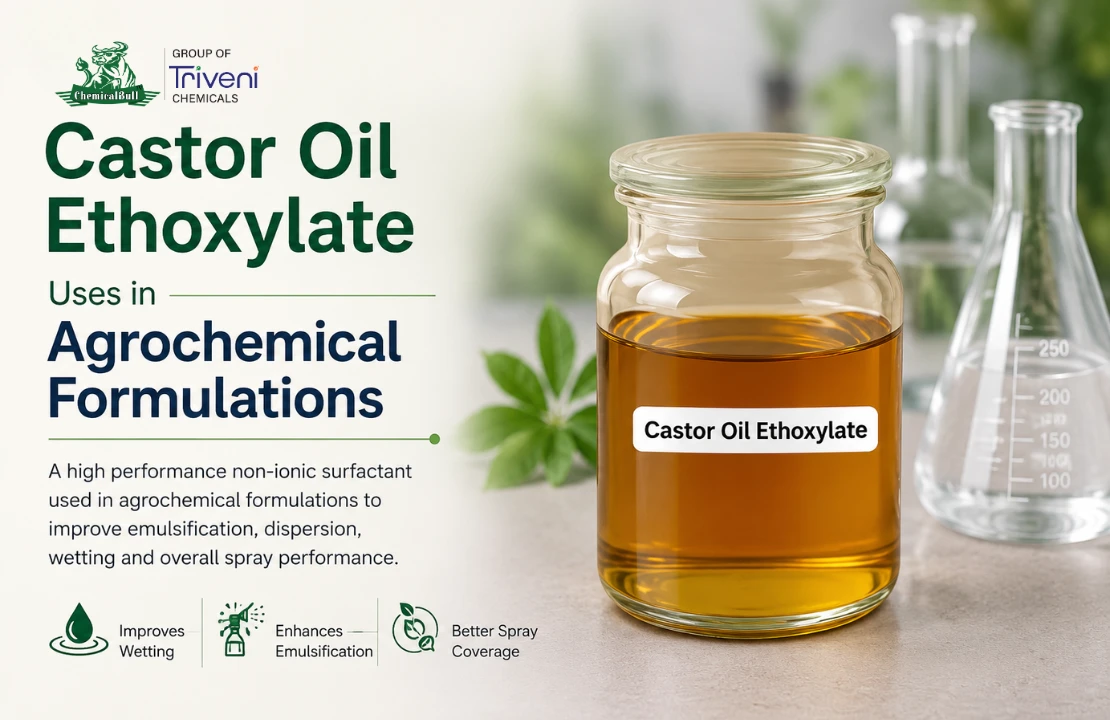
Castor Oil Ethoxylate Uses in Agrochemical Formulations
Castor Oil Ethoxylate manufacturers supply different EO grades for agrochemical, industrial cleaning, textile and specialty formulations. In crop-protection systems, it works as a non-ionic emulsifier, wetting agent and dispersing aid in EC, EW, SC, SE and OD formulations.
Agrochemical formulations must remain stable during storage, dilution and field application. Castor Oil Ethoxylate helps combine oil-based active ingredients with water, improves surface wetting and supports uniform dispersion. For bulk requirements, buyers can request packing, grade and documentation details from Chemical Bull.
Its performance depends on the degree of ethoxylation, active ingredient, solvent system, required HLB and complete surfactant package. Formulators should confirm the appropriate grade through compatibility, dilution and storage-stability testing.
Quick Answer
Castor Oil Ethoxylate is a non-ionic surfactant used as an emulsifier, wetting agent and dispersing aid in agrochemical formulations. It is used in EC, EW, SC, SE and OD systems for herbicides, insecticides and fungicides. Its EO grade influences oil compatibility, water dispersibility and formulation performance.
Castor Oil Ethoxylate manufacturers offer different EO grades for agrochemical, industrial cleaning, textile and specialty applications. Buyers should select the grade according to the active ingredient, solvent system, required HLB and dilution-stability needs.
What Is Castor Oil Ethoxylate?
Castor Oil Ethoxylate is produced through the controlled reaction of castor oil with ethylene oxide. The process introduces polyoxyethylene chains into the castor-oil structure, improving its ability to interact with both oil-based and water-based phases.
This dual affinity allows the ingredient to support the mixing of hydrophobic active ingredients with water during formulation or spray-tank dilution. It is generally classified as a non-ionic surfactant because its surface-active properties do not depend on an electrical charge.
Commercial products are available in different EO grades. Lower-EO grades generally offer greater oil compatibility, while higher-EO grades usually provide better water dispersibility. Actual behaviour can vary according to the complete formulation.
Castor Oil Ethoxylate Structure and Formula
The Castor Oil Ethoxylate structure consists of a castor-oil-based hydrophobic portion attached to hydrophilic polyoxyethylene chains. Because commercial grades contain different numbers of ethylene oxide units, there is no single fixed Castor Oil Ethoxylate formula for every grade. The molecular composition, HLB value, solubility and performance vary according to the degree of ethoxylation.
Castor Oil Ethoxylate Properties
|
Parameter |
General information |
|
Product type |
Ethoxylated castor-oil derivative |
|
Ionic character |
Non-ionic |
|
Primary functions |
Emulsification, wetting and dispersion support |
|
Appearance |
Varies by EO grade and temperature |
|
EO grade |
Selected according to formulation requirements |
|
Solubility |
Depends on the degree of ethoxylation |
|
Common sectors |
Agrochemicals, industrial cleaning, textiles and specialty formulations |
Commercial Castor Oil Ethoxylate products may be associated with CAS 61791-12-6, depending on the grade and supplier documentation. Buyers should confirm the applicable identity and CAS number.
Download the available Castor Oil Ethoxylate COA, TDS and SDS for current grade specifications, handling information and safety guidance.
Why Castor Oil Ethoxylate Is Used in Agrochemicals
Agrochemical formulations may require different supporting ingredients depending on the product type and performance target. Within the broader range of agrochemicals, Castor Oil Ethoxylate is most relevant to the Agrochemicals Formulation & Adjuvants segment, particularly emulsifier systems used in selected herbicide, insecticide and fungicide formulations. Its suitability should be confirmed according to the active ingredient, solvent system, EO grade and required dilution stability.
Castor Oil Ethoxylate can support this process in several ways.
Emulsification
In emulsifiable and emulsion-based systems, it helps reduce interfacial tension between oil and water phases. This supports the formation of smaller and more uniformly distributed droplets during dilution.
It may be used as a primary emulsifier or as part of a blended emulsifier package, depending on the active ingredient and solvent composition.
Wetting
Plant surfaces are often waxy and naturally resist water. Castor Oil Ethoxylate reduces surface tension, helping spray droplets spread more evenly across the leaf surface. This supports improved spray coverage and more uniform distribution of the formulation during application.
Final field performance depends on the complete formulation, dosage, application method and weather conditions.
Dispersion Support
In suspension-based systems, Castor Oil Ethoxylate may help wet solid particles and support their distribution throughout the liquid phase. It is generally combined with suitable dispersants, rheology modifiers and stabilisers rather than being used as the only formulation aid.
Compatibility Support
Its non-ionic character can make it suitable for use alongside selected anionic or other non-ionic surfactants. However, compatibility should always be checked because surfactant combinations can affect viscosity, foam, particle stability and dilution behaviour.
Related Ethoxylated Surfactants in Formulation Systems
Agrochemical formulations often use blended surfactant systems rather than relying on one ingredient alone. Along with Castor Oil Ethoxylate, formulators may evaluate Tallow Amine Ethoxylate where wetting, emulsification and formulation compatibility are required.
For systems requiring higher water solubility or solubilisation support, Hydrogenated Castor Oil Ethoxylate may also be considered. However, standard and hydrogenated grades differ in structure, properties and common applications, so they should not be treated as interchangeable.
Formulators selecting surfactants for agrochemical formulations should compare EO grade, HLB balance, active-ingredient compatibility, solvent system, dilution stability and storage performance before final approval.
Applications in Different Formulation Types
EC – Emulsifiable Concentrates
An EC formulation normally contains an oil-soluble active ingredient, solvent and emulsifier package. When the concentrate is added to water, the surfactant system helps create a stable emulsion.
Castor Oil Ethoxylate may be evaluated as a primary or co-emulsifier where compatibility with the selected solvent and active ingredient is suitable.
EW – Emulsion in Water
EW systems contain an oil phase dispersed within a continuous water phase. Castor Oil Ethoxylate may help stabilise this interface and support consistent droplet distribution.
The appropriate grade must be selected according to the oil phase, active ingredient concentration and required storage stability.
SC – Suspension Concentrates
In an SC formulation, finely divided solid active ingredients remain suspended in water. Castor Oil Ethoxylate may function as a wetting or auxiliary dispersing agent, helping liquid contact the particle surface.
Its use level should be balanced carefully because excessive surfactant may increase foam or affect rheology.
SE – Suspo-Emulsions
SE systems combine suspended solid particles with an emulsified liquid phase. These formulations require a balanced combination of emulsifiers, wetting agents, dispersants and stabilisers.
Castor Oil Ethoxylate may support the emulsified phase, but complete formulation testing is essential because SE systems are technically complex.
OD – Oil Dispersions
Oil dispersions contain solid active ingredients suspended in an oil-based medium. During dilution, the surfactant package must help disperse the concentrate evenly into water.
Selected Castor Oil Ethoxylate grades may be used as part of this emulsification and dispersion system.
How to Select the Right EO Grade
The EO grade should not be selected independently of the complete formulation. Important factors include:
- Active ingredient solubility and polarity
- Type of solvent or oil phase
- Required HLB balance
- Water dispersibility
- Co-emulsifier and dispersant system
- Dilution stability in soft and hard water
- Storage temperature and shelf-life target
- Foam, viscosity and application requirements
Lower-EO grades generally remain more closely associated with the oil phase. Increasing the degree of ethoxylation usually improves hydrophilicity and water dispersibility. However, the highest EO grade is not automatically the best choice.
Laboratory trials should compare emulsion quality, dilution stability, particle size, foam, viscosity and performance under different water and temperature conditions.
Formulation Considerations
Castor Oil Ethoxylate is not universally suitable for every pesticide system. Performance may change according to active ingredient chemistry, EO grade, solvent polarity, formulation pH and surfactant concentration.
Excessive use may affect foam, emulsion stability, viscosity or spray behaviour. Insufficient use may result in incomplete wetting, phase separation or unstable dilution.
Small-scale compatibility, accelerated storage and dilution tests should therefore be completed before commercial-scale use. The final selection should be based on formulation data rather than general grade descriptions alone.
Handling and Storage
Store Castor Oil Ethoxylate in tightly closed containers in a cool, dry and well-ventilated location. Protect the material from excessive heat, direct sunlight and contamination.
Appropriate gloves, protective eyewear and industrial handling practices should be followed. Storage temperature, shelf life and handling precautions must be confirmed from the applicable SDS and technical documentation.
Castor Oil Ethoxylate Price Factors
Castor Oil Ethoxylate price depends on the EO grade, specification, packing size, order quantity, raw-material availability and delivery location. Buyers should compare price together with batch consistency, formulation suitability and documentation support.
For a current quotation, share the required EO grade, quantity, packing preference and delivery location with Chemical Bull.
Bulk Supply and Procurement
Bulk buyers should confirm the required EO grade, application, quantity, packing preference and documentation before placing an order. It is also important to review batch consistency, availability, COA, TDS and SDS support.
For bulk requirements, review available grades, packing and documentation with a reliable Castor Oil Ethoxylate supplier and submit your enquiry to Chemical Bull.
Frequently Asked Questions
1. What is ethoxylated castor oil used for?
Ethoxylated castor oil is used as an emulsifier, wetting agent and dispersing aid in agrochemical, industrial cleaning, textile and specialty formulations. In agrochemicals, it is used in EC, EW, SC, SE and OD systems.
2. Which agrochemical formulations may use it?
Castor Oil Ethoxylate is used in EC, EW, SC, SE and OD formulations for herbicides, insecticides and fungicides. Its role depends on the active ingredient, solvent system and EO grade.
3. Is Castor Oil Ethoxylate non-ionic?
Yes. Castor Oil Ethoxylate is a non-ionic surfactant used for emulsification, wetting and dispersion.
4. How is the correct EO grade selected?
The correct EO grade is selected according to the active ingredient, solvent polarity, required HLB, water dispersibility and compatibility with other surfactants. Laboratory testing confirms final suitability.
5. Is it the same as Hydrogenated Castor Oil Ethoxylate?
No. Standard Castor Oil Ethoxylate and Hydrogenated Castor Oil Ethoxylate differ in feedstock structure, physical properties and typical applications. Buyers should confirm the exact product identity before procurement.
6. Where can buyers obtain a Castor Oil Ethoxylate SDS?
Buyers can obtain the Castor Oil Ethoxylate SDS, COA and TDS for the specific grade from the supplier. The documents provide current specifications, handling precautions and storage guidance.
Conclusion
Castor Oil Ethoxylate supports emulsification, wetting and dispersion in selected agrochemical formulations. Its suitability depends on EO grade, active ingredient chemistry, solvent composition and the complete surfactant package.
Careful grade selection and formulation testing can help improve dilution stability, processing consistency and spray-mixture uniformity. Share your required grade, quantity and delivery location with Chemical Bull for bulk availability, documentation and quotation support.