Chemical Bull
140
27-Jul-2026
2-Ethylhexyl Cocoate Uses in Cosmetics and Personal Care
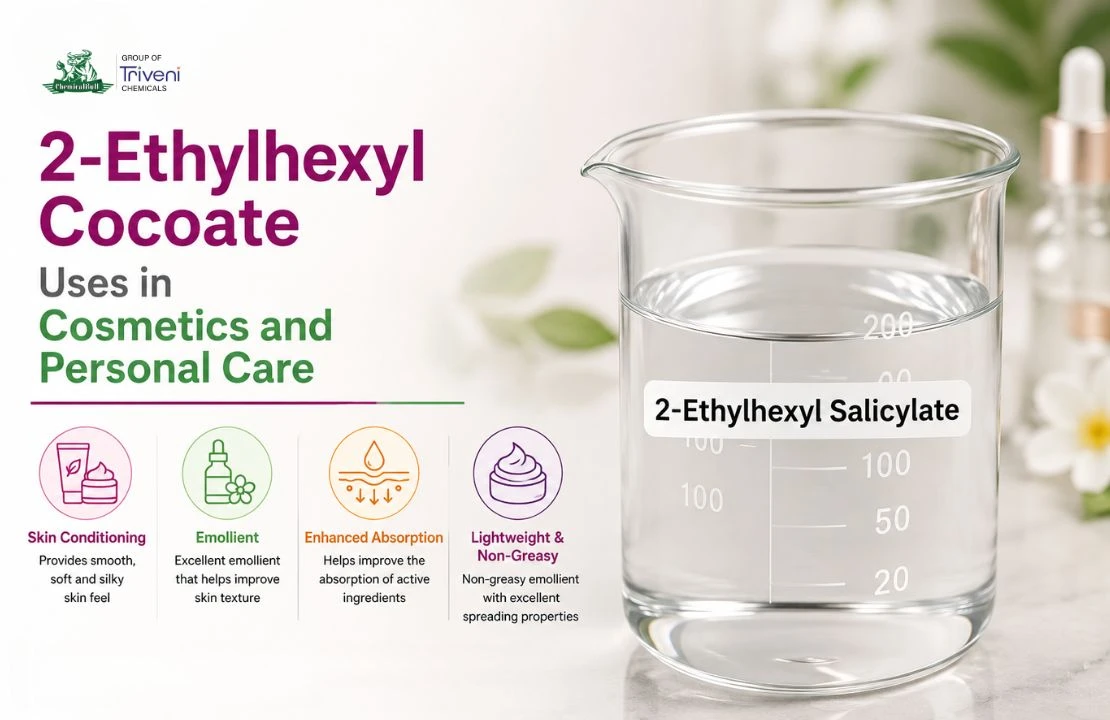
2-Ethylhexyl Cocoate is a lightweight emollient ester of 2-ethylhexanol and coconut-derived fatty acids, used across skin care, hair care, and sun care formulations for its fast-spreading, non-greasy feel. ChemicalBull is a bulk 2-Ethylhexyl Cocoate supplier for cosmetic and personal care manufacturers.
Formulators reach for it when a product needs emollience without the heavy, occlusive feel of thicker oils.
Looking for a reliable 2-Ethylhexyl Cocoate supplier for your cosmetic or personal care formulation? Request a quote from ChemicalBull — bulk quantities, CoA per batch, India and US-locale delivery.
Quick Answer
2-Ethylhexyl Cocoate is used in cosmetics and personal care as a lightweight emollient and skin-conditioning agent. Derived from coconut fatty acids esterified with 2-ethylhexanol, it spreads easily, absorbs quickly, and leaves a dry, non-greasy after-feel — making it common in facial moisturizers, sunscreens, hair conditioners, and makeup formulations where a rich, oily texture would be undesirable. It also acts as a solvent/carrier for UV filters and pigments in sun care and color cosmetic products.
2-Ethylhexyl Cocoate Uses
What is 2-Ethylhexyl Cocoate used for? It is used primarily as a functional emollient across personal care formulations:
- Skin care — lightweight moisturizers, facial creams, body lotions, and massage oils
- Sun care — carrier/solvent for UV filters, improving spreadability and SPF product texture
- Hair care — conditioners, serums, and leave-in treatments for shine and detangling without buildup
- Color cosmetics — pigment wetting agent in foundations, lipsticks, and liquid makeup
Role of 2-Ethylhexyl Cocoate in Cosmetic Formulations
2-Ethylhexyl Cocoate sits in a specific formulation niche between heavier natural oils (like coconut or jojoba oil) and very light silicone fluids. It gives formulators oil-like emollience and spreadability without silicone's cost premium or the heavier, sometimes tacky after-feel of unmodified vegetable oils. This is why it shows up across such different product types — a sunscreen needs it to help dissolve and spread UV filters evenly; a hair serum needs it for shine without weighing hair down; a foundation needs it to wet out pigment smoothly. In each case, the underlying job is the same: deliver emollience and spreadability while staying light on skin or hair.
What Is 2-Ethylhexyl Cocoate?
2-Ethylhexyl Cocoate is produced by esterifying 2-ethylhexanol (a branched-chain fatty alcohol) with fatty acids derived from coconut oil, which is predominantly a blend of lauric, myristic, and other medium-chain fatty acids. This branched-alcohol, mixed-fatty-acid structure is what gives the ester its characteristic light, fast-spreading, low-viscosity texture compared to esters made from straight-chain alcohols or single fatty acids.
Why Is 2-Ethylhexyl Cocoate Used in Formulations?
Formulators select this ester for three practical reasons:
- Light sensory profile — low viscosity and fast absorption make it suitable for facial and leave-on products where heaviness is undesirable.
- Broad compatibility — dissolves and disperses a range of UV filters, pigments, and other oil-soluble actives effectively.
- Stability — as a saturated ester, it resists oxidation better than some unsaturated natural oils, supporting longer product shelf life.
2-Ethylhexyl Cocoate Technical Specifications
|
Property |
Typical Value |
|
CAS Number |
61789-31-9 |
|
INCI Name |
Ethylhexyl Cocoate |
|
Appearance |
Colorless to pale yellow oily liquid |
|
Acid Value |
≤ 1 mg KOH/g |
|
Saponification Value |
~145–165 mg KOH/g |
|
Density (20°C) |
~0.85–0.87 g/cm³ |
|
Viscosity (25°C) |
~10–20 cSt |
|
Solubility |
Oil-soluble; insoluble in water |
|
Purity (typical commercial grade) |
≥98% |
Applications in Cosmetics and Personal Care
1. Skin Care Formulations
Used in facial moisturizers, body lotions, and massage oils as a lightweight emollient that improves spreadability without leaving a greasy residue. It's particularly common in "dry-touch" or "non-comedogenic-positioned" product lines where formulators want oil-like slip without oil-like heaviness.
2. Sun Care Formulations
How Does 2-Ethylhexyl Cocoate Work in Sunscreen Formulations?
UV filters, especially organic (chemical) filters, often need an oil-soluble carrier to dissolve properly and disperse evenly across the skin. 2-Ethylhexyl Cocoate serves this carrier role while also contributing to the overall spreadability of the sunscreen, helping the product apply in a thin, even film — a factor that directly affects how consistently the labeled SPF performs on skin.
3. Hair Care Formulations
In conditioners, serums, and leave-in treatments, 2-Ethylhexyl Cocoate contributes shine and detangling slip without the buildup associated with heavier silicones or oils, making it useful in "lightweight" or "silicone-free" positioned hair care lines.
4. Color Cosmetics
In foundations, liquid lipsticks, and other pigmented products, it functions as a pigment-wetting agent, helping pigments disperse evenly through the formulation base and improving application smoothness.
5. Personal Care Applications
Beyond core skin, sun, hair, and color cosmetic uses, 2-Ethylhexyl Cocoate is widely used across general personal care products:
- Body lotions and body oils — providing light emollience and easy spreadability over larger skin surface areas without a greasy after-feel
- Deodorants and antiperspirant sticks/roll-ons — as an emollient base component that improves glide and skin feel during application
- Massage and bath oils — contributing slip and a smooth, non-tacky finish
- Baby care lotions and oils — used in gentle, lightweight formulations where a non-greasy, fast-absorbing texture is a key formulation requirement
- Cleansing balms and oils — helping dissolve makeup and impurities while rinsing cleanly, supporting the light after-feel these products are marketed on
Because personal care products are used across large body areas and often daily, the fast-absorbing, non-greasy character of 2-Ethylhexyl Cocoate is frequently a bigger formulation driver here than in smaller-dose facial products.
Typical 2-Ethylhexyl Cocoate Usage Levels
|
Application |
Typical Usage Level (wt%) |
Primary Function |
|
Facial moisturizers/lotions |
2–8% |
Lightweight emollience |
|
Sunscreen formulations |
3–10% |
UV filter carrier, spreadability |
|
Hair conditioners/serums |
1–5% |
Shine, detangling, light conditioning |
|
Color cosmetics (foundation, lipstick) |
2–10% |
Pigment wetting, spreadability |
|
Body lotions, deodorants, massage oils |
2–8% |
Emollience, glide, spreadability |
Actual usage levels depend on the overall emollient system and target sensory profile — our technical team can help align dosage with your formulation's texture goals.
Advantages of 2-Ethylhexyl Cocoate in Formulation
- Fast absorption, dry-touch finish — supports modern "lightweight" and "non-greasy" product positioning.
- Broad UV filter and pigment compatibility — functions reliably as a carrier/dispersant across sun care and color cosmetic systems.
- Oxidative stability — saturated ester structure resists rancidity better than some natural oil alternatives.
- Cost-effective alternative to silicones — delivers comparable slip and spreadability at a different cost and sourcing profile.
- Non-comedogenic positioning support — commonly used in formulations marketed toward acne-prone or oily skin types, given its light texture.
- Formulation flexibility — blends well with both natural oils and silicone fluids to fine-tune sensory profile.
Formulator's Note: Best Practices for Sensory and Stability Performance
A detail that matters more than most formulators expect: because 2-Ethylhexyl Cocoate is derived from a mixed coconut fatty acid feedstock rather than a single fatty acid, batch-to-batch fatty acid distribution can shift slightly depending on the coconut oil source — and this shows up as small but noticeable differences in spreading feel and absorption speed, even when the acid value and viscosity specs are within range. For sensory-critical products like facial serums or premium sun care, it's worth requesting a batch sample for a bench sensory check before committing to a large production run, rather than relying on the spec sheet alone.
A second point worth flagging for sun care formulators: 2-Ethylhexyl Cocoate is an effective carrier for organic UV filters, but it does not itself provide meaningful photostability. If your formulation pairs it with a photo-unstable filter combination, the ester won't compensate — photostabilizer selection still needs to be addressed independently in the formulation.
Difference Between 2-Ethylhexyl Cocoate and Ethylhexyl Palmitate?
Both are branched-chain esters of 2-ethylhexanol, but they differ in the fatty acid used — 2-Ethylhexyl Cocoate uses a blend of coconut-derived fatty acids, while Ethylhexyl Palmitate uses a single fatty acid, palmitic acid (C16). This gives Ethylhexyl Palmitate a slightly heavier, more emollient after-feel, while 2-Ethylhexyl Cocoate tends to feel lighter and absorbs faster due to the shorter average chain length in its coconut-derived fatty acid mix. Formulators often choose between the two based on the target sensory weight of the finished product — Cocoate for very light, fast-absorbing products, Palmitate for slightly richer emollience.
2-Ethylhexyl Cocoate vs. Other Common Emollient Esters
|
Ingredient |
Fatty Acid Source |
Sensory Profile |
Typical Use Case |
|
2-Ethylhexyl Cocoate |
Coconut fatty acid blend |
Very light, fast-absorbing |
Sun care, lightweight lotions |
|
Palmitic acid (C16) |
Light-moderate, smooth |
Facial and body moisturizers |
|
|
Myristic acid (C14) |
Light, fast-spreading |
Lotions, hair care, pigment dispersion |
|
|
Coconut/palm-derived MCT |
Light, non-greasy |
Natural-positioned skin care |
Need side-by-side technical data sheets to compare 2-Ethylhexyl Cocoate against Ethylhexyl Palmitate for your target sensory profile? Request samples and TDS documentation from our technical sales team — we can align the comparison to your specific formulation.
Industrial and Commercial Importance
Beyond mainstream cosmetics, 2-Ethylhexyl Cocoate is used in:
- Sunless tanning products — as an emollient carrier alongside DHA-based active systems
- Baby care formulations — in lightweight, non-greasy lotion bases where gentle texture is a formulation priority
- Industrial and specialty personal care blends — as a functional additive in select cleansing and conditioning products
Consistent acid value, viscosity, and fatty acid distribution from batch to batch matter directly to formulation performance, since drift in any of these specs can shift sensory feel and UV filter solubility in ways that are hard to trace back to the raw material.
Frequently Asked Questions
-
What is 2-Ethylhexyl Cocoate used for?
It is used as a lightweight emollient and skin-conditioning agent in skin care, sun care, hair care, and color cosmetic formulations, valued for its fast-spreading, non-greasy after-feel. -
Is 2-Ethylhexyl Cocoate the same as Ethylhexyl Cocoate?
Yes, 2-Ethylhexyl Cocoate and Ethylhexyl Cocoate refer to the same ingredient; Ethylhexyl Cocoate is the standard INCI name used on cosmetic ingredient labels. -
Is 2-Ethylhexyl Cocoate suitable for oily or acne-prone skin?
It is commonly used in formulations positioned for oily or acne-prone skin due to its light, non-greasy texture, though comedogenicity depends on the overall formulation, not a single ingredient in isolation. -
Why is 2-Ethylhexyl Cocoate used in sunscreen formulations?
It acts as a carrier and solvent for oil-soluble UV filters, helping them disperse evenly and contributing to the smooth, even spreadability that supports consistent SPF performance on skin. -
What is the difference between 2-Ethylhexyl Cocoate and Ethylhexyl Palmitate?
2-Ethylhexyl Cocoate is derived from a coconut fatty acid blend and feels lighter and faster-absorbing, while Ethylhexyl Palmitate uses palmitic acid and offers a slightly richer, more emollient after-feel.
Conclusion
2-Ethylhexyl Cocoate earns its place across skin, sun, hair, color, and broader personal care formulations through one consistent trait: light, fast-absorbing emollience without the heaviness of thicker oils or the cost premium of silicones. Whether it's carrying UV filters in a sunscreen, adding shine to a hair serum, or keeping a body lotion feeling dry-touch, the underlying job stays the same. For formulators weighing it against Ethylhexyl Palmitate or Isopropyl Myristate, the choice largely comes down to target sensory weight and absorption speed.
Comment Section