Chemical Bull
303
10-Sep-2026
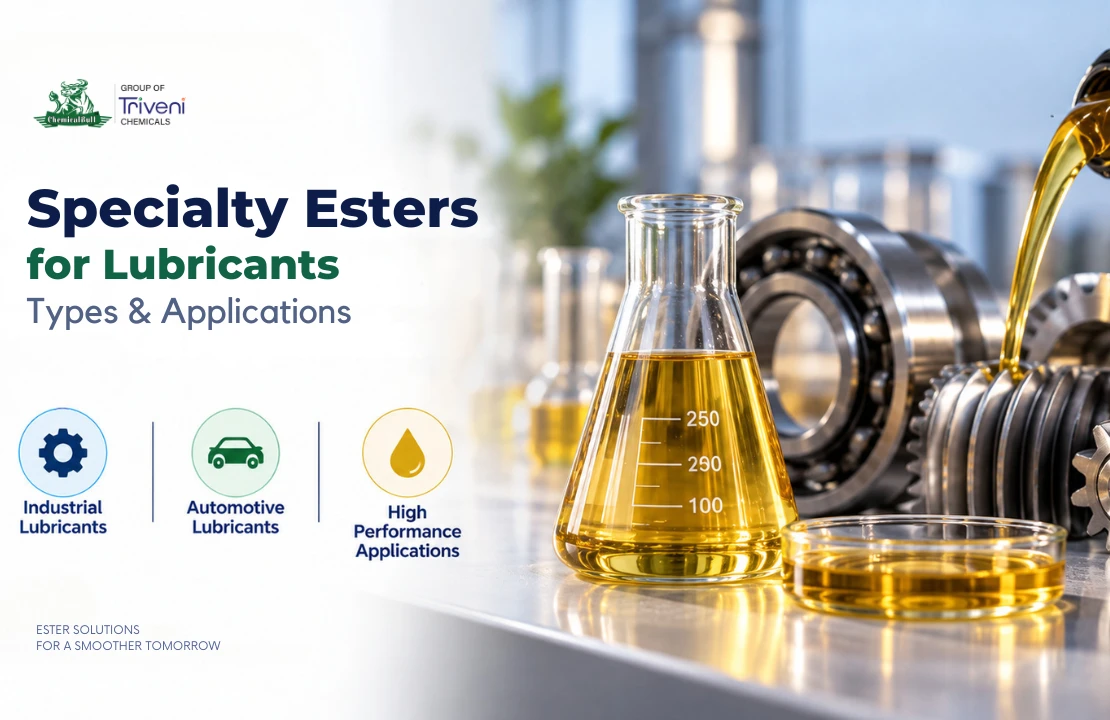
Specialty Esters for Lubricants | Types & Applications
Specialty esters are used in lubricant formulations where properties such as lubricity, friction control, temperature performance, viscosity behavior, compatibility, and environmental performance are important. Different ester structures provide different combinations of these properties, so the right ester depends on the lubricant's application, operating conditions, base-oil system, and formulation requirements.
ChemicalBull supplies specialty ester chemicals for lubricant, industrial, and specialty formulation applications, including Trimethylolpropane Trioleate, Pentaerythritol Tetraoleate, Ethylhexyl Oleate, Ethylhexyl Palmitate, Ethylhexyl Stearate, Glycerol Monooleate, and Glyceryl Trioleate. Buyers and formulators can review individual product specifications and contact Chemical Bull for bulk supply requirements.
Quick Answer: What Are Specialty Esters Used for in Lubricants?
Specialty esters are ester-based materials selected for specific lubricant performance requirements such as lubricity, friction reduction, low-temperature behavior, viscosity control, solvency, thermal performance, and compatibility with other formulation components. Depending on their chemical structure, esters may function as base-stock components, co-base fluids, additives, or specialty formulation ingredients in industrial, automotive, metalworking, compressor, hydraulic, and environmentally sensitive lubricant systems.
The important point is that not every ester provides every performance benefit. Ester selection should be based on molecular structure, viscosity, operating temperature, oxidation and hydrolytic stability, compatibility, additive interactions, and the requirements of the finished lubricant.
What Are Specialty Esters Used in Lubricants?
Specialty esters are used because the ester functional group and the surrounding molecular structure can provide properties that are useful in lubricant formulations. Their relatively polar nature can promote interaction with metal surfaces and influence solvency and additive compatibility, while the specific alcohol and acid components determine many of the final material's physical and performance characteristics.
Lubricity and Friction Reduction
Lubricity is one of the principal reasons esters are considered for demanding lubricant formulations. Depending on their molecular structure, ester molecules can interact with surfaces and contribute to boundary lubrication and friction control.
The actual effect depends on the ester chemistry, concentration, base oil, additive package, temperature, load, and contact conditions. Therefore, a particular ester should be evaluated in the complete formulation rather than judged solely by its chemical class.
Film Formation
Some ester chemistries can contribute to the formation and persistence of lubricating films at contacting surfaces. This can be valuable where boundary or mixed lubrication conditions occur.
Film behavior depends on molecular structure, viscosity, polarity, temperature, surface chemistry, and the presence of other formulation components.
Thermal Performance
Selected synthetic ester systems are used where lubricants must operate under demanding temperature conditions. Ester selection can influence resistance to thermal degradation and volatility, although thermal performance varies significantly between different ester structures.
For high-temperature applications, formulators should evaluate the complete lubricant rather than assuming that all esters have identical thermal stability.
Low-Temperature Performance
Certain ester structures provide useful low-temperature characteristics and can be incorporated into lubricant systems that require fluidity at lower operating temperatures.
Low-temperature behavior is influenced by molecular structure, saturation, branching, molecular weight, and the interaction of the ester with other base stocks.
Compatibility With Base Oils
Esters can be blended with other lubricant base stocks, but compatibility should be evaluated for the specific combination.
For example, ester components may be used alongside other synthetic or mineral-derived base stocks when the formulation requires changes in lubricity, solvency, temperature behavior, or additive response.
Biodegradability Where Applicable
Some ester chemistries are selected for environmentally acceptable or biodegradable lubricant formulations. However, biodegradability should never be assumed simply because a material is an ester.
The chemical structure, raw-material origin, formulation composition, and applicable test method all influence environmental performance.
Specialty Esters for Lubricants at a Glance
|
Specialty Ester |
Broad Ester Type |
Potential Formulation Role |
Example Application Areas |
|
Polyol fatty ester |
Ester base-stock component, lubricity component |
Industrial lubricants, metalworking fluids, specialty formulations |
|
|
Polyol ester |
Lubricant base-stock/additive component |
Lubricants, greases, specialty industrial formulations |
|
|
Fatty ester |
Lubricity and oil-phase component |
Industrial and specialty formulations |
|
|
Fatty ester |
Ester component with lubricating/spreading characteristics |
Specialty formulations and selected industrial uses |
|
|
Fatty ester |
Lubricating and formulation component |
Specialty and industrial formulations |
|
|
Aromatic ester |
Solvent, plasticizer, specialty formulation component |
Coatings, polymers and selected specialty systems |
|
|
Glycerol fatty ester |
Lubricity/emulsification component |
Metalworking and specialty formulations |
|
|
Triglyceride ester |
Lubricity and oil-phase component |
Industrial and specialty formulations |
The table is a screening guide rather than a universal application specification. Final suitability depends on product grade, specifications, formulation composition, operating conditions, and testing.
Types of Specialty Esters for Lubricant Formulations
Specialty esters used in lubricant technology can be grouped according to their molecular structure and ester functionality. Common categories include monoesters, diesters, fatty esters, polyol esters, complex esters, and trimellitate esters.
Monoesters
Monoesters are formed from one alcohol and one carboxylic acid. Their relatively simple molecular structures allow formulators to select properties based on the alcohol and acid components.
Depending on their chemistry, monoesters can be used as lubricity components, solvents, emollients, plasticizers, or specialty formulation ingredients.
Diesters
Diesters are generally produced from dicarboxylic acids and alcohols. They have been used in synthetic lubricant formulations where properties such as low-temperature fluidity, solvency, and lubricity are important.
Their suitability depends on the specific acid/alcohol combination and the requirements of the lubricant.
Fatty Esters
Fatty esters are produced from fatty acids and alcohols and represent an important group of specialty ester materials.
Examples relevant to specialty formulations include:
- Ethylhexyl Oleate
- Ethylhexyl Palmitate
- Ethylhexyl Stearate
- Glycerol Monooleate
- Glyceryl Trioleate
These materials can provide useful lubricity, oil compatibility, spreading, and formulation characteristics, but their specific lubricant performance varies with molecular structure.
Polyol Esters
Polyol esters are produced using polyhydric alcohols such as trimethylolpropane or pentaerythritol. Their molecular architecture can provide useful combinations of viscosity, lubricity, thermal behavior, and low volatility for demanding lubricant formulations.
Two important examples in this category are:
Trimethylolpropane Trioleate
Trimethylolpropane Trioleate for lubricant formulations is a polyol fatty ester used in industrial lubrication and metalworking-related formulations. Chemical Bull's product information identifies it for applications including industrial lubricants, compressor oils, hydraulic fluids, and metalworking fluids.
Its performance should be evaluated according to the required viscosity, operating temperature, additive package, oxidation requirements, and base-oil system.
Pentaerythritol Tetraoleate
Pentaerythritol Tetraoleate is a highly functional ester used in lubricant and specialty industrial formulations. Its multi-ester structure makes it relevant to applications where lubricity, viscosity behavior, and thermal performance are important. Chemical Bull also positions the material for lubricant, grease, polymer, and coatings applications.
Complex Esters
Complex esters are designed using combinations of acid and alcohol components to obtain a targeted performance profile. They may be used where formulators need a particular balance of viscosity, lubricity, thermal behavior, solvency, or other properties.
Because their performance depends strongly on their composition, specifications and technical data should be reviewed before selecting a complex ester.
Trimellitate Esters
Trimellitate esters are another class of synthetic ester used in high-performance lubricant formulations. They can be considered where high-temperature performance, low volatility, and long service requirements are important.
Their application suitability should be determined from the specific grade and finished lubricant requirements.
Chemical Bull Specialty Esters and Their Lubricant Applications
Chemical Bull's specialty ester portfolio includes different molecular structures rather than a single universal lubricant ester. This allows buyers to investigate different ester families according to their formulation requirements.
Trimethylolpropane Trioleate
Trimethylolpropane Trioleate is particularly relevant to synthetic ester lubricant systems and industrial applications where lubricity, viscosity characteristics, and thermal/oxidative performance are important. It can be considered for industrial lubricants, metalworking formulations, and selected hydraulic or compressor lubricant systems where its specification is appropriate.
Pentaerythritol Tetraoleate
Pentaerythritol Tetraoleate is a polyol ester with a highly functionalized structure. It can be considered in lubricant and grease formulations where lubricity and thermal performance are required. Its suitability should be assessed against the viscosity and operating requirements of the finished formulation.
Ethylhexyl Oleate
Ethylhexyl Oleate is a fatty ester formed from 2-ethylhexanol and oleic acid. It is widely used in formulation systems outside lubricants as well, particularly personal care, so it should not be positioned as an exclusive lubricant base stock. Its ester structure can nevertheless make it relevant to selected lubricant and industrial formulations.
Ethylhexyl Palmitate
Ethylhexyl Palmitate is a fatty acid ester with applications extending across cosmetic and specialty formulations. Where considered for lubricant-related applications, its actual role should be determined from the required viscosity, lubricity, compatibility, and formulation specifications rather than from the ester classification alone.
Ethylhexyl Stearate
Ethylhexyl Stearate is another fatty ester with broad formulation uses. Its physical characteristics can make it relevant to selected specialty and industrial systems, but application-specific testing remains important when it is evaluated as a lubricant component.
2-Ethylhexyl Benzoate
2-Ethylhexyl Benzoate should be positioned more broadly than the other lubricant-focused esters. It is used as a solvent, plasticizer, and specialty formulation component, particularly in coatings and polymer-related applications. It may therefore be relevant to selected lubricant or industrial formulations without being treated as a universal lubricant base stock.
Glycerol Monooleate
Glycerol Monooleate is a glycerol fatty ester that can be relevant to lubricity, emulsification, and boundary-lubrication systems. It is particularly worth considering in specialty formulations such as selected metalworking fluids where surface interaction and lubricity are important.
Glyceryl Trioleate
Glyceryl Trioleate is a triglyceride ester of glycerol and oleic acid. Chemical Bull identifies it for industrial applications including lubricant formulations, metalworking-related uses, and specialty processing systems.
How Do Specialty Esters Improve Lubricant Performance?
The performance contribution of an ester comes from its molecular structure rather than simply from the word "ester."
Lubricity
Polar ester molecules can interact with metal surfaces and contribute to boundary lubrication. This can be particularly useful when the lubricant operates under conditions where hydrodynamic film separation is reduced.
Friction Control
Some ester structures can reduce friction by improving the interaction between contacting surfaces. The effect depends on ester chemistry, concentration, load, temperature, and the rest of the lubricant formulation.
Solvency
Many esters have useful solvency characteristics. In some formulations, this can help dissolve or carry additives and other components that have limited compatibility with non-polar base oils.
Temperature Performance
Specific ester structures can provide useful high- or low-temperature properties. However, thermal and oxidative stability should be confirmed for the selected grade rather than generalized across all ester chemistries.
Surface Interaction
The polarity of many esters can promote surface affinity. This is one reason ester-containing lubricants can perform differently from less-polar hydrocarbon base stocks.
Specialty Esters Used in Different Lubricant Applications
Specialty Esters for Industrial Lubricants
Industrial lubricant formulations may use ester components where lubricity, solvency, viscosity characteristics, temperature performance, or environmental requirements justify their inclusion.
Potential areas include:
- Machinery lubricants
- Industrial oils
- Process lubricants
- Specialty gear formulations
- Compressor lubricants
- Hydraulic systems
- Metalworking fluids
The suitable ester depends on the equipment, operating temperature, load, base-oil chemistry, additive system, and service-life requirements.
Esters for Metalworking Fluids
Metalworking fluids are an important application area for ester chemistry.
Selected esters may contribute to:
- Lubricity
- Boundary lubrication
- Friction control
- Wetting
- Oil-phase compatibility
- Formulation solvency
For metalworking applications, the ester should be evaluated alongside emulsifiers, corrosion inhibitors, additives, water content, and the specific machining operation.
Esters for Compressor & Hydraulic Lubricants
Selected synthetic esters can be incorporated into compressor and hydraulic lubricant formulations where their viscosity, lubricity, temperature behavior, and compatibility are appropriate.
However, not every specialty ester is suitable for every compressor or hydraulic application. Equipment specifications, operating temperature, seal compatibility, additive requirements, and lubricant viscosity grade must be considered before selection.
Esters for Automotive & Engine Lubricants
Synthetic ester components are used in certain automotive and engine lubricant formulations because of their lubricity, polarity, solvency, and temperature-performance characteristics.
Depending on the formulation, an ester may act as a base-stock component, co-base fluid, or functional formulation component rather than serving as the entire lubricant base.
Esters for Biodegradable Lubricants
Esters are widely investigated for environmentally acceptable lubricant systems because certain ester structures can offer favorable biodegradability and environmental profiles.
However, biodegradability is structure-dependent. A formulation should be assessed using the relevant environmental test methods and regulatory requirements rather than assuming that every ester automatically qualifies as a biodegradable lubricant component.
Advantages and Limitations of Specialty Esters
Specialty esters can offer important formulation advantages, but they also have limitations that should be considered during product selection.
|
Potential Advantage |
Formulation Consideration |
|
Strong lubricity |
Performance depends on ester structure and concentration |
|
Useful polarity |
Can affect additive and base-oil compatibility |
|
Good solvency |
May help incorporate selected additives |
|
Low-temperature benefits |
Varies by molecular structure |
|
Thermal performance |
Depends on saturation and ester architecture |
|
Biodegradability potential |
Not universal across all esters |
|
Formulation flexibility |
Requires compatibility testing |
|
Specialty functionality |
May come with higher raw-material cost |
A technically sound formulation therefore evaluates both the advantages and limitations of the ester instead of selecting it solely because it belongs to the ester family.
How to Choose the Right Ester for Lubricants
Choosing a specialty ester should begin with the application requirement rather than the product name.
|
Selection Factor |
Why It Matters |
|
Viscosity |
Influences flow and lubricant-film behavior |
|
Viscosity-temperature behavior |
Important when operating temperature varies |
|
Lubricity |
Relevant to friction and wear control |
|
Thermal stability |
Important at elevated operating temperatures |
|
Oxidation stability |
Influences lubricant service life |
|
Low-temperature properties |
Important for cold operating conditions |
|
Polarity |
Can influence surface interaction and solvency |
|
Base-oil compatibility |
Helps maintain a stable formulation |
|
Additive compatibility |
Important when combining multiple components |
|
Hydrolytic stability |
Relevant where moisture or water exposure occurs |
|
Biodegradability |
Important for environmentally sensitive applications |
|
Seal/material compatibility |
Important for equipment reliability |
|
Application |
Determines the required ester chemistry |
|
Product specifications |
Ensures the raw material meets formulation requirements |
A Practical Selection Approach
Start with the application and operating conditions.
For example:
Step 1: Define the lubricant type and equipment.
Step 2: Establish the required viscosity range.
Step 3: Identify operating temperature and load conditions.
Step 4: Determine lubricity, oxidation, thermal, and low-temperature requirements.
Step 5: Check compatibility with the selected base oils and additives.
Step 6: Review seal and material compatibility where relevant.
Step 7: Compare technical specifications and laboratory test results.
Step 8: Validate the complete lubricant formulation before commercial production.
This approach is more reliable than choosing an ester based only on its name, price, or one individual performance property.
Fatty Esters vs Polyol Esters for Lubricants
Fatty esters and polyol esters overlap in lubricant applications, but they should not be treated as interchangeable categories.
|
Property |
Fatty Esters |
Polyol Esters |
|
General structure |
Fatty acid + alcohol/glycerol-based structures |
Polyhydric alcohol + fatty/organic acids |
|
Examples |
Ethylhexyl Oleate, Ethylhexyl Palmitate |
TMP Trioleate, Pentaerythritol Tetraoleate |
|
Lubricity |
Often useful |
Often strong in demanding formulations |
|
Molecular architecture |
Varies |
Often highly branched/multifunctional |
|
Typical role |
Specialty lubricant/formulation component |
Synthetic lubricant base-stock/component |
|
Low-temperature behavior |
Structure-dependent |
Structure-dependent |
|
Thermal/oxidative behavior |
Structure-dependent |
Structure-dependent |
|
Selection |
Application and specification driven |
Application and specification driven |
The important difference is molecular architecture, not simply whether one category is "natural" and the other is "synthetic."
Specialty Esters vs Conventional Mineral Oil Base Stocks
Specialty esters and mineral-oil base stocks have different chemical structures and therefore can behave differently in lubricant formulations.
|
Property |
Specialty Esters |
Mineral-Oil Base Stocks |
|
Molecular polarity |
Generally higher |
Generally lower |
|
Lubricity contribution |
Often significant |
Depends on base-oil grade and formulation |
|
Solvency |
Often useful for selected additives |
Depends on base-oil composition |
|
Low-temperature performance |
Structure-dependent |
Grade-dependent |
|
Biodegradability |
Varies by ester chemistry |
Generally lower than many biodegradable ester systems |
|
Cost |
Often higher |
Often more economical |
|
Formulation role |
Base stock, co-base, additive, or specialty component |
Primary base-stock system in many conventional lubricants |
Ester Structure and Lubricant Performance
The structure of an ester can significantly influence how it behaves in a lubricant formulation.
Alcohol Backbone
Changing the alcohol component changes the molecular architecture and can affect viscosity, volatility, lubricity, and temperature behavior.
Fatty-Acid Chain
The chain length and degree of unsaturation influence properties such as melting behavior, viscosity, oxidation tendency, and low-temperature performance.
Ester Functionality
Monoesters, diesters, and polyol esters have different numbers and arrangements of ester groups. This affects polarity, molecular size, viscosity, and interaction with other formulation components.
Branching
Branching can influence molecular packing and therefore properties such as low-temperature flow and viscosity behavior.
Saturation
Saturated and unsaturated ester structures can behave differently with respect to oxidation, low-temperature properties, and overall formulation stability.
For this reason, two products that are both described as "esters" should not automatically be expected to perform in the same way.
Formulator's Note: Ester Compatibility and Selection
A practical formulation mistake is selecting an ester based only on viscosity.
Two esters with similar viscosity can behave differently because their polarity, molecular structure, solvency, oxidation behavior, hydrolytic stability, and additive interactions may differ.
A formulator should therefore evaluate the ester as part of the complete lubricant system. When an ester is blended with another base oil or additive package, compatibility, phase stability, viscosity response, oxidation behavior, seal interaction, and performance under the intended operating conditions should be checked experimentally.
For a new formulation, laboratory blending and performance testing are more reliable than assuming compatibility from chemical class alone.
Specialty Ester Suppliers for Lubricant Manufacturers
Chemical Bull supplies specialty ester chemicals for lubricant manufacturers, formulators, industrial buyers, distributors, and specialty chemical users. The portfolio includes polyol esters, fatty esters, glycerol esters, and other specialty ester materials that can be evaluated for lubricant and industrial formulations.
Buyers evaluating a specialty ester can request applicable product specifications, technical documentation, packaging details, availability, and bulk supply information before making a formulation or procurement decision.
Looking for specialty esters for your lubricant formulation? Contact Chemical Bull for product information and bulk supply requirements.
Frequently Asked Questions About Specialty Esters for Lubricants
-
What are specialty esters used for in lubricants?
They improve lubricity, friction control, solvency, viscosity, and temperature performance. -
What are the main types of lubricant esters?
Monoesters, diesters, fatty esters, polyol esters, complex esters, and trimellitate esters. -
What are examples of specialty esters for lubricants?
TMP Trioleate, Pentaerythritol Tetraoleate, Ethylhexyl Oleate, Ethylhexyl Palmitate, and Glyceryl Trioleate. -
What is the difference between fatty esters and polyol esters?
Fatty esters typically use fatty acids with alcohols, while polyol esters use polyhydric alcohols and can have multiple ester groups. -
How do I select a specialty ester for a lubricant formulation?
Consider viscosity, temperature, lubricity, oxidation stability, base-oil compatibility, additives, and the specific application.
Need a Specialty Ester for Your Lubricant Formulation?
If you are evaluating specialty esters for industrial lubricants, metalworking fluids, synthetic lubricant systems, or other specialty formulations, Chemical Bull can support product selection and bulk sourcing based on your required specification, quantity, application, and documentation needs.


Comment Section