Chemical Bull
665
28-Jul-2026
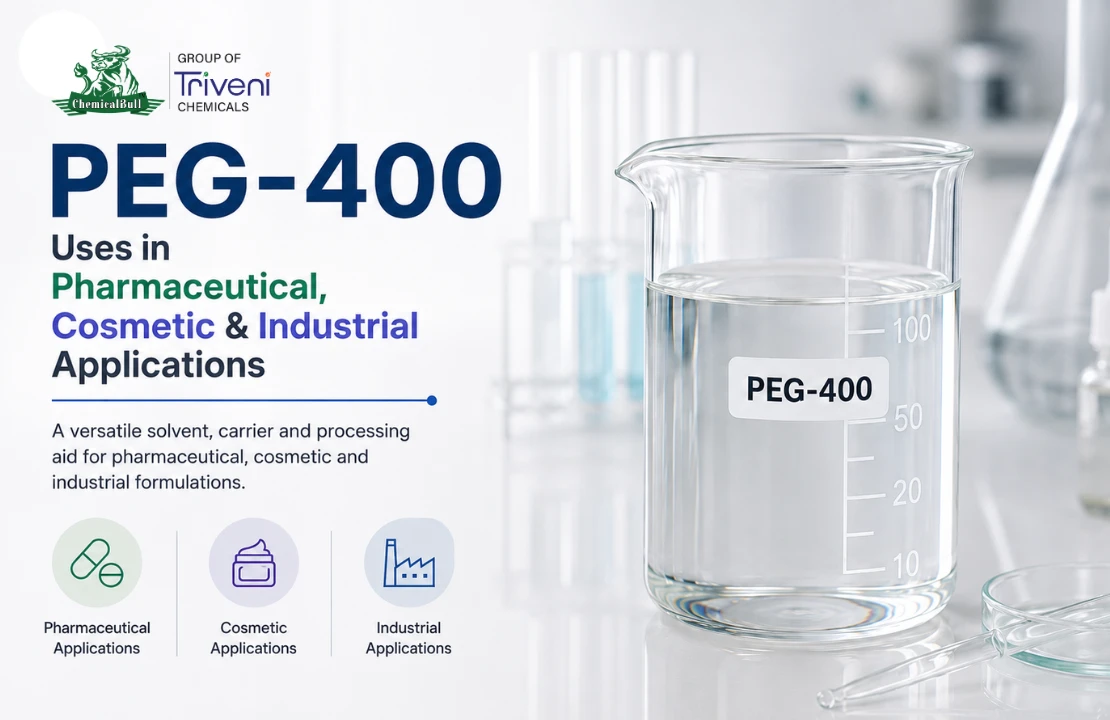
What Is PEG-400?
PEG-400 is a low-molecular-weight polyethylene glycol grade with an average molecular weight of approximately 400. It is generally supplied as a clear, colourless and viscous liquid.
It is compatible with water and many formulation ingredients, making it useful in pharmaceutical, cosmetic and industrial systems that require easy handling and solvent support.
Compared with higher polyethylene glycol grades, PEG-400 remains liquid under normal handling conditions and adds less structure to a formulation. It is therefore commonly selected for liquid, semi-liquid and topical products. Buyers should source the required grade from a reliable PEG 400 supplier that can provide consistent quality and relevant technical documentation.
PEG-400 is a formulation raw material and not a finished consumer product. Buyers and formulators should confirm the required grade, specification, concentration and application suitability before use.
Quick Answer: What Is PEG-400 Used For?
PEG-400, also known as Polyethylene Glycol 400, is used in pharmaceutical, cosmetic, personal care and industrial formulations as a solvent, co-solvent, carrier, excipient, moisture-support ingredient, lubricant and processing aid.
Its liquid form helps improve ingredient incorporation, formulation uniformity, product flow and manufacturing convenience. Common applications include oral liquids, soft gelatin capsule fills, topical products, creams, lotions, gels, lubricants, coatings, inks and specialty chemical blends.
Technical Profile of PEG-400
|
Function |
Role in Formulations |
|
Solvent |
Helps dissolve or carry compatible ingredients |
|
Co-solvent |
Works with another solvent to improve ingredient incorporation |
|
Carrier |
Supports uniform distribution of active or functional materials |
|
Excipient |
Provides functional support in suitable pharmaceutical products |
|
Moisture support |
Helps maintain moisture balance in selected formulations |
|
Lubricant support |
Contributes to lubricity in compatible industrial systems |
|
Processing aid |
Supports mixing, pumping, filling and production flow |
|
Flow modifier |
Helps maintain suitable liquid formulation consistency |
Specifications may vary according to grade and batch. The relevant COA and TDS should be reviewed before formulation or bulk purchase.
PEG-400 Uses in Pharmaceutical Formulations
Pharmaceutical-grade PEG-400 is widely evaluated as an excipient, solvent and carrier in oral, topical and semi-solid products.
Only a suitable pharmaceutical grade that meets the required quality or pharmacopeial standard should be selected.
Solvent and Co-Solvent
One of the main pharmaceutical uses of PEG-400 is as a solvent or co-solvent for compatible active and supporting ingredients.
It can help:
-
Improve ingredient incorporation
-
Maintain uniform distribution
-
Support liquid formulation consistency
-
Simplify mixing and filling
-
Carry compatible ingredients within the dosage form
PEG-400 does not dissolve every active ingredient. Solubility and stability trials should be conducted using the actual formulation and target concentration.
Pharmaceutical Excipient
PEG-400 functions as an excipient in selected pharmaceutical products. Its role depends on the dosage form and may include solvent support, active distribution, consistency control or processing assistance.
Formulators should evaluate:
-
Active ingredient compatibility
-
Required use level
-
Product stability
-
Regulatory requirements
-
Packaging interaction
-
Finished-product performance
Oral Liquid Formulations
PEG-400 may be used in selected oral liquids as a solvent, co-solvent or carrier for ingredients with limited water solubility.
Its use should be evaluated for taste, active stability, concentration, compatibility with flavours and sweeteners, and applicable regulatory requirements.
Soft Gelatin Capsules
PEG-400 may be considered in selected soft gelatin capsule fill systems because it provides liquid handling and carrier performance.
Before use, formulators should assess:
-
Active solubility
-
Fill viscosity
-
Capsule-shell compatibility
-
Water content
-
Leakage risk
-
Storage stability
Ointments, Creams and Topical Products
In topical pharmaceutical products, PEG-400 may function as a solvent, carrier or base-support ingredient.
It can be used in selected:
-
Medicated creams
-
Ointments
-
Topical gels
-
Lotions
-
Liquid topical preparations
PEG-400 may also be combined with higher-molecular-weight PEG grades to adjust the consistency of an ointment or topical base.
PEG-400 Uses in Cosmetics and Personal Care
PEG-400 is used in cosmetic and personal care formulations where solvent action, moisture support, smooth product flow and easy ingredient distribution are required.
Creams and Lotions
In creams and lotions, PEG-400 can support:
-
Smooth formulation consistency
-
Uniform ingredient distribution
-
Moisture balance
-
Easier mixing and filling
-
Controlled product flow
Its effect depends on the emulsifier system, oils, humectants, thickeners, fragrances and preservatives used in the formulation.
Skin Care Products
PEG-400 may be used as a solvent, carrier or moisture-support ingredient in selected skin care formulations.
Common application areas include:
-
Moisturising creams
-
Facial gels
-
Lotions
-
Cleansers
-
Cosmetic serums
-
Treatment formulations
Formulators should test its effect on skin feel, viscosity, spreadability, appearance and product stability.
Hair Care Products
In hair care formulations, PEG-400 can support ingredient incorporation, moisture balance and product flow.
It may be evaluated in hair gels, styling products, conditioning systems, treatment creams and other specialty hair care products.
Compatibility with surfactants, polymers, conditioning agents and fragrances should be confirmed.
Cosmetic Gels and Cleansing Systems
The liquid form of PEG-400 makes it suitable for selected gels, serums and cleansing systems that require easy blending and uniform distribution of compatible ingredients.
Final sensory, viscosity and stability testing should be completed before commercial production.
PEG-400 Uses in Industrial Applications
PEG-400 is used in industrial formulations as a carrier, solvent, lubricant-support material and processing aid.
Industrial Lubricants and Processing Fluids
PEG-400 may be included in selected lubricants, metalworking fluids and processing blends where water compatibility and easy flow are important.
It can support:
-
Lubricity
-
Fluidity
-
Additive distribution
-
Pumping and handling
-
Formulation uniformity
Performance should be tested under the intended operating temperature, pressure and load conditions.
Coatings, Paints and Inks
In coatings, paints and printing inks, PEG-400 may support ingredient distribution, viscosity control and formulation flow.
Its effect on drying, adhesion, surface finish, film properties and water resistance should be assessed in the complete system.
Plastic and Polymer Processing
PEG-400 may be evaluated as a processing aid or lubricant-support ingredient in selected plastic, rubber and polymer formulations.
Its suitability depends on the polymer type, processing temperature, additive system and required finished-product properties.
Textile and Specialty Chemical Formulations
PEG-400 may also be used in selected textile auxiliaries, adhesives and specialty chemical blends to support wetting, carrying, lubrication, viscosity adjustment or processing convenience.
Compatibility with all major formulation components should be confirmed before scale-up.
Main Functions of PEG-400
|
Function |
Role in Formulations |
|
Solvent |
Helps dissolve or carry compatible ingredients |
|
Co-solvent |
Works with another solvent to improve ingredient incorporation |
|
Carrier |
Supports uniform distribution of active or functional materials |
|
Excipient |
Provides functional support in suitable pharmaceutical products |
|
Moisture support |
Helps maintain moisture balance in selected formulations |
|
Lubricant support |
Contributes to lubricity in compatible industrial systems |
|
Processing aid |
Supports mixing, pumping, filling and production flow |
|
Flow modifier |
Helps maintain suitable liquid formulation consistency |
Key Benefits of PEG-400
PEG-400 is widely selected because it offers:
-
Easy liquid handling and dosing
-
Effective solvent and carrier support
-
Good compatibility with many aqueous systems
-
Improved distribution of compatible ingredients
-
Moisture support in selected personal care formulations
-
Convenient mixing, pumping and filling
-
Broad use across pharmaceutical, cosmetic and industrial applications
The final benefit depends on grade, concentration and complete formulation design.
PEG-400 vs Other PEG Grades
|
PEG Grade |
Typical Physical Form |
Common Application Difference |
|
PEG 200 |
Low-viscosity liquid |
Used where lower viscosity and easy flow are required |
|
PEG 300 |
Liquid |
Provides slightly more body than PEG 200 |
|
Viscous liquid |
Balanced liquid handling, solvent support and broad formulation use |
|
|
Viscous liquid to semi-solid |
Provides more consistency than PEG-400 |
|
|
Soft waxy solid |
Adds structure and body to semi-solid systems |
|
|
Waxy solid |
Used as a binder and texture-support material |
|
|
Firmer solid |
Provides greater structural and consistency support |
PEG-400 vs PEG-600
PEG-400 and PEG-600 differ mainly in molecular weight, viscosity and physical consistency.
PEG-400 is generally more fluid and easier to pump, pour and incorporate into liquid formulations. It is commonly selected as a solvent, co-solvent or carrier.
PEG-600 has a higher average molecular weight and provides more body. It may be preferred for formulations requiring additional consistency or semi-solid character.
The correct PEG grade should be selected according to the required texture, processing conditions and final application.
PEG-400 Formulation Compatibility and Stability
PEG-400 should be evaluated in the finished formulation before commercial use.
Important checks include:
|
Evaluation Point |
Why It Matters |
|
Required grade |
Confirms suitability for the intended application |
|
Use level |
Affects viscosity, solubility and formulation performance |
|
Active compatibility |
Important in pharmaceutical and cosmetic products |
|
Water compatibility |
Supports aqueous formulation development |
|
Packaging interaction |
Helps prevent leakage or material interaction |
|
Storage stability |
Confirms appearance and performance over time |
|
Microbial control |
Important in water-containing formulations |
Finished-product testing should include appearance, colour, odour, viscosity, phase stability and packaging compatibility.
How Buyers Select PEG-400
Buyers should evaluate PEG-400 according to application requirements rather than price alone.
Important purchasing checks include:
-
Pharmaceutical, cosmetic or industrial grade
-
Required specification and purity
-
Appearance
-
Batch consistency
-
COA availability
-
TDS and SDS availability
-
Packaging size
-
Current stock
-
Delivery timeline
Pharmaceutical buyers should clearly mention the required quality standard or pharmacopeial grade when requesting a quotation.
PEG-400 Pricing Factors
The cost of PEG-400 can vary based on the required grade, product specification, order volume, packaging type and delivery destination. Pharmaceutical-grade material may also require additional quality or compliance documentation, which can affect the quotation.
Other commercial factors include current stock position, freight, handling and repeat purchase requirements. Buyers should compare technical suitability, batch consistency and document support along with price.
Bulk PEG-400 Supply Support
ChemicalBull supports bulk PEG-400 requirements for pharmaceutical, cosmetic, personal care and industrial applications.
Procurement teams can request product availability, suitable grade options, packing details, batch documents and delivery support. To receive a relevant quotation, share the intended application, required quantity and destination.
Frequently Asked Questions
-
What is PEG-400 used for?
PEG-400 is used as a solvent, co-solvent, carrier, excipient, moisture-support ingredient, lubricant and processing aid in pharmaceutical, cosmetic and industrial formulations. -
Is PEG-400 used in pharmaceuticals?
Yes. Pharmaceutical-grade PEG-400 may be used in selected oral liquids, soft gelatin capsule fills, topical products, creams, ointments and gels. -
What is the role of PEG-400 as an excipient?
PEG-400 can support ingredient solubility, active distribution, formulation consistency and manufacturing convenience in suitable pharmaceutical products. -
Is PEG-400 used in cosmetics?
Yes. PEG-400 may be used in creams, lotions, gels, cleansers, serums, hair care products and other selected personal care formulations. -
What is the difference between PEG-400 and PEG-600?
PEG-400 is generally more fluid and suitable for liquid formulations. PEG-600 has a higher average molecular weight and provides more body or consistency.

Comment Section