Chemical Bull
253
28-Jul-2026
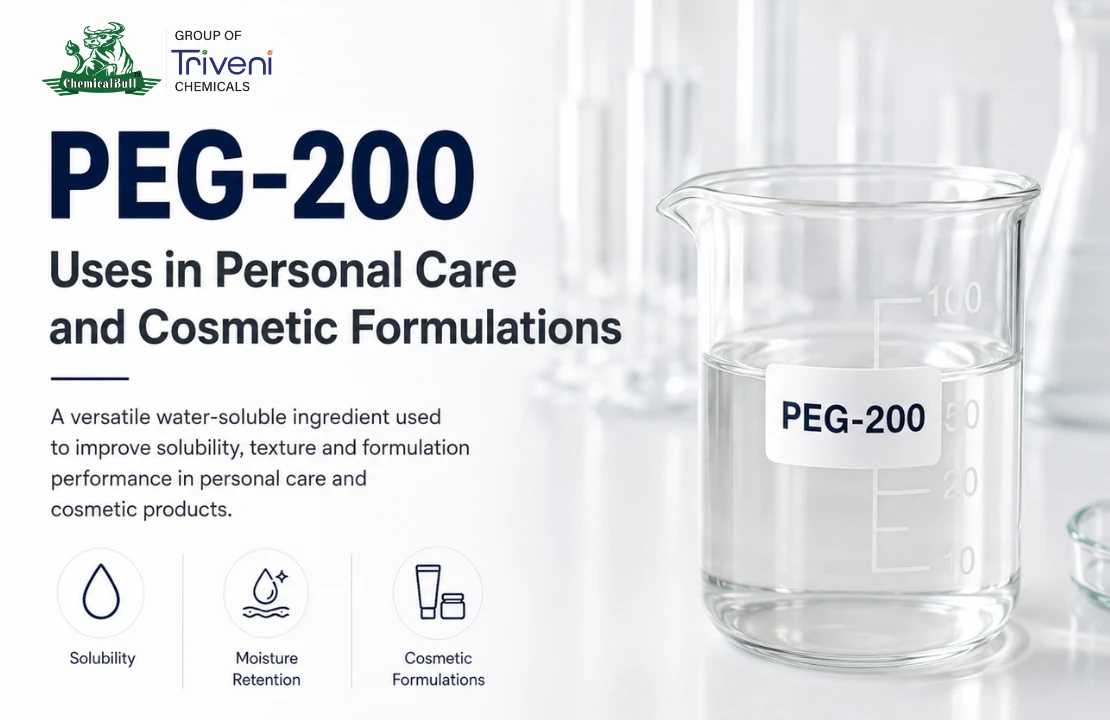
PEG-200 Uses in Personal Care and Cosmetic Formulations
PEG-200, or Polyethylene Glycol 200, is a low-molecular-weight, water-soluble glycol widely used across personal care and cosmetic formulations. With CAS number 25322-68-3 and an average molecular weight of approximately 200 g/mol, it combines high water solubility, strong humectant properties, and broad ingredient compatibility, making it a preferred functional additive in products ranging from moisturizers to shampoos.
PEG-200 is also referred to as Polyethylene Glycol 200 or Macrogol 200. Its combination of hygroscopicity, low viscosity, and compatibility with both aqueous and oil-phase ingredients has made it a top choice for formulating creams, lotions, cleansers, shampoos, and a wide range of other personal care products. For bulk cosmetic-grade PEG-200 with COA and MSDS support, Chemical Bull is a trusted PEG-200 Supplier serving cosmetic manufacturers, personal care formulators, and industrial chemical buyers across India and global export markets.
What Is PEG-200: Chemical Identity and Physical Properties
|
Property |
Details |
|
Chemical Name |
Polyethylene Glycol 200 |
|
Abbreviation |
PEG-200 |
|
Synonyms |
Macrogol 200, PEG 200 |
|
CAS Number |
25322-68-3 |
|
Average Molecular Weight |
~200 g/mol |
|
Physical Form |
Clear, colorless to slightly yellow liquid |
|
Boiling Point |
>200°C (decomposes) |
|
Freezing Point |
Approx. -65°C to -55°C |
|
Flash Point |
>200°C |
|
Solubility |
Fully miscible with water; soluble in most organic solvents |
Why PEG-200 Is Preferred in Cosmetic Formulations
PEG-200's physical and chemical characteristics give it a distinct performance profile compared to higher molecular weight PEGs such as PEG-400 or PEG-4000.
Key performance advantages:
- High water solubility: Fully miscible with water, allowing easy incorporation into aqueous-based formulations without residue
- Strong humectant behavior: Attracts and retains moisture from the surrounding environment, supporting skin and hair hydration
- Low viscosity: Free-flowing liquid form simplifies blending and processing at the manufacturing stage
- Broad ingredient compatibility: Mixes well with surfactants, emollients, fragrances, and preservatives commonly used in cosmetics
- Mild profile: Generally considered gentle at typical use concentrations in personal care products
- Cost-effectiveness: Widely available and economical, helping manage production costs at commercial scale
Application 1: Humectant and Moisturizing Agent
One of the most recognized PEG 200 uses is as a humectant in skin and hair care formulations. Humectants draw moisture from the surrounding air and help retain it within the skin or hair fiber.
Why PEG-200 is used as a humectant:
- Improves moisture retention in dry or dehydrated skin formulations
- Supports a smoother, softer after-feel on application
- Enhances the perceived hydration benefit of lotions and creams
- Contributes to conditioning performance in leave-on and rinse-off hair products
Application 2: Solvent for Active Ingredients
PEG-200 is frequently used as a solvent to help dissolve active ingredients, fragrances, and additives that do not mix well with water alone.
Solvent-related benefits:
- Bridges solubility between water-soluble and oil-soluble components
- Improves dispersion of actives in serums, essences, and lightweight lotions
- Supports uniform distribution of ingredients across a production batch
- Reduces the likelihood of ingredient separation during shelf storage
Application 3: Viscosity and Texture Modifier
Formulators rely on PEG-200 to adjust the thickness, flow, and sensory feel of a formulation.
Texture-related functions:
- Thins overly thick formulations to a workable consistency
- Contributes to a lightweight, non-greasy finish in creams and lotions
- Supports desired flow properties in cleansers, gels, and styling products
- Assists in achieving a consistent product texture across manufacturing batches
Application 4: Emulsion Stabilizer
In emulsified systems where water and oil-based ingredients must coexist smoothly, PEG-200 supports emulsion stability.
- Works alongside primary surfactants and emulsifying agents
- Improves overall consistency of creams and lotions
- Reduces the likelihood of phase separation over the product's shelf life
- Supports a more uniform texture in multi-phase formulations
Application 5: Carrier for Fragrances and Colorants
PEG-200's solvent properties make it useful as a carrier for fragrances and colorants.
- Helps evenly disperse fragrance oils throughout a formulation
- Supports consistent color distribution across a production batch
- Reduces the risk of uneven concentration in specific areas of the product
- Applicable across cleansers, lotions, shampoos, and liquid soaps
Application 6: Skin Conditioning Agent
In skincare products, PEG-200 is often classified as a skin-conditioning agent due to its moisture-attracting and spreadability-enhancing properties.
- Improves spreadability of creams, lotions, and after-sun products
- Contributes to a smoother, more comfortable application experience
- Supports the overall sensory profile of finished skincare formulations
Common Products Containing PEG-200
|
Product Category |
Typical Role of PEG-200 |
|
Moisturizers and body lotions |
Humectant, texture modifier |
|
Facial cleansers and toners |
Solvent, texture modifier |
|
Shampoos and conditioners |
Humectant, conditioning agent |
|
Liquid soaps and hand washes |
Solvent, fragrance carrier |
|
Shaving creams and gels |
Texture modifier, emulsion stabilizer |
|
Sunscreens and after-sun products |
Skin conditioning agent |
|
Makeup removers |
Solvent |
|
Hair styling products |
Texture and viscosity modifier |
PEG-200 vs Other PEG Variants
|
Property |
PEG-200 |
PEG-400 |
PEG-4000 |
|
Physical Form |
Liquid |
Liquid |
Solid/waxy |
|
Molecular Weight |
~200 g/mol |
~400 g/mol |
~4000 g/mol |
|
Viscosity |
Low |
Medium |
High (solid) |
|
Primary Role |
Humectant, solvent |
Solvent, emollient |
Thickener, binder |
|
Best for |
Lightweight lotions, cleansers, hair care |
Creams, emulsions |
Solid formulations, thickened systems |
PEG-200's lower molecular weight and fluid form distinguish it for humectant and solvent functions, rather than thickening, which is better suited to higher molecular weight PEGs.
Quality Parameters and Grade Selection
When sourcing PEG-200 for cosmetic applications, confirm the following from your supplier:
|
Quality Parameter |
Relevance |
|
Purity/Assay |
Confirms active content and consistency of the product |
|
Colour (APHA) |
Low colour important for clear or light-colored formulations |
|
Water content |
Affects performance and stability in formulations |
|
pH |
Confirms suitability for skin and hair care use |
|
Specific gravity |
Confirms product identity and batch consistency |
|
Contaminant screening (e.g., ethylene oxide, 1,4-dioxane) |
Ensures compliance with cosmetic safety expectations |
Always request COA and MSDS. For cosmetic use, confirm compliance with relevant cosmetic regulatory standards in your target market.
Frequently Asked Questions
1. What is PEG-200?
PEG-200 is a low-molecular-weight polyethylene glycol, a clear, water-soluble liquid used as a humectant, solvent, and viscosity modifier in cosmetic and personal care formulations.
2. What are the main PEG 200 uses in cosmetics?
It is mainly used as a humectant, solvent for active ingredients, viscosity/texture modifier, emulsion stabilizer, and carrier for fragrances and colorants.
3. Is PEG-200 safe for skin?
At concentrations typically used in cosmetic formulations, PEG-200 is generally considered safe, provided it is manufactured and sourced under proper quality controls.
4. How is PEG-200 different from PEG-400 or PEG-4000?
PEG-200 has a lower molecular weight and is a fluid, whereas PEG-4000 is solid. PEG-200 is mainly chosen for humectant and solvent functions, while higher molecular weight PEGs are used for thickening.
5. Which products commonly contain PEG-200?
Moisturizers, cleansers, shampoos, conditioners, liquid soaps, shaving creams, sunscreens, and makeup removers.
6. What purity grade is required for cosmetic-grade PEG-200?
Requirements vary by application, but formulators should confirm purity, colour (APHA), water content, and contaminant screening with the supplier's COA before procurement.
7. What documentation should I request when sourcing PEG-200?
Always request a Certificate of Analysis (COA) and Material Safety Data Sheet (MSDS). Confirm compliance with cosmetic regulatory standards applicable in your target market.
Conclusion
PEG-200 remains a widely relied-upon ingredient in personal care and cosmetic formulations due to its multifunctional benefits. To summarize:
- What it is – A low-molecular-weight, water-soluble polyethylene glycol used as a functional additive in cosmetic products
- Core functions – Acts as a humectant, solvent, viscosity modifier, emulsion stabilizer, and carrier for fragrances and colorants
- Where it's used – Found in moisturizers, cleansers, shampoos, conditioners, soaps, shaving products, and sunscreens
- Why it's chosen – Valued for water solubility, ingredient compatibility, consistent performance, mild profile, and affordability
- What matters when sourcing it – Purity, contaminant control, and adherence to quality/regulatory standards
Key takeaways for formulators and brands:
- PEG-200 supports both texture and hydration in a single ingredient
- Its versatility reduces the need for multiple separate additives in a formulation
- Product consistency depends heavily on sourcing from a quality-controlled supplier
- Understanding what PEG-200 is helps brands make informed formulation and ingredient-sourcing decisions
For bulk PEG-200 with COA and MSDS support, connect with Chemical Bull, a trusted PEG-200 Supplier serving cosmetic manufacturers, personal care formulators, and industrial chemical buyers across India and global export markets.
Comment Section