Chemical Bull
526
09-Jul-2026
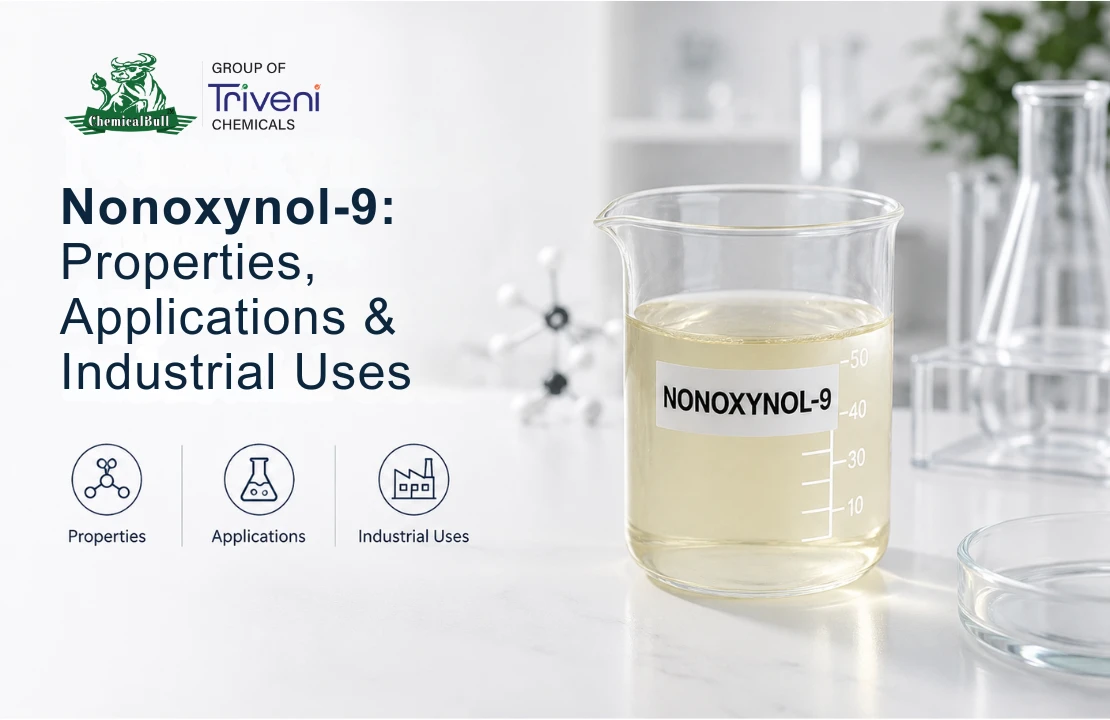
Nonoxynol-9: Properties, Applications, and Industrial Uses
Nonoxynol-9 is a non-ionic surfactant that belongs to the ethoxylated (NPE) group of surfactants. It is created by combining nonylphenol with around 9 moles of ethylene oxide, producing a molecule with a hydrophobic nonylphenol tail as well as a hydrophilic polyethylene oxide chain comprised of approximately 9 units of ethylene oxide. Its amphiphilic form provides the ability to effectively wet, emulsify, disperse, solubilizing and detergency capabilities in a variety of formulations and industrial uses.
Nonoxynol-9 is a component of cosmetics and pharmaceutical products, lab settings, industrial cleaning solutions, textile products, as well as emulsion systems and other specialty blends of surfactants. To purchase industrial-grade bulk supplies that come with COA, MSDS, and technical documents,
ChemicalBull is a reliable Nonoxynol-9 supplier serving pharmaceutical formulators, industrial manufacturers, and specialty chemical buyers across India and global export markets.
Chemical Identity and Physical Properties:
|
Property |
Details |
|
Chemical Name |
Nonoxynol-9 |
|
IUPAC Name |
2-[4-(2,4,4-trimethylpentan-2-yl)phenoxy]ethanol (simplified) |
|
Common Names |
NP-9, Nonylphenol Ethoxylate (9 EO), NPE-9 |
|
CAS Number |
14409-72-4 |
|
Molecular Formula |
C33H60O10 |
|
Molecular Weight |
616.8 g/mol |
|
Surfactant Type |
Non-ionic (ethoxylated nonylphenol) |
|
Physical Form |
Clear to pale yellow viscous liquid |
|
Boiling Point |
662°C |
|
Solubility |
Slightly soluble in methanol and chloroform; dispersible in water |
|
EO Units |
Approximately 9 |
|
HLB Value |
Approximately 13 (based on 9 EO units) |
Key Functional Properties
Nonoxynol-9's non-ionic nature and balanced HLB value give it a specific set of functional properties that make it useful across multiple formulation types:
- Emulsification: Stabilizes oil-in-water and water-in-oil emulsions in pharmaceutical and industrial formulations
- Wetting: Reduces surface tension of aqueous systems, improving substrate penetration and coverage
- Dispersing: Helps distribute solid particles uniformly in liquid formulations.
- Solubilizing: Assists in dispersing oil-soluble ingredients into aqueous systems
- Detergency: Removes soil, grease, and organic deposits in cleaning applications
- Surfactant compatibility: As a non-ionic, it is compatible with anionic, cationic, and amphoteric surfactants in blended systems
Nonoxynol 9 Uses: Industrial and Formulation Applications
1. Pharmaceutical Formulations
Nonoxynol-9 is used in selected pharmaceutical formulations where a non-ionic surfactant, solubilizer, emulsifier, or wetting agent is required. It contributes to:
- Improved solubilization of poorly water-soluble active pharmaceutical ingredients (APIs)
- Stable emulsion formation in topical pharmaceutical preparations
- Wetting and dispersion of active ingredients in liquid formulations
- Compatibility with other pharmaceutical excipients in blended systems
Confirm regulatory suitability, grade compliance, and applicable pharmacopoeia specifications with your supplier before use in any pharmaceutical application.
2. Personal Care and Cosmetic Products
In personal care formulations, Nonoxynol-9 functions as a surfactant, emulsifier, and wetting agent in selected product types where its performance and regulatory acceptability are confirmed. Common applications include:
- Emulsion stabilization in creams and lotions
- Wetting and spreading agent in topical formulations
- Solubilizer for oil-soluble ingredients in aqueous personal care systems
- Formulation aids in specialty personal care surfactant blends
Note: Regulatory status for personal care use varies by region and product type. Always confirm applicable regulations before formulation use.
3. Industrial Cleaning and Degreasing
One of the primary nonoxynol-9 uses in industry is as a wetting and detergency agent in industrial cleaning systems. It performs well in:
- Metal surface cleaning and degreasing concentrates
- Industrial parts washing systems
- Hard surface cleaners and floor degreasers
- Institutional cleaning concentrates
- Equipment and tank cleaning formulations
Its capability to lower surface tension as well as penetrate soiled surfaces, in conjunction with the compatibility of other anionic and non-ionic surfactants make it an effective component of complicated industrial cleaning mixes.
4. Textile Processing
In textile processing, Nonoxynol-9 is used as a wetting, scouring, and emulsifying auxiliary:
- Scouring: Assists in removing natural oils, waxes, and processing aids from raw fibers during pre-treatment
- Dyeing aids: Improve dye bath wetting and uniformity of dye penetration into fiber
- Emulsifier: Helps emulsify lubricants and softeners used during fiber and yarn processing
- Dispersant: Supports uniform dispersion of dyestuffs and chemical auxiliaries in process baths
5. Laboratory and Research Applications
Nonoxynol-9 is extensively used in lab environments as a nonionic surfactant used for cell membrane solubilization and lysis in biochemical and biological research. It is also used as a dispersion and wetting agent for the development of analytical methods, as well as a standard surfactant in surfactant performance tests and comparative studies.
6. Emulsion Systems and Specialty Surfactant Blends
In emulsions for industrial use, Nonoxynol-9 is a key ingredient in stable oil-water film interfacial formation polymerization in emulsions, co-surfactant compatibility for anionic and nonionic blends, and to ourtting effectiveness for industrial formulations that are spray-applied.
Nonoxynol 9 How to Use: Formulation Guidance
nonoxynol 9 how to use depends on the application. The following guidance applies to industrial formulation use:
|
Application Type |
Typical Usage Level |
Addition Method |
|
Industrial cleaning concentrates |
1% to 10% |
Add to water phase with agitation |
|
Pharmaceutical topical formulations |
0.1% to 2% |
Incorporate into emulsion or gel phase |
|
Textile scouring baths |
0.5% to 3% |
Dissolve in process water before use |
|
Emulsion systems |
1% to 5% |
Add to oil-water interface during emulsification |
|
Laboratory cell lysis buffers |
0.1% to 1% |
Add to aqueous buffer at target concentration |
|
Surfactant blends |
5% to 30% |
Blend with co-surfactants at room temperature |
General formulation tips:
- Nonoxynol-9 is a liquid and does not require heating before addition in most applications
- It is compatible with anionic, cationic (at controlled ratios), and amphoteric surfactants
- In hard water, its performance is generally stable compared to some anionic surfactants
- Always conduct compatibility testing before committing to a full-scale formulation
Nonoxynol 9 Alternatives
There is a growing concern for environmental and regulatory aspects of alternatives to nonoxynol-9, especially for products that are intended for consumption. The reason for this is environmental issues related to the biodegradation behavior of nonylphenol Ethoxylates (NPEs), as well as the limitations that are imposed on them by certain regulations, especially in the EU and Canada.
The following table summarizes commonly considered alternatives:
|
Alternative |
Type |
Key Advantage Over N-9 |
|
Lauryl Alcohol Ethoxylate (LAE) |
Non-ionic (alcohol ethoxylate) |
Better biodegradability; no phenol concern; EU-permitted |
|
Tridecyl Alcohol Ethoxylate |
Non-ionic (alcohol ethoxylate) |
Higher cloud point; suitable for some industrial cleaning applications |
|
Coco Glucoside / Decyl Glucoside |
Non-ionic (alkyl polyglucoside) |
Renewable origin; mild; consumer-safe |
|
Polysorbate 20 / 80 |
Non-ionic (sorbitan ester ethoxylate) |
Pharma-approved; mild; well-documented safety profile |
|
Poloxamers (Pluronics) |
Non-ionic (block copolymer) |
Lab and pharmaceutical use; low toxicity; FDA-accepted |
|
Alkyl Polyglucosides (APG) |
Non-ionic (sugar-based) |
Biodegradable; mild; suitable for personal care and cleaning |
Key considerations when selecting nonoxynol-9 alternatives:
- Match the HLB of the alternative to your oil phase or application requirement
- Confirm regulatory acceptance in your target market and product category
- Verify performance equivalence through bench testing before finalising the switch
Grades and Quality Parameters
When sourcing Nonoxynol-9 for industrial or formulation use, confirm these parameters:
|
Quality Parameter |
Relevance |
|
Purity / Active content |
Confirms surfactant concentration in supplied material |
|
EO mole average |
Confirms the HLB and performance characteristics of the grade |
|
Colour (APHA) |
Relevant for personal care and clear formulation products |
|
pH (1% solution) |
Confirms compatibility with target formulation pH |
|
Cloud point |
Indicates performance at elevated temperatures |
|
Moisture content |
Affects storage stability and formulation consistency |
|
Heavy metals |
Required for pharma and personal care applications |
Request COA, MSDS, and Technical Data Sheet from your supplier before procurement.
Frequently Asked Questions
1. What is Nonoxynol-9?
It is a non-ionic surfactant made by ethoxylating nonylphenol with approximately 9 moles of ethylene oxide, used as an emulsifier, wetting agent, dispersant, and detergent in industrial and formulation applications.
2. What are the main nonoxynol-9 uses in industry?
Key uses include pharmaceutical formulations, personal care products, industrial cleaning, textile processing, laboratory cell lysis, emulsion systems, and specialty surfactant blends.
3. How to use nonoxynol-9 in a cleaning formulation?
Add it to the water phase at 1% to 10% concentration with agitation. It is compatible with anionic and other non-ionic surfactants commonly used in cleaning blends.
4. What are the best nonoxynol-9 alternatives?
Lauryl Alcohol Ethoxylate, Alkyl Polyglucosides, Polysorbates, and Tridecyl Alcohol Ethoxylate are commonly used alternatives, depending on the application and regulatory requirements.
5. Is Nonoxynol-9 restricted in the EU?
Yes, it is restricted in detergents, cleaning products, and textile applications in the EU under REACH regulations. Confirm the current status for your specific application before use.
6. What is the CAS number for Nonoxynol-9?
CAS 14409-72-4, molecular formula C33H60O10, molecular weight 616.8 g/mol.
7. What documentation should I request when sourcing Nonoxynol-9?
Always request COA, MSDS, Technical Data Sheet, EO grade confirmation, and any relevant regulatory compliance documentation for your target application and market.
Conclusion
Nonoxynol-9 has the capability to be a non-ionic surfactant, with a wide variety of industrial uses in cleaner systems, pharmaceutical formulations, and textile processes, as well as laboratory usage and Emulsion Chemistry. Its emulsifying, wetting, dispersing, and solubilizing properties are beneficial across a variety of formulas in which the non-ionic performance of surfactants and their compatibility with different ingredient classes are needed.
Formulators also need to be cognizant of the regulatory requirements of nonylphenol ethoxylates used in consumer applications, and consider alternatives to nonoxynol-9 when regulatory limitations are in place and where biodegradability enhancement is the goal of the formulation.
If you are looking for bulk Nonoxynol-9 supplies with COAs, MSDS, grade confirmation, and other technical information, connect with Chemical Bull, an established Nonoxynol-9 distributor serving pharmaceutical producers Industrial formulators, manufacturers of textile chemicals, as well as specialty chemical buyers in India and the world's export markets.
Comment Section