Chemical Bull
409
22-Jul-2026
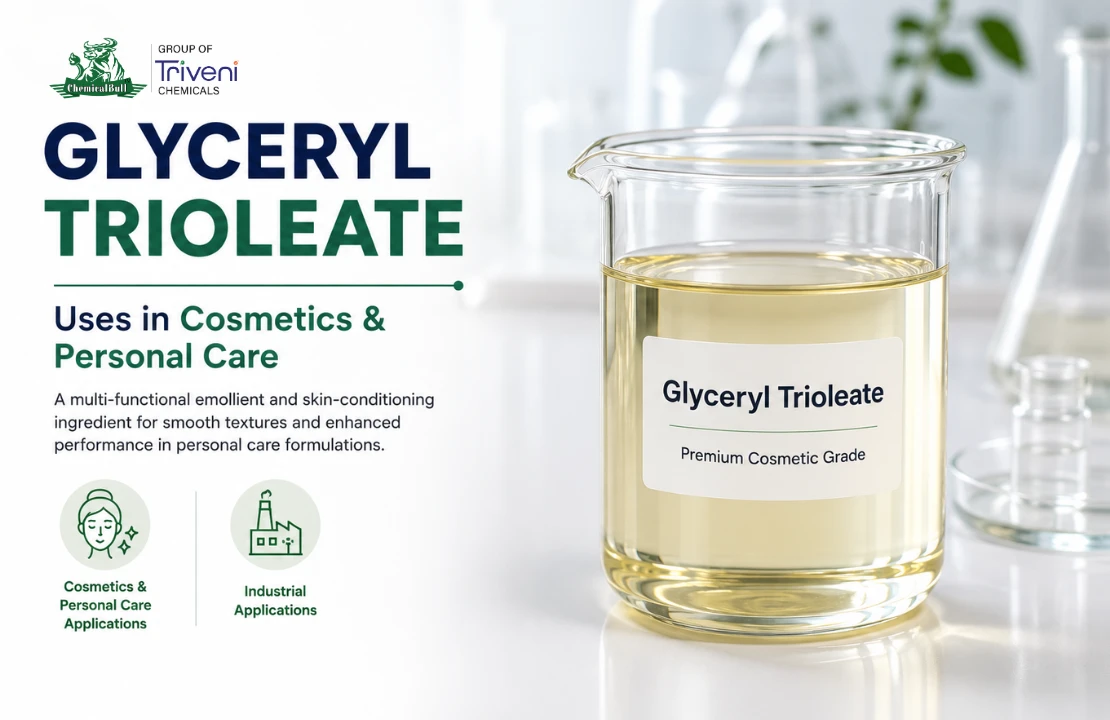
Glyceryl Trioleate Uses in Cosmetics and Personal Care
Quick Answer: What is Glyceryl Trioleate Used For?
Glyceryl Trioleate is used in cosmetics as an emollient, skin-conditioning agent, and oil-phase ingredient. It helps improve softness, spreadability, lubrication, texture, and sensory performance in creams, lotions, lip products, and color cosmetics.
Introduction
Glyceryl Trioleate, also known as Triolein, is an unsaturated triglyceride ester widely used as a cosmetic ingredient in personal care and beauty formulations. Derived from glycerol and oleic acid, this oil-soluble ingredient provides excellent emollient properties and helps improve the sensory performance of finished products.
In cosmetic manufacturing, Glyceryl Trioleate helps improve skin feel, product glide, formulation richness, and oil-phase performance. It is commonly used in:
- Creams and lotions
- Lipsticks and lip balms
- Body care products
- Makeup formulations
- Skincare systems
- Oil-based personal care products
Unlike surfactants or emulsifiers that primarily stabilize water-oil mixtures, Glyceryl Trioleate functions mainly as a conditioning lipid ingredient that supports the feel and performance of the oil phase.
For cosmetic manufacturers, personal care formulators, and bulk chemical buyers, selecting a reliable Glyceryl Trioleate supplier is important for maintaining product consistency, documentation support, and formulation performance.
ChemicalBull Technical Team provides technical information on cosmetic raw materials, aroma chemicals, and industrial ingredients based on supplier documentation, formulation references, and industry application knowledge.
What is Glyceryl Trioleate?
Glyceryl Trioleate, also known as Triolein, is an unsaturated triglyceride ester made from glycerol and oleic acid. In cosmetics and personal care, it is used as an emollient, skin-conditioning ingredient, texture aid, and oil-phase support material.
It belongs to the triglyceride family and is oil-compatible. This makes it useful in creams, lotions, lip products, color cosmetics, body care products, and oil-rich personal care systems.
Chemical Properties Overview
|
Technical Point |
Details |
|
Product name |
Glyceryl Trioleate |
|
Common synonym |
Triolein |
|
Chemical type |
Unsaturated triglyceride ester |
|
CAS number |
122-32-7 |
|
Molecular formula |
C57H104O6 |
|
Molar mass |
885.43 g/mol |
|
Structure type |
Glycerol backbone esterified with three oleic acid chains |
|
Fat / oil classification |
Unsaturated triglyceride oil |
|
Typical appearance |
Colorless to pale yellow viscous liquid |
|
Solubility |
Practically insoluble in water; soluble in nonpolar solvents such as hexane and chloroform |
|
Main cosmetic role |
Emollient, skin-conditioning agent, texture support |
|
SDS |
Buyers should review Glyceryl Trioleate SDS before handling |
|
Application areas |
Skincare, creams, lotions, lipsticks, color cosmetics, body care |
Glyceryl Trioleate works best in formulations where the oil phase has an important role. It should be evaluated with the selected oils, waxes, emulsifiers, antioxidants, stabilizers, and packaging system before commercial use.
Structure, Hydrolysis and Hydrogenation
Glyceryl Trioleate has the formula C57H104O6 and is an unsaturated triglyceride. Its structure contains a glycerol backbone esterified with three oleic acid chains.
During hydrolysis, Glyceryl Trioleate can break down into glycerol and oleic acid. Hydrogenation can reduce its unsaturation and convert it toward more saturated glyceride-type materials with different texture, melting behavior, and stability properties.
Glyceryl Trioleate Uses in Cosmetics
Glyceryl Trioleate uses in cosmetics are mainly linked to emolliency, skin conditioning, texture improvement, glide, and oil-phase support. It is suitable for selected cosmetic systems where formulators want a smooth, soft, and uniform finish.
Key Cosmetic Applications
|
Application |
Function |
|
Creams & Lotions |
Improves softness, glide, and skin feel |
|
Lipsticks & Lip Balms |
Supports smooth application and lubrication |
|
Body Care Products |
Enhances richness and conditioning feel |
|
Makeup Products |
Supports pigment movement and texture |
|
Oil-Based Formulations |
Improves oil-phase compatibility |
Emollient and Skin-Conditioning Properties
Glyceryl Trioleate acts as an emollient in cosmetic products. It helps create a softer and smoother feel on the skin by supporting the lipid phase of the formulation.
In skincare products, this can improve the sensory profile of creams, lotions, balms, and body care products. It may also support a richer after-feel when used with suitable oils, esters, waxes, and butters.
Viscosity-Control in Creams and Lotions
Glyceryl Trioleate may support texture and viscosity balance in selected creams and lotions. It can help improve the movement, richness, and spread of oil-rich systems.
It is not a primary thickener, but it can influence the body and feel of the finished product. Formulators should test it with the complete emulsifier system, oil phase, stabilizer, and thickener package.
Glyceryl Trioleate in Personal Care Formulations
Glyceryl Trioleate in personal care formulations is used where softness, lubrication, glide, and oil-phase performance matter. It may be considered in body care, lip care, cleansing oils, massage products, hair care oils, and specialty personal care systems.
Its performance depends on product format. A lotion may need a lighter feel, while a lipstick may need richer glide and better pigment movement.
Lipsticks and Color Cosmetics
Glyceryl Trioleate may be used as a formulation ingredient in lipsticks, lip balms, makeup bases, and color cosmetic systems where smooth glide, softness, and pigment movement are important. It can help improve application feel and support better distribution of pigments within the oil phase.
It should not be used directly on the skin or lips as a standalone finished product. In color cosmetics, Glyceryl Trioleate should be properly formulated with pigments, waxes, oils, film formers, emulsifiers, and stabilizers.
Before commercial use, formulators should test the final product for payoff, texture, shine, stability, compatibility, and skin or lip safety.
Compatibility with Other Cosmetic Ingredients
Glyceryl Trioleate is often evaluated with emulsifiers, solubilizers, waxes, and oil-phase ingredients. It may work well in systems where an emollient oil phase needs support from compatible emulsifiers.
For related formulation ingredients, buyers may also evaluate Glycerol Monooleate for emulsification support, Polysorbate 85 for oil-rich cosmetic systems, and Glycol Distearate for pearlizing and opacity support.
Formulator's Note: Stability & Handling Insights
Formulator note: Glyceryl Trioleate should be evaluated in the actual cosmetic system before scale-up. Its performance depends on oil phase composition, emulsifier selection, antioxidant support, processing temperature, packaging, and storage conditions.
|
Check Point |
Why It Matters |
|
Oil-phase compatibility |
Confirms blending with oils, waxes, and esters |
|
Oxidation control |
Helps protect oil-rich systems from rancidity |
|
Emulsion stability |
Confirms performance in creams and lotions |
|
Texture impact |
Shows effect on spreadability and richness |
|
Pigment compatibility |
Important for color cosmetics |
|
Storage behavior |
Supports shelf stability and quality control |
|
COA and TDS review |
Helps verify quality and specification |
For E-E-A-T and buyer trust, every batch should be reviewed through COA, TDS, SDS, appearance, odor, purity, storage guidance, and application suitability before formulation approval.
Best Practices for Stability & Storage
Recommended storage practices:
- Store in tightly closed containers
- Protect from excessive heat and sunlight
- Avoid unnecessary air exposure
- Maintain suitable storage conditions
- Review SDS before handling
COA, TDS, and SDS documentation should be reviewed before bulk approval.
Glyceryl Trioleate vs. Other Common Emollients and Emulsifiers
Glyceryl Trioleate is mainly used for emolliency and oil-phase support. Other cosmetic ingredients may be stronger emulsifiers, solubilizers, pearlizers, humectants, or texture builders.
|
Ingredient |
Main Function |
Best Use Area |
Key Difference |
|
Glyceryl Trioleate |
Emollient, skin-conditioning aid |
Creams, lotions, lip care, color cosmetics |
Supports softness, glide, and oil-phase feel |
|
Glycerol Monooleate |
Emulsifier and emollient support |
Cosmetic and industrial formulations |
More focused on emulsification support |
|
Polysorbate 85 |
Solubilizer and emulsifier |
Oil-rich personal care systems |
Helps disperse selected oils and fragrance materials |
|
PEG 400 |
Solvent, humectant, formulation aid |
Skincare and personal care systems |
More water-compatible than oil-rich esters |
|
Glycol Distearate |
Pearlizing and opacity agent |
Shampoos, body washes, cleansers |
Creates pearlescent appearance |
This comparison helps formulators avoid wrong ingredient selection. Glyceryl Trioleate should not be treated as a direct replacement for every emulsifier or solubilizer. It is better understood as an oil-compatible emollient and formulation support ingredient.
How Manufacturers Select Glyceryl Trioleate
Cosmetic manufacturers and personal care formulators should select Glyceryl Trioleate based on application type, specification, purity, appearance, odor, oil-phase compatibility, and stability results.
|
Buying Check |
Why It Matters |
|
Appearance |
Helps confirm material quality |
|
Odor |
Important for cosmetic acceptability |
|
Purity / specification |
Supports batch consistency |
|
COA |
Confirms batch quality |
|
TDS |
Gives formulation and technical details |
|
SDS |
Supports safe handling and storage |
|
Packing size |
bulk requirement |
|
Batch consistency |
Important for repeat manufacturing |
For export buyers and large-scale users, supplier reliability is also important. Regular quality, proper packaging, documentation support, and timely dispatch help reduce production delays.
Glyceryl Trioleate Price and Buying Factors
Glyceryl Trioleate price depends on grade, purity, packing size, order quantity, documentation, supplier reliability, and market availability. Buyers should compare technical quality along with price because inconsistent material can affect product feel, appearance, and stability.
Before placing a bulk order, buyers should request COA, TDS, SDS, sample support, specification details, packing information, and delivery timeline. This helps formulation teams approve the material properly before production use.
Glyceryl Trioleate for Cosmetic Formulations | Get a Quote
Cosmetic manufacturers and personal care formulators require consistent-quality Glyceryl Trioleate for formulation development and commercial production.
When selecting a Glyceryl Trioleate supplier, buyers should evaluate:
- COA availability
- TDS and SDS documentation
- Batch consistency
- Packaging options
- Technical support
- Supply reliability
ChemicalBull supplies Glyceryl Trioleate for cosmetic and personal care applications with technical documentation support including COA, TDS, SDS, and sample assistance.
Need Glyceryl Trioleate for formulation development? Request technical specifications and bulk pricing from ChemicalBull.
Frequently Asked Questions
What is Glyceryl Trioleate used for?
Glyceryl Trioleate is used in cosmetics and personal care as an emollient, skin-conditioning agent, texture aid, and oil-phase support ingredient. It helps improve softness, spreadability, glide, and product uniformity.
What is Glyceryl Trioleate also known as?
Glyceryl Trioleate is also known as Triolein. It is a triglyceride ester formed from glycerol and three oleic acid chains.
Is Glyceryl Trioleate safe for skin?
Glyceryl Trioleate may be used in selected skincare and cosmetic formulations, but final skin suitability depends on concentration, purity, product type, and complete formula. It should be used as a formulation ingredient, not as a direct-use skincare product.
Is Glyceryl Trioleate a triglyceride?
Yes, Glyceryl Trioleate is a triglyceride. It is made from glycerol and three oleic acid chains, which makes it an unsaturated triglyceride ester.
What is the structure of Glyceryl Trioleate?
Glyceryl Trioleate has a glycerol backbone esterified with three oleic acid chains. This structure gives it strong oil-phase compatibility and supports its use in cosmetic and personal care formulations.
What is Glyceryl Trioleate used for in lip products?
Glyceryl Trioleate may be used in lipsticks, lip balms, lip glosses, and lip care formulations to support glide, softness, lubrication, pigment movement, and smoother application feel.
What is the difference between Glyceryl Trioleate and Glycerol Monostearate?
Glyceryl Trioleate is mainly used as an emollient and oil-phase support ingredient, while Glycerol Monostearate is commonly used as an emulsifier, thickener, and texture-support ingredient.


Comment Section