Chemical Bull
17
23-Sep-2026
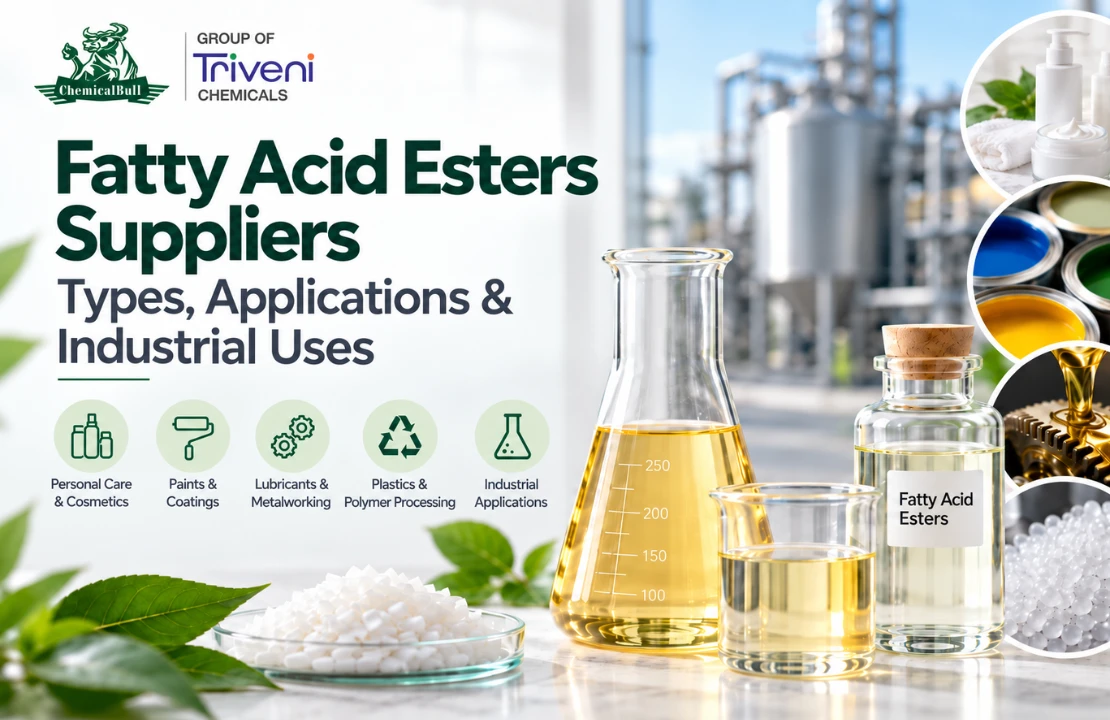
Fatty Acid Esters Suppliers | Types, Applications & Industrial Uses
Fatty acid esters are versatile compounds formed by the reaction of fatty acids with alcohols, polyols, or other suitable alcohol-containing compounds. Their combination of oil compatibility, lubricity, emulsification, solvency, and surface-active properties makes them useful across cosmetics, personal care, food, pharmaceuticals, lubricants, plastics, rubber, coatings, and specialty chemical applications.
For specific fatty acid ester sourcing requirements, technical specifications, documentation, and bulk quantities, ChemicalBull can assist with suitable product and supply options.
Quick Answer: What Are Fatty Acid Esters?
Fatty acid esters are compounds produced when a fatty acid reacts with an alcohol or polyol, forming an ester bond. Their properties depend on factors such as fatty acid chain length, degree of saturation, molecular structure, molecular weight, and degree of esterification.
Common fatty acid ester groups include:
-
Glycerol fatty acid esters
-
Sorbitan fatty acid esters
-
Alkyl fatty acid esters
-
Glycol fatty acid esters
-
Polyol fatty acid esters
These materials can function as emulsifiers, emollients, lubricants, dispersing aids, processing additives, plasticizers, and specialty intermediates depending on their chemical structure.
What Are Fatty Acid Esters?
Fatty acid esters contain a fatty acid-derived portion combined with an alcohol-derived portion. The general esterification reaction can be represented as:
Fatty Acid + Alcohol → Fatty Acid Ester + Water
The alcohol component may be a simple alcohol, glycerol, glycol, sorbitan, or another polyol. Changing either component can significantly alter the resulting ester.
For example:
-
Longer fatty acid chains generally increase hydrophobicity.
-
Unsaturated fatty acids can influence oxidation behaviour and fluidity.
-
Polyhydric alcohols can produce mono-, di-, or higher esters.
-
Higher molecular weight can influence viscosity and melting behaviour.
-
The degree of esterification can affect emulsification and surface activity.
Because of this structural flexibility, fatty acid esters are available in a broad range of physical and functional forms.
Types of Fatty Acid Esters
Fatty acid esters can be classified according to the alcohol or polyol used during esterification.
1. Glycerol Fatty Acid Esters
Glycerol fatty acid esters are produced by esterifying glycerol with fatty acids. Depending on the degree of esterification, they may exist as monoesters, diesters, or mixtures.
They are widely used in food, cosmetics, personal care, pharmaceuticals, and industrial formulations.
Glycerol Monostearate
Glycerol Monostearate is a glycerol ester of stearic acid commonly used as an emulsifying, stabilizing, and consistency-modifying ingredient.
Its applications include:
-
Personal care formulations
-
Creams and lotions
-
Food formulations
-
Pharmaceutical preparations
-
Industrial emulsions
Glycerol Monolaurate
Glycerol Monolaurate is a glycerol ester derived from lauric acid. Its amphiphilic structure allows it to interact with both oil and water phases.
It is used in:
-
Personal care
-
Cosmetic formulations
-
Food-related applications
-
Specialty formulations
-
Selected industrial applications
2. Sorbitan Fatty Acid Esters
Sorbitan esters are formed by esterifying sorbitan with fatty acids. They are widely recognized for their emulsifying and surface-active properties.
Their performance can vary depending on the fatty acid component and degree of esterification.
Sorbitan Monostearate
Sorbitan Monostearate is derived from stearic acid and sorbitan. It is commonly used as a lipophilic emulsifier and formulation aid.
Typical applications include:
-
Cosmetics
-
Personal care products
-
Food formulations
-
Pharmaceutical formulations
-
Industrial emulsions
Sorbitan Monooleate
Sorbitan Monooleate is an ester of sorbitan and oleic acid. Its unsaturated fatty acid structure gives it different physical characteristics from saturated sorbitan esters.
It is used in:
-
Emulsification systems
-
Personal care formulations
-
Industrial formulations
-
Specialty chemical applications
3. Alkyl Fatty Acid Esters
Alkyl fatty acid esters are formed when fatty acids react with monohydric alcohols. Their properties vary considerably according to the alcohol chain length and fatty acid used.
These esters are commonly associated with:
-
Emollient systems
-
Lubricants
-
Plasticizers
-
Coatings
-
Industrial fluids
-
Specialty formulations
Ethylhexyl Oleate
Ethylhexyl Oleate is an ester derived from oleic acid and 2-ethylhexanol. It is a hydrophobic ester with applications where lubricity, spreading, and oil-phase compatibility are important.
4. Glycol Fatty Acid Esters
Glycol esters are produced by reacting fatty acids with glycols such as ethylene glycol or related polyhydric alcohols.
Their properties depend on:
-
Fatty acid composition
-
Glycol structure
-
Degree of esterification
-
Molecular weight
-
Purity
Ethylene Glycol Distearate, for example, is a fatty acid glycol ester used in selected cosmetic, personal care, and specialty formulation applications.
5. Polyol Fatty Acid Esters
Polyol fatty acid esters are produced using polyhydric alcohols containing multiple hydroxyl groups. These compounds can provide useful lubrication, surface modification, and oil-phase properties.
Trimethylolpropane Trioleate
Trimethylolpropane Trioleate is a polyol ester based on trimethylolpropane and oleic acid. It is particularly relevant to industrial applications where lubrication and thermal or oxidative performance are important considerations.
Potential applications include:
-
Industrial lubricants
-
Metalworking fluids
-
Specialty oils
-
Hydraulic and functional fluids
-
Industrial formulations
Fatty Acid Ester Classification by Structure
|
Ester Type |
Alcohol / Polyol Component |
Typical Fatty Acid Component |
Common Functional Characteristics |
|
Glycerol esters |
Glycerol |
Stearic, lauric, oleic acids |
Emulsification, consistency, oil-phase modification |
|
Sorbitan esters |
Sorbitan |
Stearic, oleic, lauric acids |
Surface activity, emulsification |
|
Alkyl esters |
Monohydric alcohols |
Oleic, stearic, palmitic acids |
Lubricity, emolliency, solvency |
|
Glycol esters |
Glycols |
Stearic and other fatty acids |
Emulsification, texture modification |
|
Polyol esters |
Polyols |
Oleic and other fatty acids |
Lubrication, thermal performance, surface modification |
Important Properties of Fatty Acid Esters
The performance of a fatty acid ester depends strongly on its molecular structure and composition.
Fatty Acid Chain Length
Longer fatty acid chains generally increase hydrophobicity and can influence melting point, viscosity, and lubricity.
Shorter chains may provide greater fluidity and different solvency characteristics.
Saturation and Unsaturation
Saturated fatty acid esters generally provide greater oxidative stability than comparable highly unsaturated materials.
Unsaturated esters can offer greater fluidity but may require greater attention to oxidation stability.
Molecular Weight
Molecular weight affects:
-
Viscosity
-
Melting behaviour
-
Volatility
-
Solubility
-
Lubricity
Degree of Esterification
Monoesters, diesters, and higher esters can have significantly different physical and functional properties.
Hydrophilic-Lipophilic Balance
For surface-active fatty acid esters, HLB is an important formulation parameter. It helps indicate whether an ester is more suitable for oil-in-water or water-in-oil emulsification systems.
Fatty Acid Ester Technical Parameters
When evaluating a fatty acid ester, buyers and formulators commonly review the following parameters:
|
Parameter |
Why It Matters |
|
Appearance |
Helps identify physical consistency and quality |
|
Colour |
Important for finished-product appearance |
|
Odour |
Relevant to cosmetic, food, and sensitive formulations |
|
Acid Value |
Indicates free fatty acid content |
|
Saponification Value |
Provides information about ester composition |
|
Iodine Value |
Indicates degree of unsaturation |
|
Hydroxyl Value |
Useful for hydroxyl-containing or partially esterified materials |
|
Melting Point |
Important for handling and formulation processing |
|
Viscosity |
Relevant to lubrication and formulation behaviour |
|
Moisture |
Can affect stability and processing |
|
Purity / Active Content |
Important for consistent formulation performance |
|
HLB |
Useful for selecting surfactant-type esters |
Applications of Fatty Acid Esters
Fatty acid esters are used across multiple industries because their molecular structure can be tailored to provide different physical and functional characteristics.
Cosmetics and Personal Care
Fatty acid esters are widely used in personal care formulations as:
-
Emollients
-
Emulsifiers
-
Texture modifiers
-
Spreading agents
-
Consistency aids
-
Oil-phase ingredients
They can be found in creams, lotions, conditioners, cleansing products, makeup formulations, and other personal care systems.
Explore ChemicalBull's Personal Care Chemicals for related ingredients and formulation materials.
Food Industry
Certain fatty acid esters are used in food applications as emulsifiers, stabilizers, processing aids, and texture-modifying ingredients, depending on their regulatory status and applicable food-grade specifications.
Food applications require careful evaluation of:
-
Food-grade status
-
Applicable regulations
-
Purity
-
Residual solvents
-
Heavy metals
-
Microbiological specifications where applicable
-
Supplier documentation
Pharmaceutical Applications
Selected fatty acid esters are used in pharmaceutical formulations as excipients, emulsification aids, lubricants, or formulation-supporting ingredients.
The required grade may vary according to the formulation and pharmacopoeial requirements, including:
-
IP
-
BP
-
USP
-
Ph. Eur.
The exact monograph and specification should be verified for the intended application.
Industrial Applications
Fatty acid esters are important in several industrial sectors, including:
Lubricants
Certain esters provide good lubricity, film formation, low-temperature characteristics, and compatibility with lubricant formulatio
Metalworking Fluids
Selected ester structures can provide lubricity and boundary-film characteristics in metalworking applications.
Plastics
Some fatty acid esters are used as processing aids, plasticizers, lubricants, or surface-modifying additives.
See ChemicalBull's Plastic & Rubber Chemicals for related industrial materials.
Rubber
Selected ester materials may be incorporated into rubber processing systems where lubrication, dispersion, or processing characteristics are required.
Coatings
Fatty acid esters may be used in specialty coatings and surface-treatment systems where oil compatibility, flow, or film characteristics are relevant.
Home Care
Certain ester-based materials are used in detergents, cleaners, fabric-care systems, and specialty home-care formulations.
Related materials can be explored through ChemicalBull's Home Care Chemicals
Fatty Acid Esters vs Fatty Acids
Although both fatty acids and fatty acid esters originate from fatty acid chemistry, their properties and applications can differ significantly.
|
Feature |
Fatty Acids |
Fatty Acid Esters |
|
Functional group |
Carboxylic acid |
Ester |
|
General structure |
R–COOH |
R–COOR′ |
|
Polarity |
Generally higher |
Depends on ester structure |
|
Acidity |
Acidic |
Generally neutral |
|
Water interaction |
Varies with chain length |
Generally low for long-chain esters |
|
Lubricity |
Application-dependent |
Often useful in lubricant systems |
|
Emulsification |
Possible |
Common for selected ester/surfactant structures |
|
Industrial role |
Raw material, intermediate, processing ingredient |
Lubricant, emollient, emulsifier, processing aid |
Fatty Acid Esters vs Ethers
Fatty acid esters should not be confused with fatty alcohol ethers or ethoxylated surfactants.
A fatty acid ester contains an ester functional group, represented as:
R–COO–R′
An ether contains an ether linkage, represented as:
R–O–R′
For example, ethoxylated fatty alcohols may provide surfactant properties but are chemically different from fatty acid esters.
This distinction is important when preparing specifications, selecting raw materials, comparing supplier quotations, or building chemical product categories.
How to Select the Right Fatty Acid Ester
Selecting a fatty acid ester should begin with the intended application rather than simply the product name.
1. Define the Application
Identify whether the material will be used in:
-
Cosmetics
-
Personal care
-
Food
-
Pharmaceuticals
-
Lubricants
-
Plastics
-
Rubber
-
Coatings
-
Home care
-
Other industrial formulations
2. Identify the Required Ester Structure
Determine whether the application requires:
-
Glycerol ester
-
Sorbitan ester
-
Alkyl ester
-
Glycol ester
-
Polyol ester
3. Check the Fatty Acid Composition
The fatty acid chain can affect:
-
Melting point
-
Oxidative stability
-
Viscosity
-
Lubricity
-
Hydrophobicity
-
Compatibility
4. Verify Technical Specifications
Compare the supplier's:
-
COA
-
TDS
-
SDS
-
Purity
-
Acid value
-
Saponification value
-
Iodine value
-
Moisture
-
Melting point
-
Viscosity
-
HLB, where applicable
5. Confirm Grade Requirements
For regulated or sensitive applications, confirm whether the required material needs to comply with a particular food, pharmaceutical, cosmetic, technical, or industrial specification.
Formulator's Note: Stability and Performance
Two fatty acid esters with similar names may not necessarily perform identically in a formulation.
Differences in fatty acid distribution, degree of esterification, residual free fatty acid, unsaturation, purity, and manufacturing conditions can influence formulation behaviour.
For development work, it is useful to evaluate the selected ester under actual processing conditions, including:
-
Processing temperature
-
Shear conditions
-
Concentration
-
Oil-phase composition
-
Cooling profile
-
Storage temperature
-
Packaging conditions
During stability testing, monitor changes in:
-
Colour
-
Odour
-
Viscosity
-
Phase separation
-
Acid value
-
Oxidation
-
Compatibility
This approach helps determine whether the selected ester is suitable for the complete formulation rather than only meeting an initial specification.
Best Practices for Storage of Fatty Acid Esters
Storage conditions depend on the individual ester, but common considerations include:
-
Store in a cool, dry, well-ventilated area.
-
Protect moisture-sensitive materials from excessive humidity.
-
Keep containers tightly closed.
-
Avoid unnecessary exposure to heat.
-
Protect oxidation-sensitive materials from prolonged exposure to air, heat, or light where applicable.
-
Follow the supplier's SDS and technical storage recommendations.
-
Check the product-specific shelf life before use.
Materials with different melting points may require different handling and temperature-control conditions.
Frequently Asked Questions About Fatty Acid Esters
1. What are fatty acid esters used for?
Fatty acid esters are used in cosmetics, personal care, food, pharmaceuticals, lubricants, plastics, rubber, coatings, home care, and specialty chemical formulations. Their specific function depends on their fatty acid chain, alcohol component, and degree of esterification.
2. What are the main types of fatty acid esters?
The main types include glycerol fatty acid esters, sorbitan fatty acid esters, alkyl fatty acid esters, glycol fatty acid esters, and polyol fatty acid esters. Each group has different physical and functional properties based on its chemical structure.
3. What determines the properties of fatty acid esters?
Key factors include fatty acid chain length, degree of saturation, molecular weight, alcohol or polyol structure, degree of esterification, purity, and molecular composition. These factors influence properties such as melting point, viscosity, lubricity, emulsification, and oxidative stability.
4. Are fatty acid esters used in lubricants?
Yes. Selected fatty acid esters are used in lubricants, metalworking fluids, specialty oils, hydraulic fluids, and other industrial lubrication systems because they can provide useful lubricity, film-forming characteristics, and formulation compatibility.
5. What documents should I request from a fatty acid ester supplier?
Depending on the application, buyers may request a COA, TDS, SDS, product specification, grade information, and applicable regulatory or certification documents. For pharmaceutical or food applications, the relevant grade and specification should also be verified.
6. How do I choose the right fatty acid ester supplier?
Consider the supplier's product specification, grade availability, COA consistency, technical documentation, packaging options, MOQ, lead time, bulk supply capability, and ability to meet the requirements of your intended application.
What Should Buyers Look for in Fatty Acid Ester Suppliers?
A reliable fatty acid ester supplier should be able to provide clear technical information and consistent commercial support.
Important factors include:
-
Clearly identified product and CAS number
-
Consistent technical specifications
-
Batch-specific COA
-
TDS and SDS
-
Appropriate grade availability
-
Suitable packaging options
-
MOQ information
-
Reliable lead times
-
Bulk supply capability
-
Technical communication
-
Transparent commercial terms
For industrial procurement, it is also useful to verify whether the supplier is providing the material directly or through a distribution and sourcing network.
ChemicalBull and Fatty Acid Ester Sourcing
ChemicalBull supplies and sources a range of chemical raw materials for industrial and formulation applications. Its chemical portfolio covers multiple application areas, allowing buyers to evaluate related materials according to their required technical specifications.
For broader industrial requirements, explore Industrial Chemicals and compare the available raw-material categories according to application and specification.
When requesting a fatty acid ester, buyers should provide:
-
Product name
-
CAS number, if available
-
Required quantity
-
Intended application
-
Required grade
-
Packaging preference
-
Required documentation
-
Delivery location
Providing these details helps suppliers identify a suitable material and prepare a more accurate commercial offer.
Looking for a Fatty Acid Ester Supplier?
Looking for a specific fatty acid ester? Send the product name, required quantity, application, grade, and documentation requirement to ChemicalBull to discuss suitable sourcing options and availability.
Comment Section