Chemical Bull
315
27-Aug-2026
Acetylacetone for Industrial Applications
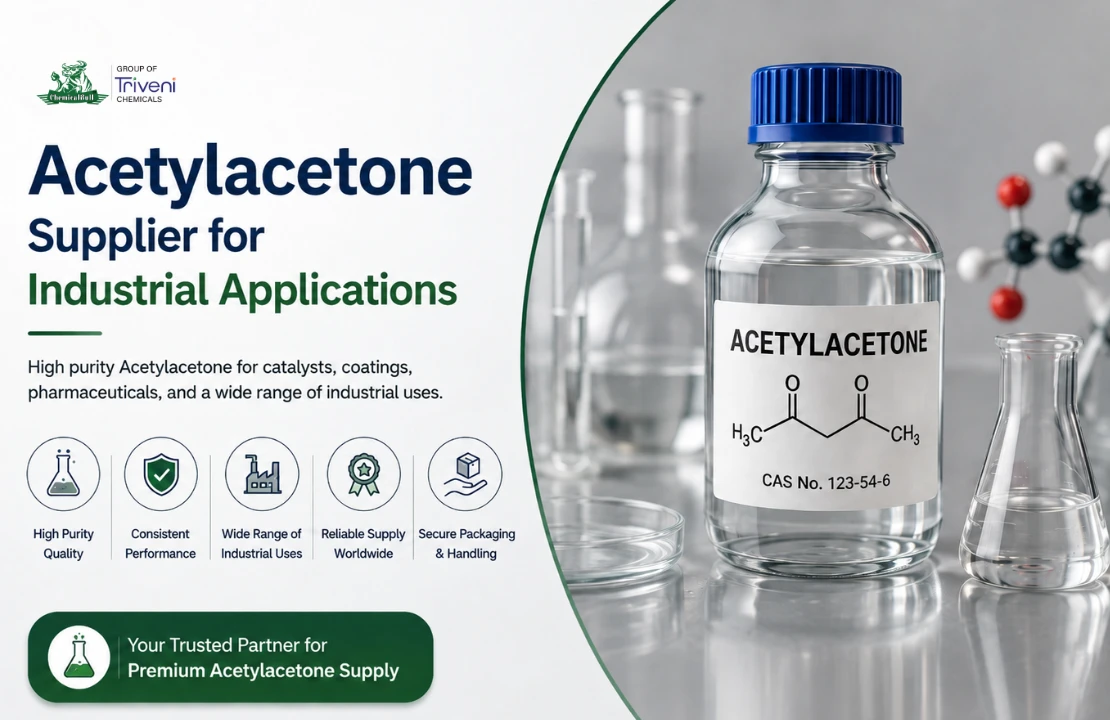
Acetylacetone, also known as 2,4-Pentanedione, is a β-diketone used as a chemical intermediate, chelating agent and solvent in various industrial and specialty chemical applications. Its ability to interact with metal ions makes it particularly useful for producing metal acetylacetonates and related specialty compounds.
For businesses looking for an Acetylacetone Supplier, ChemicalBull provides product information and commercial sourcing support based on industrial requirements.
Quick Answer: What Is Acetylacetone?
Acetylacetone is a β-diketone with the chemical formula C₅H₈O₂ and CAS No. 123-54-6. It is also known as 2,4-Pentanedione or pentane-2,4-dione and is used as a chemical intermediate, chelating agent and solvent in industrial applications.
Its keto-enol tautomerism and ability to coordinate with metal ions make it particularly useful in chemical synthesis and metal-complex production.
What Is Acetylacetone?
Acetylacetone is a β-diketone containing two carbonyl groups separated by a methylene group.
Its chemical structure gives it several useful characteristics, including the ability to participate in organic reactions and form coordination complexes with various metal ions.
One of its most important industrial uses is the production of metal acetylacetonates, which can be used in catalyst systems, specialty chemicals, chemical synthesis and materials-related applications.
Acetylacetone Technical Information
Property | Information |
Chemical Name | Acetylacetone |
IUPAC Name | Pentane-2,4-dione |
Other Name | 2,4-Pentanedione |
CAS Number | 123-54-6 |
Molecular Formula | C₅H₈O₂ |
Molecular Weight | 100.12 g/mol |
Chemical Class | β-Diketone |
Physical Form | Liquid |
Appearance | Colorless to pale yellow liquid |
Primary Industrial Roles | Chemical intermediate, chelating agent and solvent |
What Is Acetylacetone Used For?
Acetylacetone is used across several areas of industrial chemistry.
Common applications include:
- Chemical synthesis
- Specialty chemical manufacturing
- Metal acetylacetonate production
- Catalyst and catalyst-precursor systems
- Coatings and specialty materials
- Fine chemical synthesis
- Selected pharmaceutical and agrochemical intermediates
- Metal-processing applications
- Research and analytical chemistry
The exact application depends on the required grade, purity and manufacturing process.
Why Is Acetylacetone Important in Industrial Applications?
Acetylacetone has a useful combination of chemical reactivity and metal-chelating ability.
Its structure allows it to form acetylacetonate species that coordinate with metal ions. These metal complexes can have applications in catalyst systems, chemical synthesis and specialty material production.
This makes acetylacetone useful beyond its role as a conventional organic solvent.
Major Industrial Applications of Acetylacetone
1. Metal Acetylacetonate Production
A major application of acetylacetone is the preparation of metal acetylacetonates.
Depending on the metal, these compounds may be used in:
- Catalyst systems
- Chemical synthesis
- Specialty chemical manufacturing
- Materials chemistry
- Metal-organic precursor applications
The required acetylacetone specification depends on the downstream process and quality requirements.
2. Chemical Intermediate
Acetylacetone is used as a building block in organic and specialty chemical synthesis.
Its β-diketone structure allows it to participate in reactions used to produce various downstream compounds, including:
- Heterocyclic compounds
- Specialty intermediates
- Fine chemicals
- Metal-organic compounds
- Selected pharmaceutical intermediates
- Selected agrochemical intermediates
3. Catalyst and Catalyst-Precursor Applications
Acetylacetone is important in catalyst chemistry mainly through the production of metal acetylacetonates.
These metal complexes can function as catalyst components or precursors in selected chemical, polymer-related and materials processes.
The specific function depends on the metal complex and the manufacturing system.
4. Coatings and Specialty Materials
Acetylacetone and its derivatives may be used in selected coating and specialty material systems.
Its chemical properties can be relevant where metal coordination, chemical intermediates or controlled reactions are required.
The suitability of the material should be evaluated according to the specific formulation.
5. Fine Chemical Manufacturing
Fine chemical manufacturers can use acetylacetone as a starting material or intermediate in selected synthesis routes.
In these applications, purity and impurity control may be important because downstream processes can involve multiple reaction and purification stages.
6. Pharmaceutical and Agrochemical Intermediates
Acetylacetone can be used as a chemical building block in the synthesis of selected pharmaceutical and agrochemical intermediates.
It should be considered a starting material or intermediate, rather than a pharmaceutical active ingredient.
The required specification depends on the individual manufacturing process.
Acetylacetone Applications at a Glance
Industry | Typical Role |
Specialty Chemicals | Chemical intermediate |
Metal Chemicals | Metal-complex formation |
Catalyst Manufacturing | Raw material for metal acetylacetonates |
Coatings | Solvent or chemical intermediate in selected systems |
Fine Chemicals | Organic synthesis |
Pharmaceutical Chemicals | Selected intermediate synthesis |
Agrochemicals | Selected intermediate synthesis |
Materials Chemistry | Metal-organic precursor chemistry |
Research | Reagent and synthesis material |
How Does Acetylacetone Work as a Chelating Agent?
Acetylacetone can act as a bidentate chelating ligand.
Under suitable conditions, the hydrogen attached to the central methylene group can be removed, producing an acetylacetonate species. This ligand can coordinate with metal ions through its oxygen atoms and form a chelate structure.
A simplified representation is:
Metal Ion + Acetylacetone → Metal Acetylacetonate Complex
The structure and properties of the resulting complex depend on factors such as the metal ion and reaction conditions.
This chelating ability is one of the main reasons acetylacetone is used in metal-complex and catalyst-related chemistry.
Understanding Keto-Enol Tautomerism of Acetylacetone
Acetylacetone can exist in equilibrium between keto and enol forms.
The keto form contains carbonyl groups, while the enol form contains a hydroxyl group and carbon-carbon double bond.
This equilibrium contributes to the chemical behaviour of acetylacetone and helps explain its ability to coordinate with metal ions.
The proportion of keto and enol forms can vary depending on the surrounding environment, including the solvent and conditions.
What Grade of Acetylacetone Do Industrial Buyers Need?
The appropriate grade depends on the intended application.
Acetylacetone may be required for:
- Industrial chemical manufacturing
- Specialty chemical synthesis
- Metal-complex production
- Coatings
- Fine chemical synthesis
- Analytical applications
- Research
A manufacturer producing a metal complex may place greater importance on assay, moisture and impurity levels, while a research or analytical user may require a different specification.
The highest assay is not automatically the correct choice for every application. Buyers should select a specification that matches their actual process requirements.
Expert Insight: Why Assay Alone Is Not Enough
A high assay does not automatically mean that a raw material is suitable for every industrial process.
For acetylacetone applications involving metal-complex formation or sensitive chemical synthesis, buyers may also need to consider moisture, impurity levels and batch consistency.
Before regular procurement, manufacturers can evaluate the material under their actual process conditions and confirm that the agreed specification meets their requirements.
Acetylacetone Storage and Handling
Acetylacetone should be stored and handled according to the supplier's current Safety Data Sheet (SDS) and applicable workplace regulations.
General considerations include:
- Keep containers properly closed.
- Store in a suitable, well-ventilated area.
- Keep away from excessive heat and ignition sources.
- Use appropriate personal protective equipment.
- Follow applicable chemical handling and transportation requirements.
The exact storage and handling requirements should always be confirmed from the current SDS for the supplied product.
Why Choose ChemicalBull for Acetylacetone?
ChemicalBull supports industrial buyers looking for Acetylacetone by providing product information, commercial sourcing support and specification-based supply options.
Buyers can discuss:
- Required purity and specification
- Bulk quantity and packaging
- COA, SDS and technical documentation
- Delivery and recurring supply requirements
For Acetylacetone sourcing, ChemicalBull focuses on understanding the buyer's application, quantity and technical requirements before providing a commercial offer.
Acetylacetone Supplier in India
Businesses sourcing Acetylacetone in India should evaluate suppliers based on product specification, purity, documentation, packaging, availability, delivery capability and recurring supply requirements.
Because Acetylacetone can be offered in different grades and specifications, buyers should clearly communicate their intended application and technical requirements before placing a commercial order.
Buying Acetylacetone in Bulk
Industrial buyers may require acetylacetone for regular manufacturing, specialty chemical production, metal-complex synthesis, contract manufacturing or large-volume processing.
When requesting a bulk quotation, buyers should provide:
- Required quantity
- Purity or specification
- Intended application or grade
- Packaging requirement
- Delivery location
- Required documentation
- Preferred delivery schedule
Providing these details helps suppliers prepare a quotation based on the actual purchasing requirement.
Frequently Asked Questions About Acetylacetone
What is Acetylacetone used for?
Acetylacetone is used as a chemical intermediate, chelating agent and solvent in specialty chemical manufacturing, metal-complex production, catalyst-related applications, coatings, fine chemical synthesis and selected pharmaceutical and agrochemical processes.What is the CAS number and chemical formula of Acetylacetone?
Acetylacetone, also known as 2,4-Pentanedione, has the CAS number 123-54-6, molecular formula C₅H₈O₂, and molecular weight 100.12 g/mol.Why is Acetylacetone used as a chelating agent?
Acetylacetone can form an acetylacetonate ligand that coordinates with metal ions through its oxygen atoms. This property makes it useful for producing metal acetylacetonates used in catalyst, chemical synthesis and materials applications.What industries use Acetylacetone?
Acetylacetone is used in specialty chemicals, chemical manufacturing, catalyst production, coatings, fine chemicals, metal-complex manufacturing, selected pharmaceutical and agrochemical synthesis, and materials chemistry.What should I consider when choosing an Acetylacetone Supplier?
Industrial buyers should evaluate purity, specification, impurity limits, COA, SDS, packaging, batch consistency, supply capacity and delivery requirements. The specification should match the intended manufacturing application.
Conclusion
Acetylacetone, also known as 2,4-Pentanedione (CAS No. 123-54-6), is a versatile β-diketone used in chemical synthesis, metal-complex production, specialty chemicals, selected coating applications and other industrial processes.
Its ability to form metal acetylacetonates is one of its most important industrial characteristics, while its chemical reactivity also makes it useful as an intermediate in various synthesis routes.
For industrial procurement, buyers should evaluate purity, impurity profile, documentation, packaging, batch consistency and application requirements rather than considering price alone.
Businesses looking for an Acetylacetone Supplier can explore Acetylacetone for product information and commercial sourcing enquiries.

Comment Section