Chemical Bull
50
18-Aug-2026
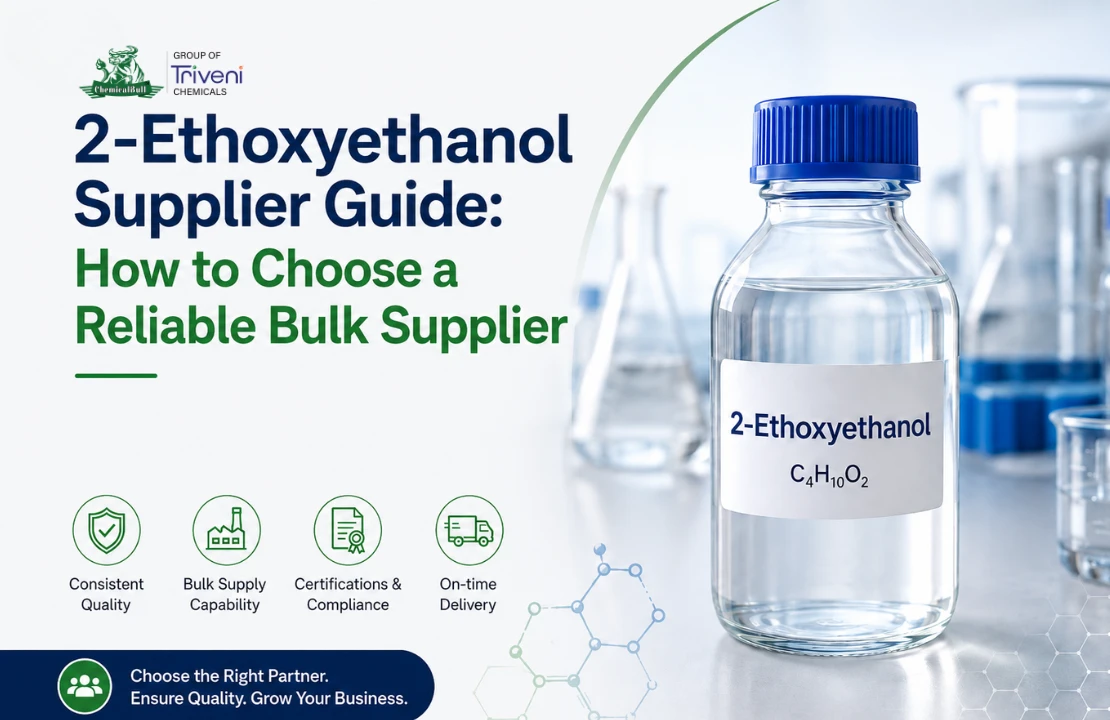
2-Ethoxyethanol Supplier Guide: How to Choose a Reliable Bulk Supplier
2-Ethoxyethanol (CAS No. 110-80-5) is a glycol ether solvent used in selected coatings, printing inks, cleaning formulations, and chemical-processing applications. When sourcing it in bulk, buyers should evaluate product specifications, purity, documentation, packaging, availability, and supplier reliability rather than price alone.
2-Ethoxyethanol is also known as Ethyl Cellosolve or Ethylene Glycol Monoethyl Ether. Its combination of an ether group and an alcohol group gives it useful solvency characteristics for selected industrial formulations and processes.
For commercial procurement, buyers should confirm the exact chemical identity, required specification, documentation, packaging, quantity, delivery requirements, and applicable regulatory considerations before placing an order.
This guide explains what 2-Ethoxyethanol is, its properties and applications, quality requirements, safety considerations, and the key factors to consider when selecting a bulk supplier.
Quick Answer: How Do You Choose a 2-Ethoxyethanol Supplier?
A reliable 2-Ethoxyethanol supplier should be able to provide the correct CAS No. 110-80-5, agreed product specifications, batch-specific CoA, current SDS, suitable packaging, reliable availability, and clear delivery terms.
Buyers should also confirm that the product is suitable for the intended application and destination-market requirements.
Key factors to check:
- Chemical identity and CAS number
- Purity and product specification
- CoA and SDS
- Batch traceability
- Packaging
- Availability and lead time
- Export documentation
- Technical and commercial support
What Is 2-Ethoxyethanol?
2-Ethoxyethanol is an organic solvent belonging to the glycol ether family. Its molecular structure contains both an ether group and an alcohol group, giving it solvency characteristics that can be useful with water and various organic materials.
The chemical is commonly known by several names:
- 2-Ethoxyethanol
- Ethyl Cellosolve
- Ethylene Glycol Monoethyl Ether
- 2-Ethoxyethyl Alcohol
2-Ethoxyethanol Chemical Properties
|
Property |
Information |
|
Chemical Name |
2-Ethoxyethanol |
|
CAS Number |
110-80-5 |
|
Chemical Formula |
C₄H₁₀O₂ |
|
Molecular Weight |
90.12 g/mol |
|
Chemical Family |
Glycol Ether |
|
Physical State |
Liquid |
|
Appearance |
Clear, colorless liquid |
|
Water Solubility |
Miscible |
|
Common Synonyms |
Ethyl Cellosolve, Ethylene Glycol Monoethyl Ether |
|
Primary Function |
Solvent |
Physical and Chemical Characteristics of 2-Ethoxyethanol
2-Ethoxyethanol is a clear, colorless liquid with a characteristic solvent odor. Its molecular structure provides both hydrophilic and organic-solvent characteristics, making it useful in selected formulations where compatibility with different components is required.
Its behavior in a formulation depends on factors such as:
- Concentration
- Temperature
- Resin or polymer chemistry
- Solvent combinations
- Evaporation requirements
- Finished-product composition
For this reason, 2-Ethoxyethanol should be evaluated according to the specific formulation or industrial process rather than selected only because of its general solvent properties.
What Is 2-Ethoxyethanol Used For?
2-Ethoxyethanol is used in selected industrial applications where its solvent characteristics meet the requirements of the formulation or process.
Coatings and Paint Formulations
2-Ethoxyethanol can function as a solvent or co-solvent in certain coating systems. It may assist in dissolving or incorporating selected resins and formulation components.
Its suitability depends on the resin system, formulation composition, application method, drying conditions, and regulatory requirements for the finished product.
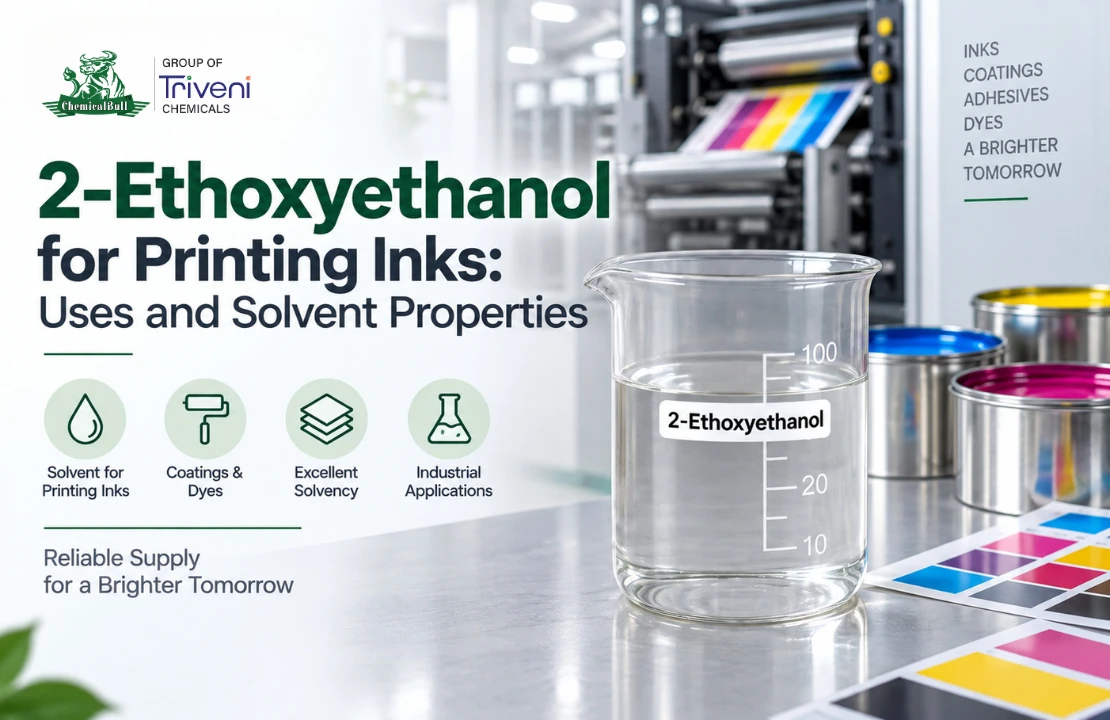
Printing Inks
2-Ethoxyethanol may be used in selected printing-ink formulations where its solvency and evaporation characteristics are appropriate.
Ink manufacturers should consider the printing process, substrate, drying conditions, resin system, and overall solvent blend when evaluating its suitability.
Industrial Cleaning Formulations
The solvent properties of 2-Ethoxyethanol can make it useful in selected industrial cleaning and degreasing formulations.
Cleaning performance depends on factors such as the contaminant, surface material, concentration, temperature, contact time, and other formulation ingredients.
Chemical Processing
2-Ethoxyethanol may also be used as a solvent or processing component in selected chemical manufacturing and synthesis applications.
Its suitability depends on the specific process, reaction conditions, materials involved, and required product specifications.
What Industries Use 2-Ethoxyethanol?
Because of its solvent characteristics, 2-Ethoxyethanol can be relevant to several industrial sectors. Its actual use depends on the formulation, process requirements, and regulations applicable to the intended application.
Coatings and Paint Industry
Manufacturers of selected coatings, paints, lacquers, and related formulations may evaluate glycol ether solvents for their solvency and formulation performance.
Printing and Ink Industry
Printing-ink manufacturers may use suitable glycol ether solvents where solvent compatibility, drying behavior, and substrate requirements need to be balanced.
Industrial Cleaning Industry
Industrial and institutional cleaning formulations may use glycol ether solvents where their solvency characteristics are appropriate for removing selected oils, residues, or contaminants.
Chemical Manufacturing
Chemical manufacturers may use 2-Ethoxyethanol as a solvent or processing component in selected production processes.
The presence of a chemical in an industry does not automatically mean that it is suitable for every product within that industry. Technical testing and regulatory review remain important before commercial use.
Advantages of 2-Ethoxyethanol
When appropriate for the intended application, 2-Ethoxyethanol can provide useful solvent characteristics.
Potential advantages include:
- Good solvency for selected organic materials
- Compatibility with water and various organic components
- Usefulness as a glycol ether solvent
- Application potential in selected coating formulations
- Application potential in selected ink and cleaning systems
- Use in certain chemical-processing applications
Limitations of 2-Ethoxyethanol
2-Ethoxyethanol is not suitable for every solvent application. Before selecting it, formulators and industrial users should consider:
- Health and occupational hazards
- Applicable regulatory requirements
- Solvent evaporation characteristics
- Resin and polymer compatibility
- Surface compatibility
- Required solvent strength
- Workplace exposure controls
- Storage and transportation requirements
Where a different safety, environmental, or performance profile is required, another solvent may be considered. Any substitution should be evaluated through appropriate technical testing.
Safety and Health Considerations
2-Ethoxyethanol has recognized health hazards, including reproductive-toxicity concerns. Its hazard classification, labeling requirements, occupational controls, and regulatory status can vary depending on jurisdiction and intended use.
Anyone handling the chemical should review the supplier's current Safety Data Sheet (SDS) before use.
Appropriate workplace controls may include:
- Adequate ventilation
- Minimizing unnecessary exposure
- Appropriate personal protective equipment
- Proper chemical labeling
- Suitable storage arrangements
- Appropriate spill-response procedures
- Workplace exposure controls where applicable
The current SDS should be used as the primary reference for detailed handling, storage, emergency-response, and exposure-control information.
Quality and Purity of 2-Ethoxyethanol
Quality consistency is important when 2-Ethoxyethanol is used repeatedly in manufacturing.
Buyers should evaluate the supplier's product specification and confirm the quality parameters relevant to their application. Depending on the specification, these may include:
- Assay or purity
- Water content
- Color
- Acidity
- Density or specific gravity
- Relevant impurities
- Batch or lot number
The exact parameters should be agreed between the buyer and supplier before commercial supply.
A supplier's Certificate of Analysis should be reviewed against the agreed product specification rather than relying only on a general statement such as "high purity."
How to Choose a Reliable 2-Ethoxyethanol Supplier
Selecting a supplier should involve several factors rather than price alone.
Product Identity
Confirm the chemical name, CAS number, grade, and required specification.
Product Quality
Review the product specification and applicable CoA to ensure the material meets the requirements of your application.
Documentation
Confirm that the supplier can provide the required SDS, CoA, and other applicable commercial or shipping documents.
Batch Traceability
Ask whether the supplied material can be traced to its relevant batch or lot documentation.
Packaging
Confirm that the supplier can provide packaging suitable for the quantity, storage system, and transportation method.
Availability and Lead Time
Discuss product availability and expected lead time before placing an order, particularly when the chemical is required for continuous manufacturing.
Export Support
For international procurement, confirm whether the supplier can provide the documents required for the destination market and shipment.
Communication
A professional chemical supplier should respond clearly to technical, documentation, and commercial questions.
What Should Buyers Check Before Purchasing 2-Ethoxyethanol?
Before placing a first or repeat order, buyers should verify that the product and supply arrangement meet their technical and commercial requirements.
Important points to check include:
- Correct chemical name and CAS No. 110-80-5
- Required purity or product specification
- Current Certificate of Analysis
- Current Safety Data Sheet
- Batch or lot traceability
- Suitable packaging
- Required order quantity
- Product availability
- Expected lead time
- Delivery location and terms
- Applicable transport requirements
- Destination-country regulatory requirements for exports
Why Choose ChemicalBull for 2-Ethoxyethanol?
ChemicalBull supports industrial buyers sourcing 2-Ethoxyethanol for bulk requirements. Buyers can share their required specification, quantity, packaging, destination, and documentation requirements to discuss suitable supply options.
For buyers evaluating a 2-Ethoxyethanol Supplier, the product page provides a convenient starting point for reviewing product information and submitting a specific sourcing requirement.
Before confirming an order, buyers should verify the current product specification, SDS, CoA, availability, packaging, delivery terms, and other applicable commercial details.
Related Glycol Ether Solvents
Depending on formulation requirements, buyers may also evaluate other glycol ether solvents. These products have different chemical structures and performance characteristics, so they should not automatically be treated as direct substitutes for 2-Ethoxyethanol.
Relevant products include:
- 2-Butoxyethyl Acetate — CAS No. 112-07-2
- Diethylene Glycol Monoethyl Ether — CAS No. 111-90-0
- Propylene Glycol Monomethyl Ether — CAS No. 107-98-2
When considering an alternative solvent, formulators should evaluate solvency, evaporation behavior, formulation compatibility, safety requirements, regulatory considerations, and final-product performance.
Frequently Asked Questions
-
What is 2-Ethoxyethanol?
2-Ethoxyethanol is a glycol ether solvent with the formula C₄H₁₀O₂ and CAS No. 110-80-5. It is also known as Ethyl Cellosolve. -
What is 2-Ethoxyethanol used for?
It is used in selected applications including coatings, printing inks, industrial cleaning formulations, and chemical processing. -
What is the CAS number of 2-Ethoxyethanol?
The CAS number of 2-Ethoxyethanol is 110-80-5. -
What is the molecular weight of 2-Ethoxyethanol?
The molecular weight of 2-Ethoxyethanol is approximately 90.12 g/mol. -
Is 2-Ethoxyethanol hazardous?
Yes. It has recognized health hazards, including reproductive-toxicity concerns. Users should review the current SDS and applicable regulations before handling it.
Conclusion
2-Ethoxyethanol is a glycol ether solvent used in selected industrial applications such as coatings, inks, cleaning formulations, and chemical processing. Buyers should evaluate product quality, documentation, safety, packaging, availability, and supplier reliability before purchasing.
For bulk sourcing, ChemicalBull provides product information and supply support based on the buyer's specific requirements.

Comment Section