Chemical Bull
166
30-Jul-2026
2-(2-Methoxyethoxy) Ethanol For Industrial Applications
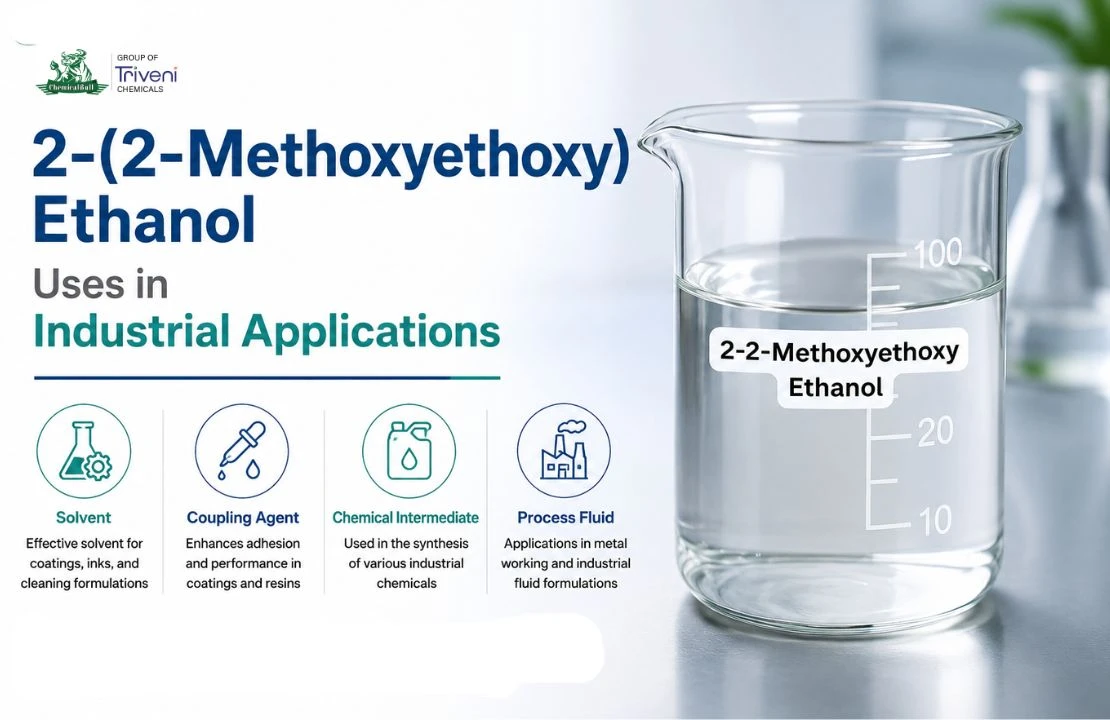
2-(2-Methoxyethoxy) Ethanol (Diethylene Glycol Monomethyl Ether, DEGME, CAS 111-77-3) is a glycol ether solvent used in paints, inks, industrial cleaners, and brake fluid formulations. ChemicalBull is a bulk 2-(2-Methoxyethoxy) Ethanol supplier for coatings, ink, and industrial formulation manufacturers.
Its high boiling point and slow evaporation rate make it a practical choice where formulators need extended open time or strong solvency without rapid solvent loss. Looking for 2-(2-Methoxyethoxy) Ethanol for your formulation? Contact ChemicalBull for a quote today.
Quick Answer
2-(2-Methoxyethoxy) Ethanol, commonly known as Diethylene Glycol Monomethyl Ether (DEGME), is used as a solvent and coupling agent in industrial paints, coatings, printing inks, cleaning formulations, and brake fluid. Its high boiling point (~194°C) and slow evaporation rate give it extended open time in coating applications, while its full water miscibility and strong solvency for both polar and moderately non-polar compounds make it effective as a coupling agent in aqueous industrial formulations.
2-(2-Methoxyethoxy) Ethanol Uses
What is 2-(2-Methoxyethoxy) Ethanol used for? It functions primarily as a solvent and coupling agent across several industrial sectors:
- Paints and coatings — coalescing and coupling solvent for extended open time
- Printing inks — solvent component in flexographic and gravure ink formulations
- Industrial and household cleaning formulations — solvency and coupling agent for degreasers
- Brake fluid — component in DOT 3 and DOT 4 hydraulic brake fluid formulations
- Textile dyeing — carrier/solvent auxiliary in dyeing processes
- De-icing fluids — component in aircraft and runway de-icing formulations
Role of 2-(2-Methoxyethoxy) Ethanol in Industrial Formulations
DEGME sits in a specific niche among glycol ether solvents: heavier and slower-evaporating than lighter grades like ethylene glycol monomethyl ether, but still fully water-miscible and effective at dissolving a broad range of resins, dyes, and additives. This combination — high boiling point plus strong solvency plus water miscibility — is why it shows up in such different formulations, from a printing ink that needs extended open time on press, to a brake fluid that needs a high boiling point for safety, to a cleaning formulation that needs a coupling agent to keep ingredients from separating.
What Is 2-(2-Methoxyethoxy) Ethanol?
2-(2-Methoxyethoxy) Ethanol is a diethylene glycol ether, structurally featuring a methyl ether group at one end and a free hydroxyl group at the other, connected through two ether linkages derived from diethylene glycol. This structure gives it both water solubility and useful organic solvency, placing it firmly in the "coupling solvent" category of industrial chemistry.
Why Is 2-(2-Methoxyethoxy) Ethanol Used in Formulations?
- High boiling point — around 194°C, giving it a slow evaporation rate suited to extended open-time applications.
- Broad solvency — dissolves a wide range of resins, dyes, and oils across different formulation types.
- Full water miscibility — functions effectively as a coupling agent in aqueous formulations.
2-(2-Methoxyethoxy) Ethanol Technical Specifications
|
Property |
Typical Value |
|
CAS Number |
111-77-3 |
|
Chemical Formula |
C5H12O3 |
|
Molecular Weight |
120.15 g/mol |
|
Appearance |
Colorless liquid |
|
Boiling Point |
~194°C |
|
Flash Point (closed cup) |
~96°C |
|
Density (20°C) |
~1.021 g/cm³ |
|
Viscosity (20°C) |
~3.5 cP |
|
Water Solubility |
Fully miscible |
|
Purity (typical commercial grade) |
≥99% |
How Is 2-(2-Methoxyethoxy) Ethanol Manufactured?
DEGME is produced by reacting diethylene glycol with methanol, or alternatively through the reaction of 2-methoxyethanol with ethylene oxide. Both processes are controlled to minimize residual free glycol and unreacted starting materials, since these impurities affect odor and performance consistency.
Reputable manufacturers verify purity and water content on every batch, since even small amounts of residual moisture or unreacted methanol can shift evaporation rate and flash point — critical in flash-point-sensitive applications like brake fluid.
Safety, Handling, and Storage Guidelines
- Storage — tightly sealed containers, away from heat sources and open flame (flash point ~96°C).
- Ventilation — well-ventilated areas or local exhaust ventilation during processing.
- Material compatibility — compatible with stainless steel, HDPE; verify for extended bulk storage.
- Shelf life — properly sealed DEGME typically maintains stable specs for 1–2 years.
Applications in Industrial Formulations
1. Paints, Coatings, and Printing Inks
How Does DEGME Work as a Coating and Ink Solvent? Its slow evaporation keeps film or ink wet on the substrate or press longer, giving more working time — valuable in gravure and flexographic printing.
2. Industrial and Household Cleaning Formulations
coupling agent for surfactants, fragrances, and partially water-soluble ingredients.
3. Brake Fluid
component in DOT 3 and DOT 4 formulations; high boiling point contributes to the fluid's overall boiling point safety spec.
4. Textile Dyeing
solvent/carrier auxiliary helping dyes dissolve and penetrate fibers evenly.
5. De-Icing Fluids
contributes freeze-point depression and solvency in aircraft/runway de-icing formulations.
Typical DEGME Usage Levels by Application
|
Application |
Typical Usage Level (wt%) |
Primary Function |
|
Printing inks |
5–20% |
Extended open time, solvency |
|
Industrial cleaning formulations |
2–10% |
Coupling agent |
|
Brake fluid |
20–50% |
Boiling point contribution, solvency |
|
Textile dyeing auxiliaries |
1–5% |
Dye carrier/solvent |
|
De-icing fluids |
10–40% |
Freeze-point depression, solvency |
Advantages of 2-(2-Methoxyethoxy) Ethanol in Formulation
- High boiling point — supports extended open time and high-temperature performance
- Broad solvency across resins, dyes, and oils
- Full water miscibility — reliable coupling agent
- Low volatility loss during extended processing
- Established industrial track record across coatings, inks, brake fluid
- Compatible with a broad range of resin/additive systems
Formulator's Note: Best Practices for Handling and Stability
A detail experienced formulators watch for: DEGME is hygroscopic, and even small increases in water content can noticeably shift boiling point and evaporation behavior — a real concern in brake fluid formulations where boiling point is a direct safety parameter. Keeping containers tightly sealed directly protects this safety-critical spec.
A second point for ink and coating formulators: DEGME's slow evaporation extends open time but can also extend total drying time more than expected in cooler or humid environments. Blending with a faster-evaporating co-solvent balances open time against overall dry time, rather than relying on DEGME alone.
Difference Between 2-(2-Methoxyethoxy) Ethanol and Diethylene Glycol Monobutyl Ether?
Both are diethylene glycol ethers, but DEGME has a methyl terminal group while DEGBE has a butyl group — DEGME leans toward stronger water miscibility (brake fluid, coupling), DEGBE leans toward stronger organic solvency (latex paint coalescent). See our Diethylene Glycol Monobutyl Ether Applications in Latex Paints and Coatings guide.
2-(2-Methoxyethoxy) Ethanol vs. Other Glycol Ether Solvents
|
Solvent |
Terminal Group |
Boiling Point |
Typical Use Case |
|
Butyl |
~231°C |
Latex paint coalescent |
|
|
DPM |
Methyl (propylene-based) |
~190°C |
Low-VOC coatings, cleaners |
|
EGBE |
Butyl |
~171°C |
General-purpose coupling agent |
FAQ
-
What is 2-(2-Methoxyethoxy) Ethanol used for?
Solvent/coupling agent in paints, coatings, inks, cleaning formulations, brake fluid, and textile dyeing. -
CAS number?
111-77-3. -
Same as DEGME?
Yes, IUPAC name for Diethylene Glycol Monomethyl Ether. -
DEGME vs DEGBE?
Methyl vs butyl terminal group — water miscibility vs organic solvency strength. -
Water-soluble?
Yes, fully miscible.
Conclusion
DEGME (2-(2-Methoxyethoxy) Ethanol) is a reliable industrial solvent that stays liquid longer, dissolves a wide range of ingredients, and mixes fully with water — which is why it's used in printing inks that need time to dry properly, brake fluid that needs a high boiling point to stay safe under heat, and cleaning products that need everything to mix evenly. If you're formulating paints, inks, brake fluid, or cleaners, DEGME is worth considering whenever you need a solvent that works slowly and reliably instead of evaporating too fast; compared to DEGBE, DEGME mixes better with water while DEGBE dissolves oils and resins more strongly, so the right choice depends on what your formulation needs most.
Comment Section