Chemical Bull
104
25-Sep-2026
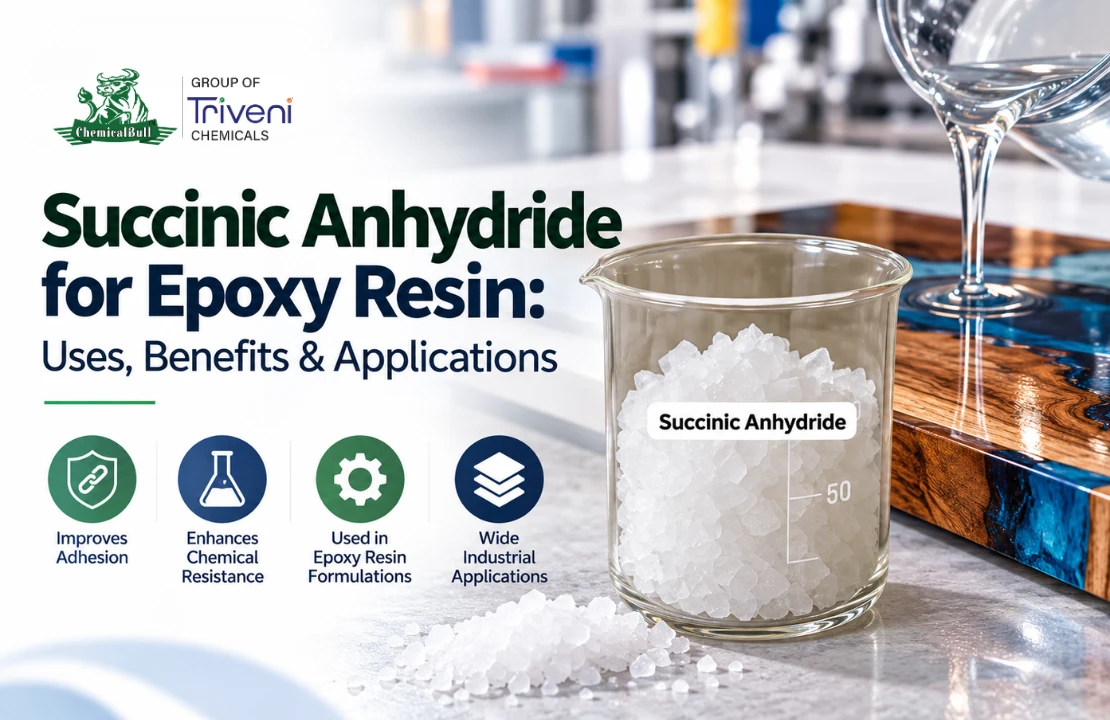
Succinic anhydride is used as a curing agent in selected epoxy resin formulations. It helps form the cured resin network used in industrial materials. U.S. resin manufacturers and formulators can evaluate it for coatings, adhesives, casting resins and electrical applications. The result depends on the epoxy resin, formulation and curing conditions.
Chemical Bull is a succinic anhydride supplier for U.S. epoxy resin manufacturers and industrial buyers. Share your required specification, quantity, application and delivery location to request a bulk quote.
What Is Succinic Anhydride?
Succinic anhydride is a cyclic acid anhydride with CAS number 108-30-5 and molecular formula C₄H₄O₃. It is supplied as a solid and used in chemical synthesis and polymer production. Its reactive anhydride group makes it useful in certain epoxy curing systems.
Buyers should identify the exact anhydride required. Succinic anhydride is not the same chemical as dodecenyl succinic anhydride (DDSA) or other modified succinic anhydrides. A formulation developed with one curing agent should not be switched to another without testing.
How Does Succinic Anhydride Work in Epoxy Resin?
An epoxy resin needs a suitable curing system to develop its final properties. In an anhydride-cured formulation, reactions involving the anhydride and epoxy groups create ester linkages in the cured network.
The formulator sets the resin-to-anhydride ratio and evaluates the mixing method, any catalyst and the curing schedule. These choices affect how fully the resin cures and how the finished part performs. Studies of succinic anhydride–epoxy systems have examined how resin type and catalysts affect curing behavior.
Because succinic anhydride is a solid, the production team should also confirm how it will be incorporated into the resin. A successful laboratory formulation needs to remain practical at the intended manufacturing scale.
Benefits for Epoxy Formulators
An Alternative Anhydride Curing Route
Succinic anhydride gives resin developers an anhydride curing option to assess against their application requirements. It can be evaluated where the target is a cured epoxy material with a defined combination of processing and finished-part properties.
Control Through Formulation Testing
The resin, component ratio and cure conditions determine properties such as hardness, adhesion, thermal response and electrical behavior. Formulators can adjust and test these variables against their own performance targets. Succinic anhydride does not guarantee the same benefit in every epoxy formulation.
Use in Modified Polymer Development
Succinic anhydride can also be used to introduce succinyl functionality into materials being developed for polymer applications. Buyers using it for synthesis should specify the requirements of that process separately from those of an epoxy curing trial.
Industrial Applications of Succinic Anhydride in Epoxy Systems
Electrical and Electronic Components
Epoxy resins are used to encapsulate and protect electrical components. An anhydride curing system can be evaluated where insulation performance is part of the design requirement. The finished formulation must be tested for the electrical, thermal and processing conditions of the actual component.
Industrial Coatings
Coating formulators can evaluate succinic anhydride in epoxy systems developed for surface protection. Relevant tests may include adhesion, hardness and resistance to the chemicals or conditions the coating will encounter in service.
Adhesives
Epoxy adhesives are selected for particular substrates, joint designs and operating conditions. Succinic anhydride can be assessed as a curing component during adhesive development. Formulators should test both working behavior during application and the strength of the finished bond.
Casting Resins
Casting requires a formulation that can be mixed, placed and cured under the manufacturer’s production conditions. When assessing succinic anhydride for an epoxy casting resin, teams should check processing behavior and the properties of the cured component.
These are formulation applications, not a claim that one succinic anhydride grade is suitable for every coating, adhesive or electrical product.
What Should U.S. Epoxy Manufacturers Check Before Buying?
Start with the succinic anhydride specification approved for your formulation. For a development project, share the epoxy resin being evaluated and whether the order is for trials or regular production. For an established process, provide the acceptance limits used by your quality team.
A complete bulk enquiry should include the required purity or specification, order quantity, preferred packaging, U.S. delivery location and any documentation your plant needs. Request the Certificate of Analysis (COA) and Safety Data Sheet (SDS) for the material offered.
Before production approval, confirm that the proposed material works in your own mixing and cure process. Compare the finished epoxy against your requirements rather than judging the curing agent by its name or purity alone.
Bulk Succinic Anhydride Supply for the USA
Chemical Bull supports U.S. manufacturers, resin formulators and procurement teams sourcing succinic anhydride for industrial requirements. Send your specification, expected quantity and destination so our team can review the material and supply details for your project.
Request a succinic anhydride quote for your epoxy resin application.
Frequently Asked Questions
1. Is succinic anhydride an epoxy resin curing agent?
Yes. Succinic anhydride is used as a curing agent in selected epoxy resin systems. The formulator must establish the suitable component ratio and curing conditions through testing.
2. What is the CAS number of succinic anhydride?
The CAS number of succinic anhydride is 108-30-5. Include it in your enquiry to distinguish the product from other succinic anhydride derivatives.
3. Is succinic anhydride the same as DDSA?
No. Dodecenyl succinic anhydride (DDSA) is a different, substituted anhydride. The two should not be treated as direct replacements without formulation testing.
4. Can succinic anhydride be used in epoxy coatings and adhesives?
It can be evaluated as part of epoxy formulations for coatings and adhesives. Suitability depends on the resin, cure process and performance required from the finished product.
5. What should I provide for a bulk quote in the USA?
Send your required specification, quantity, intended application, packaging preference and U.S. delivery location. Ask for the COA and SDS covering the material quoted.
Comment Section



