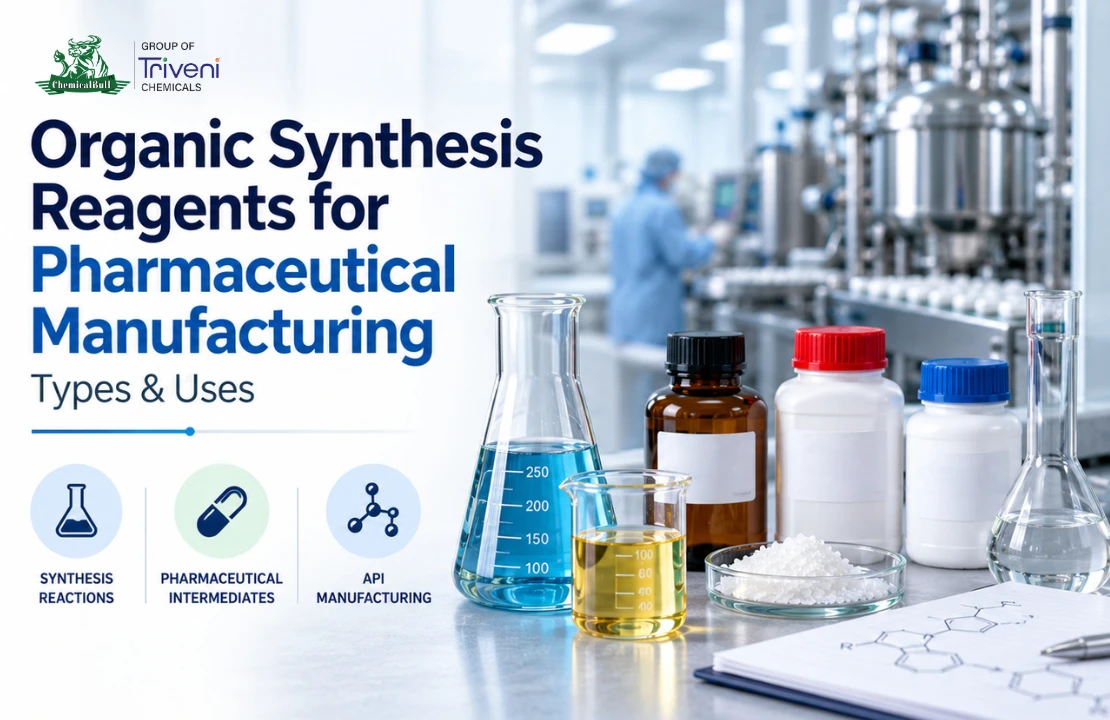
Organic Synthesis Reagents for Pharmaceutical Manufacturing: Types & Uses
Organic synthesis reagents are the working tools behind many pharmaceutical synthesis steps. They help chemists build, modify and transform molecules during the production of pharmaceutical intermediates and active pharmaceutical ingredients, supporting reactions such as reduction, acylation, alkylation, chlorination, functional-group protection and carbon-chain construction.
For pharmaceutical manufacturers, fine chemical companies and R&D teams, selecting the right reagent can influence reaction selectivity, yield, impurity profile and process consistency. This guide covers the major reagent types, common examples and their role in commercial pharmaceutical manufacturing. Buyers looking for a reliable organic synthesis reagent supplier can also explore sourcing options for industrial and pharmaceutical synthesis requirements.
What Are Organic Synthesis Reagents?
Organic synthesis reagents are chemicals used to carry out specific transformations in organic molecules. They can add, remove or modify functional groups and help convert one intermediate into another during multi-step synthesis.
In pharmaceutical manufacturing, these reagents are selected according to the target molecule, reaction pathway, required purity, process conditions and production scale.
Why Organic Synthesis Reagents Are Important in Pharmaceutical Manufacturing
Most pharmaceutical molecules are not produced in a single reaction. They are built through several controlled synthesis stages.
At different stages, manufacturers may need to reduce a functional group, introduce an acyl group, protect a reactive site, form a carbon-carbon bond or create a new intermediate. Organic synthesis reagents make these transformations possible.
Their selection can influence:
- reaction efficiency and selectivity
- impurity profile
- downstream purification
- batch consistency
- production cost
- scale-up performance
For commercial production, reagent quality becomes especially important because the same reaction may need to be repeated across multiple manufacturing batches.
Main Types of Organic Synthesis Reagents Used in Pharmaceuticals
Reducing Reagents
Reducing reagents are used to convert functional groups into a more reduced form during organic synthesis.
Sodium Borohydride is a widely used reducing reagent for selected carbonyl reductions and other controlled transformations. It is commonly valued for its relatively selective reducing behavior in suitable pharmaceutical and fine chemical synthesis routes.
Reducing reagents are selected according to the functional group, required selectivity and reaction conditions.
Chlorinating and Activating Reagents
Some synthesis routes require conversion of functional groups into more reactive derivatives before the next manufacturing step.
Thionyl Chloride is commonly used as a chlorinating and activating reagent in organic synthesis. It can be used in selected processes to convert carboxylic acids to acid chlorides and alcohols to alkyl chlorides.
Such activation steps are useful when preparing intermediates for further substitution, coupling or acylation reactions.
Strong Bases and Alkoxide Reagents
Strong bases are important in reactions where deprotonation, condensation, elimination or other base-driven transformations are required.
Sodium Ethoxide is an alkoxide base used in selected condensation, alkylation and organic synthesis processes.
Potassium tert-Butoxide is a strong base commonly selected for reactions where strong deprotonation or elimination conditions are required.
The choice between different bases depends on reaction selectivity, solvent system, substrate and required transformation.
Protecting-Group Reagents
During multi-step pharmaceutical synthesis, one reactive functional group may need to be temporarily protected while another part of the molecule is modified.
Benzyl Chloroformate is commonly used as a protecting-group reagent, particularly for introducing the Cbz protecting group in selected amine-containing molecules.
Protecting-group chemistry helps manufacturers control reaction pathways and reduce unwanted side reactions during complex synthesis.
Acylating Reagents
Acylating reagents are used to introduce acyl groups into target molecules and are important in the formation of esters, amides and other derivatives.
Propionyl Chloride is an example of an acylating reagent used in selected organic and pharmaceutical intermediate synthesis processes.
Its application depends on the required target structure, reaction conditions and downstream product specification.
Carbon-Building Intermediates in Pharmaceutical Synthesis
Some materials are used less as direct transformation reagents and more as reactive intermediates or building blocks for constructing complex molecules.
Ethyl Cyanoacetate
Ethyl Cyanoacetate is a versatile organic synthesis intermediate containing both nitrile and ester functionality.
It is used in selected condensation, heterocyclic and carbon-chain construction reactions, making it useful in pharmaceutical, agrochemical and fine chemical synthesis.
Malononitrile
Malononitrile is a reactive intermediate containing two nitrile groups.
It is widely used in selected carbon-carbon bond formation and heterocyclic synthesis reactions. Its high reactivity makes it useful in routes where complex molecular frameworks need to be developed.
Methyl Acetoacetate
Methyl Acetoacetate is a beta-keto ester used as a building block in organic synthesis.
It can participate in condensation, alkylation and other carbon-building reactions, making it relevant to pharmaceutical intermediate and specialty chemical manufacturing.
Quick Reference: Common Organic Synthesis Reagents
|
Chemical |
Main Role in Synthesis |
Typical Function |
|
Sodium Borohydride |
Reducing reagent |
Reduction of selected functional groups |
|
Thionyl Chloride |
Chlorinating / activating reagent |
Formation of reactive chloride derivatives |
|
Sodium Ethoxide |
Alkoxide base |
Condensation and base-driven reactions |
|
Potassium tert-Butoxide |
Strong base |
Deprotonation and elimination reactions |
|
Benzyl Chloroformate |
Protecting-group reagent |
Protection of selected amine groups |
|
Propionyl Chloride |
Acylating reagent |
Introduction of propionyl groups |
|
Ethyl Cyanoacetate |
Reactive intermediate |
Carbon-building and heterocyclic synthesis |
|
Malononitrile |
Reactive intermediate |
Carbon-carbon bond and heterocycle formation |
|
Methyl Acetoacetate |
Beta-keto ester intermediate |
Condensation and alkylation reactions |
Role of Reagents in Pharmaceutical Intermediate Manufacturing
Pharmaceutical intermediates are compounds produced between the starting material and the final active pharmaceutical ingredient.
Organic synthesis reagents are used throughout these intermediate stages. For example, one reaction may require reduction, another may need a protecting group, while a later step may involve acylation or carbon-chain construction.
This step-by-step approach allows manufacturers to build more complex molecules while controlling selectivity and impurity formation.
For a broader overview of starting materials, intermediates, excipients and related manufacturing inputs, read our guide on pharmaceutical raw materials: types, uses and applications.
Laboratory, Pilot and Commercial-Scale Use
Organic synthesis reagents are used at different stages of pharmaceutical development and production.
At laboratory scale, they support reaction development and route optimization. At pilot scale, manufacturers study process behavior, purification and scalability. Once a process moves into commercial production, some reagents can be required in much larger quantities for repeated batch manufacturing.
The actual consumption depends on reaction stoichiometry, batch size, synthesis route and production volume.
Factors That Affect Reagent Selection
A reagent should not be selected only because it can perform the required reaction.
Manufacturers also evaluate:
Selectivity: The reagent should favor the intended transformation and minimize side reactions.
Purity: Reagent quality can influence impurities and downstream purification.
Reaction conditions: Temperature, solvent, pH, pressure and reaction time can affect performance.
Scale-up suitability: Laboratory chemistry must remain controllable and practical when transferred to commercial production.
Safety and handling: Reactivity, corrosiveness, flammability, moisture sensitivity and storage requirements must be reviewed before industrial use.
Organic Synthesis Reagents vs Pharmaceutical Intermediates
Organic synthesis reagents and pharmaceutical intermediates serve different roles.
A reagent causes or supports a chemical transformation, while an intermediate is a compound produced during the synthesis pathway.
For example, a reducing reagent may convert one pharmaceutical intermediate into another, while an acylating reagent may introduce a new functional group required for the next stage.
In practical manufacturing, both are essential parts of a multi-step synthesis process.
Quality and Documentation for Pharmaceutical Buyers
B2B buyers should confirm that each synthesis reagent meets the required technical specification before use.
Depending on the product and manufacturing process, buyers commonly review:
- Certificate of Analysis
- SDS
- product specification
- purity or assay
- impurity information
- packaging details
- storage conditions
- batch consistency
For repeated pharmaceutical manufacturing, consistent quality can help maintain predictable reaction performance across multiple production runs.
Sourcing Organic Synthesis Reagents for Pharmaceutical Manufacturing
Commercial buyers should evaluate more than price when sourcing synthesis chemicals. Product identity, purity, documentation, packaging, supply consistency and suitability for the intended reaction are equally important.
A dependable organic synthesis reagent supplier should support B2B requirements with consistent specifications, required documentation and commercial quantities suitable for pharmaceutical and fine chemical manufacturing.
For complex synthesis programs, sourcing multiple reagent categories through a reliable supply network can also simplify procurement and production planning.
Conclusion: Selecting the Right Reagents for Pharmaceutical Synthesis
Organic synthesis reagents are fundamental to pharmaceutical manufacturing because they enable controlled transformations throughout multi-step synthesis.
Reducing agents such as Sodium Borohydride, activating reagents such as Thionyl Chloride, strong bases such as Sodium Ethoxide and Potassium tert-Butoxide, protecting-group reagents such as Benzyl Chloroformate, and carbon-building intermediates such as Ethyl Cyanoacetate, Malononitrile and Methyl Acetoacetate each serve different roles in chemical manufacturing.
For pharmaceutical and fine chemical companies, the right reagent should combine suitable reactivity with consistent quality, documentation and dependable commercial supply.
ChemicalBull supports B2B sourcing of pharmaceutical chemicals, intermediates and organic synthesis materials for commercial manufacturing requirements. Buyers can share their required product, quantity, specification and application for sourcing support.
Frequently Asked Questions
What are organic synthesis reagents used for in pharmaceutical manufacturing?
Organic synthesis reagents are used for reactions such as reduction, alkylation, acylation, halogenation, protection, coupling and carbon-chain construction during pharmaceutical intermediate and active ingredient synthesis.
What are common examples of organic synthesis reagents?
Common examples include Sodium Borohydride, Thionyl Chloride, Sodium Ethoxide, Potassium tert-Butoxide, Benzyl Chloroformate and Propionyl Chloride, along with reactive synthesis intermediates such as Ethyl Cyanoacetate, Malononitrile and Methyl Acetoacetate.
What is Sodium Borohydride used for in organic synthesis?
Sodium Borohydride is mainly used as a reducing reagent in selected reactions involving carbonyl compounds and related functional groups.
What is Thionyl Chloride used for in pharmaceutical synthesis?
Thionyl Chloride is used as a chlorinating and activating reagent in selected processes, including preparation of acid chlorides and other reactive intermediates.
Why are strong bases used in pharmaceutical synthesis?
Strong bases such as Sodium Ethoxide and Potassium tert-Butoxide are used for deprotonation, condensation, elimination and other base-driven organic reactions.
Are organic synthesis reagents used in bulk quantities?
Yes. Commercial pharmaceutical and fine chemical manufacturers can use synthesis reagents in larger quantities when production moves from laboratory or pilot scale to repeated industrial batches.
What is the difference between a reagent and a pharmaceutical intermediate?
A reagent causes or supports a chemical reaction, while a pharmaceutical intermediate is a compound formed during the synthesis pathway before the final active ingredient is produced.
What should buyers check before purchasing organic synthesis reagents?
Buyers should review chemical identity, purity, specification, COA, SDS, packaging, storage requirements, batch consistency and suitability for the intended manufacturing process.