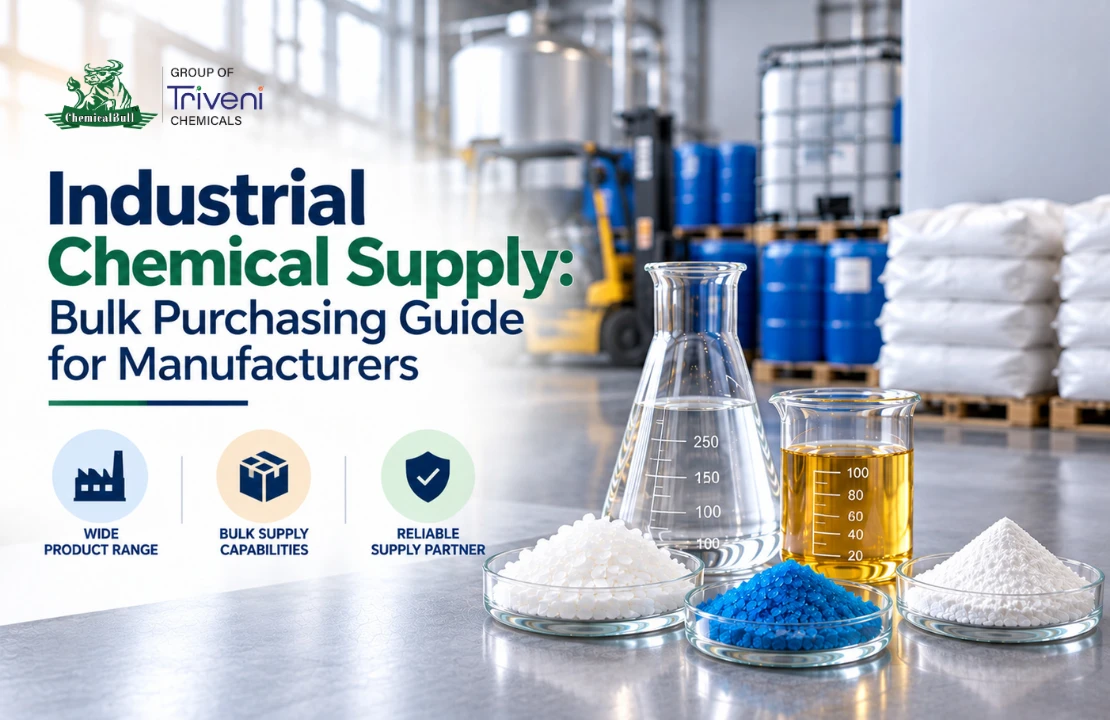
Industrial Chemical Supply: Bulk Purchasing Guide for Manufacturers
For U.S. manufacturers, buying industrial chemicals in bulk involves more than comparing price per pound or kilogram. The wrong grade, inconsistent specification, unsuitable packaging or an unexpected supply delay can affect production schedules, product quality and overall purchasing costs.
A reliable industrial chemical supply strategy considers chemical identity, purity, specification, quantity, documentation, packaging, lead time and supply continuity before an order is placed. Whether sourcing through industrial chemical suppliers or a bulk chemical distributor, procurement teams need to evaluate both technical and commercial factors.
This guide explains what manufacturers should check when purchasing industrial chemicals in bulk, how to compare supply options and what information to provide when requesting a commercial quotation.
What Are Industrial Chemicals?
Industrial chemicals are substances used as raw materials, intermediates, processing aids or formulation ingredients in commercial manufacturing and industrial processes.
Depending on the industry, these materials can include solvents, acids, bases, glycols, salts, intermediates and specialty chemicals used across chemical manufacturing, pharmaceuticals, coatings, adhesives, plastics, rubber, water treatment and other applications. Manufacturers looking for an industrial chemicals supplier can explore materials based on their production and application requirements.
Unlike laboratory purchasing, industrial requirements may involve commercial quantities and packaging selected according to the chemical's physical properties, handling requirements and intended use.
What Are Industrial Chemicals Used For?
Industrial chemicals perform different functions depending on the manufacturing process. Some become part of a finished formulation, while others function as solvents, reaction materials, intermediates, processing aids or treatment chemicals.
Common application areas include:
- Chemical manufacturing and synthesis
- Paints, coatings and adhesives
- Plastics and rubber processing
- Pharmaceutical manufacturing
- Water treatment
- Metal processing
- Detergent and cleaning formulations
- Textile processing
- Agrochemical manufacturing
The required chemical and specification can vary significantly between applications. Manufacturers working with coatings and related formulations can learn more about industrial chemicals for paints, coatings and adhesives, while rubber processors can explore industrial rubber chemicals for rubber compounding in the USA.
Understanding the end-use application helps procurement teams define the required chemical, grade and specification before approaching suppliers.
Why Do Manufacturers Purchase Industrial Chemicals in Bulk?
Bulk purchasing is common when a chemical is consumed regularly or when production requires significant quantities per batch.
Larger purchases can reduce procurement frequency and help manufacturers plan raw-material availability around their production schedules. Depending on quantity, packaging and commercial terms, bulk purchasing may also provide better purchasing efficiency.
However, ordering more material does not always mean better value.
Manufacturers should consider consumption rate, production forecasts, available storage capacity, shelf life and replenishment lead time before determining an appropriate order quantity.
The objective is to maintain reliable material availability without creating unnecessary inventory.
What to Check Before Buying Industrial Chemicals in Bulk
Price is important, but it should not be the only factor in a bulk chemical purchasing decision. Procurement teams should evaluate technical, quality, logistics and commercial requirements before issuing a purchase order.
1. Chemical Name and CAS Number
Start by confirming the exact chemical identity.
Chemicals with similar names can have different compositions, concentrations or properties. Where applicable, providing the CAS number together with the chemical name helps reduce confusion between the buyer and supplier.
Both identifiers should be included in RFQs and purchasing documents whenever possible.
2. Grade, Purity and Specification
The same chemical can be available in different grades and specifications.
Depending on the manufacturing process, buyers may need to evaluate parameters such as:
- Assay or purity
- Concentration
- Moisture
- Appearance
- Specific impurities
- Physical properties
- Application-specific requirements
The required specification should be clearly defined before commercial purchasing. A lower-priced material may provide little value if it does not meet the approved production requirements.
3. Required Quantity
Providing an accurate quantity helps suppliers evaluate availability, packaging and commercial pricing.
Instead of simply requesting a "bulk price," buyers should mention the required quantity per order. Manufacturers with recurring consumption can also provide an estimated monthly or annual requirement.
This gives the supplier better context when evaluating commercial supply.
4. Packaging Requirements
Industrial chemical packaging depends on the product's physical form, properties, quantity and transportation requirements.
Depending on the chemical, commercial packaging may include bags, drums, carboys, IBCs or other suitable containers.
Buyers should confirm available pack sizes and packaging options for the specific chemical rather than assuming that every product is supplied in the same format.
5. COA, SDS and Technical Documentation
Documentation is an important part of industrial chemical procurement.
Depending on the chemical and application, buyers commonly review a Certificate of Analysis (COA), Safety Data Sheet (SDS) and product specification.
Additional documentation may be required according to the product, application, destination or manufacturer's internal quality requirements.
6. Application Suitability
Chemical identity alone does not establish suitability for every manufacturing application.
Manufacturers should verify whether the offered grade and specification match their intended process. When several grades or concentrations are available, providing the application can also help clarify the purchasing requirement.
7. Batch Consistency
Consistency becomes particularly important when the same raw material is purchased repeatedly.
Variation in key parameters may affect processing conditions, formulation behavior or finished-product quality. Manufacturers with recurring requirements should therefore consider specification consistency when evaluating supply options.
8. Storage and Handling
Before purchasing large quantities, manufacturers should determine whether their facility can safely receive, store and handle the material.
Storage and handling requirements vary by chemical. Buyers should review the applicable SDS and follow relevant requirements for storage conditions, incompatibilities, PPE, handling and emergency procedures.
9. Availability and Lead Time
Chemical availability should align with the manufacturer's production schedule.
Procurement teams should confirm current availability and expected lead time before placing an order. For recurring requirements, future supply capability should also be considered when planning inventory.
How U.S. Manufacturers Should Evaluate Industrial Chemical Suppliers
Choosing between industrial chemical suppliers should involve more than comparing quotations.
Procurement teams should evaluate whether a supplier can clearly identify the product, meet the required specification, provide necessary documentation, offer suitable packaging and communicate realistic supply timelines.
For recurring requirements, manufacturers should also consider product availability, specification consistency, commercial quantity capability, documentation support, packaging options, logistics requirements and repeat supply capability.
These factors become particularly important when a chemical is critical to continuous production.
What Information Should Be Included in a Bulk Chemical RFQ?
A detailed RFQ helps industrial chemical suppliers understand the actual requirement and prepare a more relevant quotation.
Instead of sending only a product name and asking for the best price, U.S. manufacturers should provide the key purchasing details.
|
RFQ Information |
Details to Provide |
|
Chemical Name |
Exact product required |
|
CAS Number |
CAS number where applicable |
|
Grade/Purity |
Required grade, assay or concentration |
|
Specification |
Important technical parameters |
|
Quantity |
Quantity per order or expected consumption |
|
Packaging |
Preferred pack size or packaging |
|
Application |
Intended manufacturing use when relevant |
|
Documentation |
COA, SDS or other required documents |
|
Destination |
U.S. city, state or ZIP code |
|
Timeline |
Required delivery schedule |
For recurring production requirements, buyers can also mention estimated monthly or annual consumption. This helps suppliers better understand the scale and frequency of the requirement.
Building a Better Chemical Procurement Process
Effective industrial chemical purchasing requires coordination between procurement, production, quality, warehouse and logistics teams.
Production teams can provide consumption forecasts, quality teams can establish specifications, warehouse teams can track inventory and storage capacity, and procurement teams can plan orders according to consumption and supplier lead times.
Historical purchasing and consumption data can also help identify recurring requirements and improve future purchasing decisions.
This approach moves chemical purchasing from reactive buying toward a more structured industrial chemical supply process.
Industrial Chemical Supply in Bulk from ChemicalBull
ChemicalBull supports bulk industrial chemical supply for U.S. manufacturers and B2B buyers, covering industrial and specialty chemicals used across manufacturing, processing and formulation applications. Buyers can explore our industrial chemicals or browse chemical products according to their sourcing requirements.
As a global industrial chemicals exporter, ChemicalBull supports international B2B requirements with commercial quantities, suitable packaging options and product documentation based on the specific chemical and supply requirement. For U.S. buyers, sourcing discussions can include required quantity, specification, packaging and delivery destination.
To request a bulk quotation, share the chemical name, CAS number, grade or purity, required quantity, packaging preference, destination ZIP code and required timeline. This information helps our team evaluate the requirement and provide relevant commercial supply details.
U.S. manufacturers with one-time or recurring requirements can contact ChemicalBull for bulk industrial chemical supply and submit their purchasing details.
Conclusion
A successful industrial chemical supply strategy balances specification, quality, price, documentation, inventory, logistics and supply reliability.
For U.S. manufacturers, evaluating the complete purchasing requirement is more useful than comparing price alone. Clear specifications and complete RFQs also help suppliers understand the requirement faster and prepare more relevant commercial offers.
Before sending your next bulk chemical enquiry, prepare the chemical name, CAS number, grade or purity, specification, quantity, packaging, documentation requirements and destination. These details provide a stronger starting point for efficient B2B chemical sourcing.
Frequently Asked Questions
1. What are industrial chemicals?
Industrial chemicals are substances used as raw materials, intermediates, processing aids, solvents, formulation ingredients or other inputs in commercial manufacturing and industrial processes.
2. What are industrial chemicals used for?
Industrial chemicals are used across chemical manufacturing, pharmaceuticals, paints and coatings, adhesives, plastics, rubber, water treatment, metal processing, cleaning formulations, textiles and many other industrial applications.
3. What should manufacturers check before buying industrial chemicals in bulk?
Manufacturers should check chemical identity, CAS number, grade, purity, specification, quantity, packaging, documentation, storage requirements, availability and lead time before purchasing.
4. What documents should an industrial chemical supplier provide?
Depending on the chemical and application, buyers commonly request a COA, SDS and product specification. Additional documentation may be required for specific manufacturing applications.
5. How are industrial chemicals supplied in bulk?
Packaging varies according to the chemical and quantity. Depending on the material, commercial supply may use bags, drums, carboys, IBCs or other suitable packaging.
6. Does bulk chemical pricing depend on quantity?
Quantity can influence pricing, but specification, packaging, availability, freight, destination and commercial terms can also affect the total purchasing cost.
7. Where can manufacturers buy industrial chemicals in the USA?
U.S. manufacturers can source industrial chemicals through manufacturers, suppliers, distributors and international supply networks. Buyers should compare specification, documentation, packaging, quantity capability, availability, lead time and total purchasing cost before selecting a supply option.
8. How do manufacturers choose a bulk chemical distributor?
Manufacturers should evaluate product specification, documentation, packaging options, commercial quantity capability, availability, lead time, communication and consistency of repeat supply when selecting a bulk chemical distributor.