Chemical Bull
1565
25-May-2026
Introduction
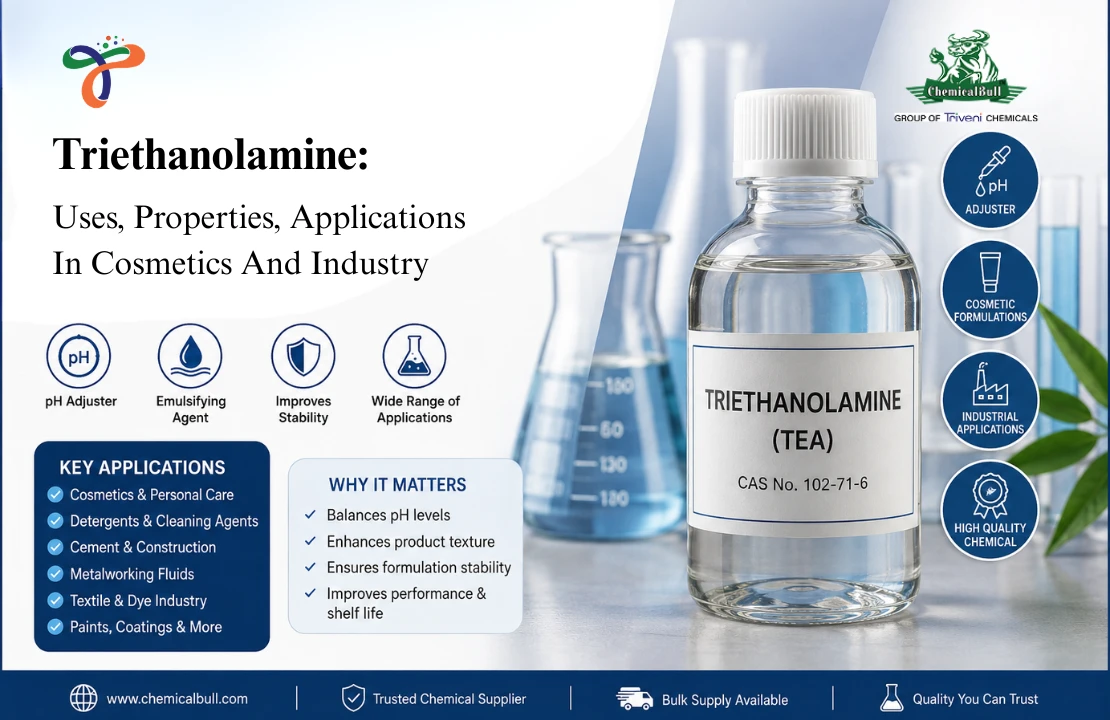
Triethanolamine, commonly known as TEA, is one of the most widely used chemical compounds in both industrial and personal care sectors. It is an organic compound that plays a critical role in formulation chemistry, especially where pH balancing and emulsification are required.
When we talk about modern chemical manufacturing, triethanolamine stands out as a multifunctional ingredient used in cosmetics, detergents, cement processing, and metalworking fluids. It is valued for its ability to improve stability, texture, and performance of formulations.
In simple terms, what is triethanolamine? It is a viscous, colorless to pale yellow liquid that works as a base chemical for adjusting acidity and improving formulation compatibility.
Chemical Nature and Properties of Triethanolamine
Triethanolamine is an amine compound containing both alcohol and amine functional groups. This unique structure allows it to act as both a weak base and an emulsifier.
Key properties include:
- Clear to pale yellow viscous liquid
- Mild ammonia-like odor
- Soluble in water and alcohol
- Stable under normal conditions
- Excellent buffering and emulsifying ability
These properties make it extremely useful in industries where chemical stability is essential.
What Does Triethanolamine Do?
If we understand what triethanolamine do to the skin, it is commonly used in cosmetic formulations rather than directly acting on the skin as an active ingredient. It functions as:
- pH stabilizer
- Emulsifying agent
- Surfactant helper
In creams and lotions, it helps oil and water mix properly so that the final product remains smooth and stable. Without it, formulations may separate or become unstable over time.
However, it is always used in controlled concentrations as per cosmetic safety regulations.
How Triethanolamine Acts as a pH Adjuster?
One of the most important roles of TEA is how triethanolamine act as pH adjuster in formulations.
Many cosmetic and industrial products require a specific pH range to remain stable and safe. Triethanolamine neutralizes acidic components and brings the formulation to a balanced pH level.
Applications of pH control include:
- Shampoos and conditioners
- Skin creams and lotions
- Industrial cleaning agents
- Paints and coatings
- Cement additives
Without proper pH adjustment, products may lose stability, become irritating, or reduce effectiveness. This is why TEA is widely preferred in formulation chemistry.
Why Triethanolamine is Used in Cosmetics?
A common question in formulation development is why we have to add triethanolamine in cosmetics.
The answer lies in its multifunctional benefits:
1. Emulsification Support
It helps oil and water phases combine smoothly, forming stable creams and lotions.
2. Texture Improvement
It improves the smoothness and consistency of cosmetic products.
3. pH Balance Maintenance
Ensures the final product is neither too acidic nor too alkaline.
4. Product Stability
It prevents separation and extends shelf life.
Because of these functions, TEA is widely used in moisturizers, sunscreens, shaving creams, and shampoos.
Industrial Applications of Triethanolamine
Triethanolamine is not limited to cosmetics. It plays a major role in the Industrial Chemicals category due to its versatility and chemical stability.
Major industrial uses include:
1. Cement Grinding Aid
TEA improves efficiency in cement grinding processes and enhances material performance.
2. Metalworking Fluids
It acts as a corrosion inhibitor and stabilizer in machining fluids.
3. Detergents and Cleaning Agents
It helps in removing grease and improving cleaning efficiency.
4. Gas Treatment
Used to remove acidic gases in refining processes.
5. Textile and Dye Industry
Improves dye dispersion and stability in textile processing.
Because of these applications, triethanolamine remains a high-demand chemical in global industrial markets.
Global Demand and Market Importance
The demand for triethanolamine continues to grow due to expansion in cosmetics, construction, and cleaning industries.
Industries prefer it because:
- It is cost-effective
- It has multifunctional properties
- It improves formulation stability
- It is compatible with many chemical systems
In global trade, businesses frequently search for:
- triethanolamine supplier
- triethanolamine manufacturer
- triethanolamine Distributor
- triethanolamine wholesaler
This shows strong B2B demand across different sectors.
Safety and Handling
Triethanolamine is generally considered safe when used properly in industrial and cosmetic formulations. However, proper handling practices should always be followed:
- Avoid direct prolonged skin exposure
- Use protective gloves in bulk handling
- Store in a cool, dry place
- Keep containers tightly closed
In cosmetics, it is used in very small and controlled concentrations to ensure product safety.
Industry Update: Current Trends
Recent industry trends show increasing use of triethanolamine in:
- Eco-friendly detergent formulations
- Green cosmetic products
- High-performance cement additives
- Industrial cleaning solutions
Manufacturers are focusing on multifunctional ingredients that reduce formulation complexity. TEA fits perfectly into this trend because it performs multiple roles in a single compound.
Chemical Bull Product Reference
For bulk supply and industrial procurement, triethanolamine is widely available through chemical distributors and manufacturers.
This product is part of the Industrial Chemicals category and is suitable for large-scale industrial and formulation use.
Conclusion
Triethanolamine is a multi-functional chemical that can be used in products for cleaning, cosmetics, and construction materials, as well as industrial processing. The ability of triethanolamine to function as a pH-adjusting agent, stabilizer, and emulsifier makes it an indispensable ingredient in contemporary chemical formulations.
In skincare or in cement manufacturing, TEA plays a critical part in enhancing efficiency and stability. The demand for it continues to increase worldwide due to its multi-functional characteristics and efficiency in cost.
For industrial buyers and large quantities, it is one of the key chemicals within the Industrial Chemicals class.


Comment Section