Chemical Bull
225
27-Jul-2026
Sorbitan Monopalmitate For Food, Cosmetics, and Pharmaceutical Industries
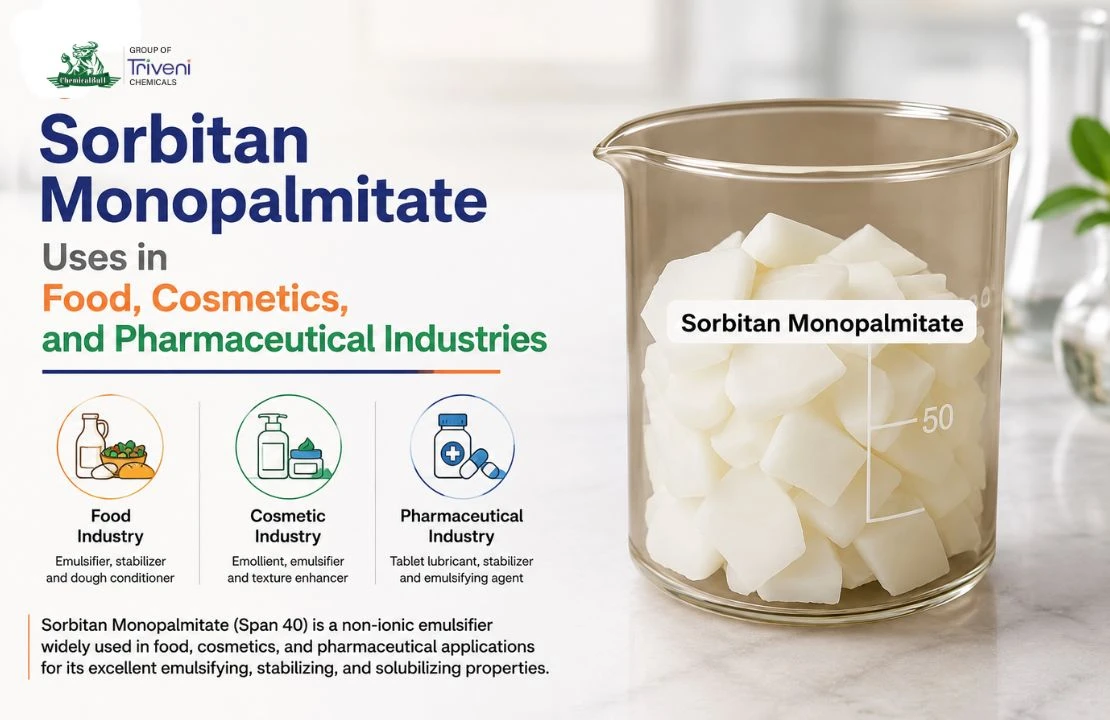
Sorbitan Monopalmitate (Span 40, CAS 26266-57-9) is a nonionic emulsifier derived from sorbitol and palmitic acid, used across food, cosmetic, and pharmaceutical formulations to stabilize water-oil systems. ChemicalBull is a bulk Sorbitan Monopalmitate supplier for food processors, cosmetic formulators, and pharmaceutical manufacturers.
Its mid-range HLB value makes it a go-to choice when a formulation needs a water-in-oil leaning emulsifier that also performs as a co-emulsifier alongside higher-HLB surfactants.
Looking for Sorbitan Monopalmitate for your formulation? Contact ChemicalBull for a quote today.
Quick Answer
Sorbitan Monopalmitate (Span 40) is a nonionic emulsifier used to stabilize water-oil emulsions in food, cosmetic, and pharmaceutical products. With an HLB value of approximately 6.7, it favors water-in-oil emulsification and is commonly paired with higher-HLB surfactants like Polysorbate 60 to fine-tune emulsion stability. In food, it functions as an approved emulsifier (E495) in bakery and whipped products; in cosmetics, it stabilizes creams and lotions; in pharmaceuticals, it is used in topical ointment and suppository bases.
Sorbitan Monopalmitate Uses
What is Sorbitan Monopalmitate used for? It is used primarily as an emulsifying and stabilizing agent across three main industries:
- Food — emulsifier (E495) in bakery shortenings, whipped toppings, coffee creamers, and confectionery coatings
- Cosmetics & Personal Care — water-in-oil emulsifier and co-emulsifier in creams, lotions, lipsticks, and anhydrous formulations
- Pharmaceuticals — excipient in topical ointment bases, suppository bases, and as a component in some sustained-release formulations
Its role across all three industries is consistent: reducing interfacial tension between water and oil phases so the two remain uniformly dispersed rather than separating.
Role of Sorbitan Monopalmitate in Food, Cosmetics, and Pharmaceutical Industries
Sorbitan Monopalmitate's role stays functionally the same across all three industries even though the finished products look nothing alike: it sits at the water-oil interface and keeps two otherwise incompatible phases from separating. In food manufacturing, that means holding a whipped topping's air-water-fat structure together through shelf life. In cosmetics, it means keeping a rich moisturizer's water phase evenly dispersed inside its oil phase instead of pooling out. In pharmaceuticals, it means giving an ointment or suppository base a stable, reproducible structure batch after batch. This cross-industry consistency — one raw material, one mechanism, three regulatory frameworks — is precisely why formulators across such different fields all reach for the same Span 40 specification sheet.
What Is Sorbitan Monopalmitate?
Sorbitan Monopalmitate is a partial ester formed by reacting sorbitol (derived from glucose) with palmitic acid, then cyclizing to form the sorbitan ring structure. The sorbitan "head" is hydrophilic, while the palmitate "tail" is lipophilic, giving the molecule its surfactant behavior. It belongs to the Span series of sorbitan esters, sitting between the more hydrophobic Sorbitan Monostearate (Span 60) and more hydrophilic sorbitan esters in terms of HLB.
Why Is Sorbitan Monopalmitate Used in Formulations?
Formulators reach for Span 40 for three practical reasons:
- Mid-range HLB (~6.7) — sits in a useful zone for water-in-oil emulsification and as a co-emulsifier that shifts overall system HLB when blended with higher-HLB surfactants.
- Regulatory acceptance — approved for food use (E495) in most major markets, alongside established cosmetic and pharmaceutical excipient status.
- Thermal and oxidative stability — as a nonionic ester, it holds up well across typical processing temperatures without ionic interactions that could disrupt sensitive formulations.
Sorbitan Monopalmitate Technical Specifications
|
Property |
Typical Value |
|
CAS Number |
26266-57-9 |
|
Chemical Formula |
C22H42O6 |
|
Molecular Weight |
~430.6 g/mol |
|
Appearance |
Cream to tan waxy solid or flakes |
|
HLB Value |
~6.7 |
|
Melting Point |
~45–47°C |
|
Acid Value |
≤ 8 mg KOH/g |
|
Saponification Value |
~140–150 mg KOH/g |
|
Solubility |
Dispersible in hot water; soluble in oils and organic solvents |
|
Food Additive Code |
E495 |
Applications in Food, Cosmetics, and Pharmaceutical Industries
1. Food Industry Applications
Sorbitan Monopalmitate (E495) is used as an emulsifier and texturizing aid in:
- Bakery shortenings and margarine — improving fat dispersion and crumb structure
- Whipped toppings and coffee creamers — stabilizing the fat-water interface for consistent whip volume and mouthfeel
- Confectionery coatings — improving gloss and bloom resistance in chocolate and compound coatings
How Does Sorbitan Monopalmitate Work as a Food Emulsifier?
In a fat-based food system, Span 40 orients at the water-oil interface with its hydrophilic sorbitan head facing the aqueous phase and its palmitate tail anchored in the fat phase. This reduces interfacial tension, allowing smaller, more stable droplets to form and resist coalescence during storage — which is what keeps a whipped topping from weeping or a margarine from developing an oily surface over time.
2. Cosmetics and Personal Care Applications
- Water-in-oil creams and lotions — Span 40 stabilizes the internal water phase within an external oil phase, common in barrier creams and richer moisturizers
- Co-emulsification with Polysorbates — blended with Polysorbate 60 or 80 to build a balanced HLB system for oil-in-water emulsions
- Anhydrous and lipstick formulations — contributes to pigment dispersion and structure in wax-based color cosmetics
3. Pharmaceutical Applications
- Topical ointment bases — used to formulate water-in-oil ointments where controlled drug release and skin occlusion are formulation goals
- Suppository bases — contributes to melting behavior and active ingredient dispersion in fatty suppository bases
- Excipient in semi-solid dosage forms — supports consistency and phase stability in creams and topical pharmaceutical preparations
Typical Sorbitan Monopalmitate Dosage by Application
|
Application |
Typical Usage Level (wt%) |
Primary Function |
|
Bakery shortening/margarine |
0.2–0.5% |
Fat dispersion, crumb structure |
|
Whipped toppings |
0.3–0.6% |
Emulsion stability, whip volume |
|
Cosmetic W/O creams |
1–5% |
Primary or co-emulsifier |
|
Lipstick/anhydrous formulations |
0.5–3% |
Pigment dispersion, structure |
|
Pharmaceutical ointment bases |
1–5% |
Water-in-oil stabilization |
Actual usage levels depend on the co-emulsifier system, target HLB, and processing temperature — our technical team can help align dosage with your formulation's phase ratio.
Advantages of Sorbitan Monopalmitate in Formulation
- Regulatory versatility — one raw material with accepted use across food, cosmetic, and pharmaceutical regulatory frameworks, simplifying multi-category sourcing.
- Predictable HLB behavior — mid-range HLB makes it a reliable building block for HLB-blending calculations with other Span/Tween surfactants.
- Nonionic stability — compatible with a wide range of actives and ionic ingredients without the interaction issues seen with ionic surfactants.
- Thermal resilience — holds emulsion structure through typical hot-process manufacturing steps without breaking.
- Sensory contribution — supports smooth, non-greasy skin feel in cosmetic and pharmaceutical topical formulations.
- Clean regulatory label positioning — food-grade status (E495) supports "approved emulsifier" labeling claims where required.
Formulator's Note: Best Practices for Emulsion Stability
A detail seasoned formulators watch closely: Sorbitan Monopalmitate should be melted and incorporated into the oil phase before emulsification, not added directly to a cooled or partially formed emulsion. Because its melting point sits around 45–47°C, adding it below this temperature leaves undissolved crystalline particles in the mix, which can seed premature crystallization or create a grainy texture in the finished cream or ointment — a defect that often doesn't show up until the batch has cooled fully, well after the process has moved on.
A second point worth flagging for cosmetic and pharmaceutical formulators: when blending Span 40 with a Polysorbate to hit a target system HLB, small shifts in the Span-to-Tween ratio can move the resulting emulsion from oil-in-water to water-in-oil behavior far more abruptly than the HLB math alone suggests. Bench-testing at 0.5% increments around your calculated ratio, rather than trusting the theoretical HLB number outright, catches this before it becomes a scale-up problem.
Difference Between Sorbitan Monopalmitate and Sorbitan Monostearate?
Sorbitan Monopalmitate (Span 40) is esterified with palmitic acid (C16), while Sorbitan Monostearate (Span 60) is esterified with stearic acid (C18) — a difference that shows up mainly in melting point and HLB. Span 60 has a slightly higher melting point (~53–57°C vs. ~45–47°C for Span 40) and a marginally lower HLB, making it more common in formulations needing firmer structure or higher processing temperature tolerance, such as some bakery fat systems and firmer cosmetic creams. Span 40 is often chosen where a slightly softer texture or lower processing temperature is preferred.
Sorbitan Monopalmitate vs. Other Sorbitan and Polysorbate Esters
|
Ingredient |
Type |
HLB |
Typical Use Case |
|
Sorbitan Monopalmitate (Span 40) |
Sorbitan ester |
~6.7 |
Mid-range W/O emulsifier, co-emulsifier |
|
Sorbitan Monostearate (Span 60) |
Sorbitan ester |
~4.7 |
Firmer W/O emulsions, bakery fats |
|
Sorbitan Monooleate (Span 80) |
Sorbitan ester |
~4.3 |
Lower-HLB W/O systems, liquid form |
|
Polysorbate 60 |
Polysorbate |
~14.9 |
O/W emulsifier, co-emulsifier pairing with Span esters |
Need side-by-side technical data sheets to compare Span 40 against Span 60 for your target melting profile? Request samples and TDS documentation from our technical sales team — we can align the comparison to your specific formulation.
Industrial and Commercial Importance
Beyond its three core industries, Sorbitan Monopalmitate is used in:
- Agrochemical formulations — as an emulsifier component in some emulsifiable concentrate (EC) and suspension concentrate systems
- Industrial and institutional cleaning products — as a mild nonionic surfactant component in select formulations
- Textile processing aids — in select finishing and lubricant emulsion applications
Consistent HLB, acid value, and melting point from batch to batch matter directly to formulation performance, since drift in any of these specs can shift emulsion stability in ways that are hard to trace back to the raw material.
Conclusion
Sorbitan Monopalmitate (Span 40) earns its place across food, cosmetic, and pharmaceutical formulations through one consistent mechanism: stabilizing water-oil interfaces at a mid-range HLB of ~6.7. Whether it's holding a whipped topping together, structuring a moisturizing cream, or stabilizing an ointment base, the underlying chemistry stays the same — only the application changes. For formulators evaluating Span 40 against alternatives like Sorbitan Monostearate, the choice largely comes down to melting point and target texture.
Frequently Asked Questions
-
What is Sorbitan Monopalmitate used for?
It is used as a nonionic emulsifier in food (E495), cosmetic, and pharmaceutical formulations, primarily to stabilize water-in-oil emulsions and act as a co-emulsifier alongside higher-HLB surfactants. -
What is the CAS number of Sorbitan Monopalmitate?
The CAS number is 26266-57-9. -
Is Sorbitan Monopalmitate safe for food use?
Yes, it is an approved food emulsifier registered as E495 in most major regulatory markets, used within specified usage limits in bakery, whipped topping, and confectionery applications. -
What is the HLB value of Sorbitan Monopalmitate?
Its HLB value is approximately 6.7, placing it in a mid-range zone suited to water-in-oil emulsification and HLB-blending with higher-HLB surfactants. -
What is the difference between Sorbitan Monopalmitate and Sorbitan Monostearate?
Sorbitan Monopalmitate is esterified with palmitic acid (C16) and has a lower melting point (~45–47°C) and slightly higher HLB than Sorbitan Monostearate, which uses stearic acid (C18) and has a firmer, higher-melting profile. -
Can Sorbitan Monopalmitate be used in pharmaceutical topical formulations?
Yes, it is commonly used as an excipient in water-in-oil ointment bases and suppository bases, where it supports emulsion stability and controlled phase dispersion.

Comment Section