Chemical Bull
31
04-Aug-2026
Polysorbate 65 Uses in Cosmetic Manufacturing
Quick Answer
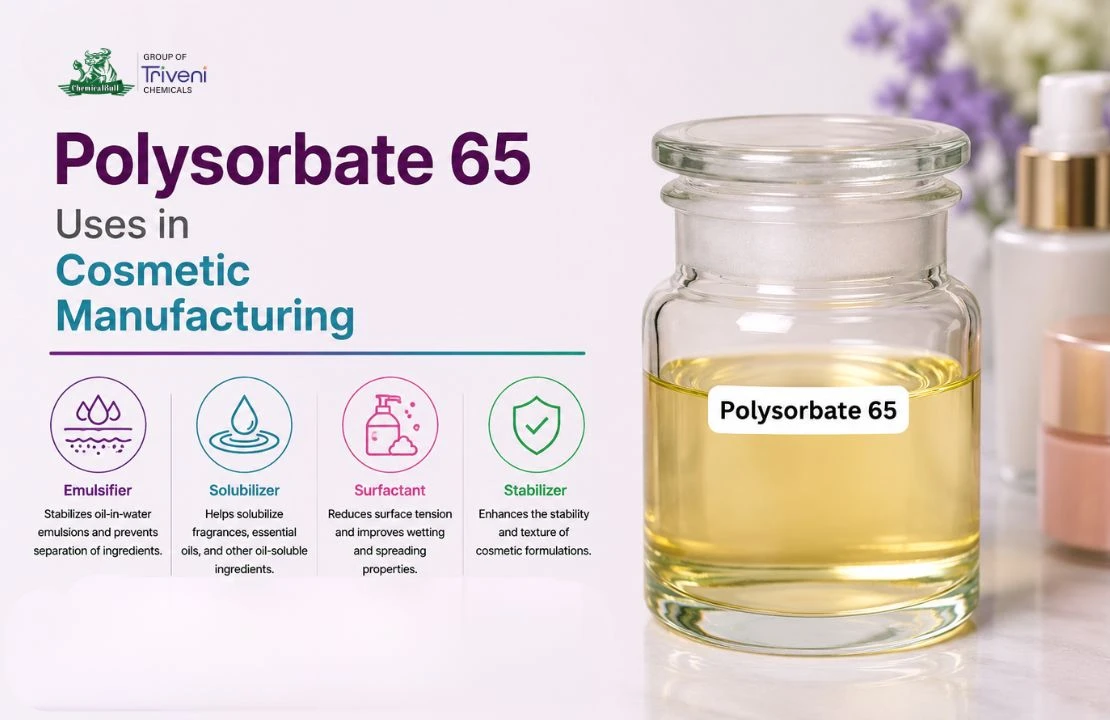
Polysorbate 65 is a nonionic emulsifier used in cosmetic manufacturing to stabilize oil-in-water emulsions and improve the texture, consistency, and stability of creams, lotions, cleansing products, sun care products, and structured cosmetic formulations.
Also known as Polyoxyethylene (20) Sorbitan Tristearate, Polysorbate 65 is valued for its ability to support richer cosmetic formulations where improved emulsion structure and product stability are required.
For bulk requirements with COA, MSDS/SDS, technical documentation, and reliable supply support, ChemicalBull is a trusted Polysorbate 65 supplier serving cosmetic formulators, personal care manufacturers, and specialty chemical buyers across India and global markets.
What Is Polysorbate 65?
Polysorbate 65, also known as Polyoxyethylene (20) Sorbitan Tristearate, is a nonionic surfactant and emulsifier belonging to the polysorbate family.
It is produced by reacting sorbitan tristearate with ethylene oxide, creating a molecule containing:
- A hydrophilic polyoxyethylene chain
- A lipophilic tristearate portion derived from stearic acid
This unique molecular structure allows Polysorbate 65 to function at the oil-water interface, reducing interfacial tension and helping create stable emulsions.
With an HLB value of approximately 10.5, Polysorbate 65 has a more lipophilic character compared with higher-HLB polysorbates such as Polysorbate 80, making it suitable for richer formulations requiring stronger oil-phase compatibility and improved texture.
Chemical Identity and Properties of Polysorbate 65
|
Property |
Details |
|
INCI Name |
Polysorbate 65 |
|
CAS Number |
9005-71-4 |
|
E Number |
E436 |
|
Chemical Name |
Polyoxyethylene (20) Sorbitan Tristearate |
|
Chemical Family |
Nonionic Surfactant |
|
Molecular Formula |
C₁₀₀H₁₉₄O₂₈ |
|
Physical Form |
Yellow viscous liquid or paste |
|
HLB Value |
Approximately 10.5 |
|
Solubility |
Dispersible in water; soluble in organic solvents |
|
Fatty Acid Component |
Stearic Acid |
|
Main Function |
Emulsifier, stabilizer, co-emulsifier |
How Is Polysorbate 65 Manufactured?
Polysorbate 65 is manufactured through a two-step chemical process.
First, sorbitol is dehydrated and esterified with stearic acid to produce sorbitan tristearate. In the second step, this intermediate undergoes ethoxylation by reacting with ethylene oxide.
This process creates a molecule with two functional regions:
Hydrophilic Portion
The polyethylene oxide chain attracts water and provides compatibility with the aqueous phase.
Lipophilic Portion
The tristearate structure interacts with oil phases and fatty components.
This balanced structure allows Polysorbate 65 to function as an effective emulsifier in cosmetic formulations.
What Are the Uses of Polysorbate 65 in Cosmetic Manufacturing?
Polysorbate 65 is used in cosmetic manufacturing for:
- Oil-in-water emulsion stabilization
- Cream and lotion formulation
- Cleansing product emulsification
- Co-emulsifier systems
- Texture improvement
- Structured cosmetic formulations
- Sun care and barrier products
Its lower HLB value makes it especially useful in formulations requiring richer textures and stronger internal structure.
Why Is Polysorbate 65 Used in Cosmetic Formulations?
1. Lower HLB Value for Richer Emulsions
Polysorbate 65 has an HLB value of approximately 10.5, which gives it a more oil-compatible character compared with Polysorbate 60 and Polysorbate 80.
This makes it suitable for:
- Rich creams
- Body butters
- Balm-type formulations
- Higher oil-content emulsions
2. Improves Emulsion Stability
Polysorbate 65 helps maintain stable cosmetic emulsions by reducing separation between oil and water phases.
Benefits include:
- Reduced phase separation
- Improved shelf stability
- Better product consistency
- Enhanced formulation reliability
3. Provides Structure and Texture
Due to its tristearate structure, Polysorbate 65 contributes body and firmness to cosmetic products.
It helps create:
- Smooth cream texture
- Rich skin feel
- Improved product appearance
- Better formulation structure
4. Works as a Co-Emulsifier
Polysorbate 65 is commonly combined with other emulsifiers to achieve the desired HLB balance.
Common combinations include:
- Polysorbate 60
- Polysorbate 80
- Sorbitan Tristearate
- Fatty alcohols
These combinations allow formulators to customize texture, stability, and performance.
Key Functions of Polysorbate 65 in Cosmetics
1. Oil-in-Water Emulsifier
Polysorbate 65 helps combine oil and water phases in creams and lotions.
It supports:
- Uniform dispersion of oils
- Stable emulsion formation
- Consistent product texture
2. Emulsion Stabilizer
It helps prevent separation during storage and temperature variations.
This makes it valuable in products requiring long shelf life.
3. Co-Emulsifier in Cosmetic Systems
Many cosmetic manufacturers use Polysorbate 65 with other emulsifiers to optimize formulation performance.
It helps balance:
- Oil phase compatibility
- Texture
- Stability
- Sensory properties
4. Structuring Agent
Its higher melting point compared with some other polysorbates helps provide firmness and body to cosmetic formulations.
Cosmetic Applications of Polysorbate 65
Creams and Lotions
Polysorbate 65 is widely used in cosmetic creams and lotions as an emulsifier and stabilizer.
Applications include:
- Moisturizing creams
- Body lotions
- Facial creams
- Rich emulsion products
Typical usage level:
1%–5%
Cleansing Products
In cleansing creams and cleansing milk formulations, Polysorbate 65 helps stabilize emulsions and improve product feel.
Applications include:
- Cleansing lotions
- Makeup removers
- Cream cleansers
Typical usage level:
1%–3%
Sun Care and Barrier Formulations
Polysorbate 65 can support formulations containing oil-soluble ingredients and UV filters.
Benefits:
- Improved emulsion stability
- Better product structure
- Enhanced formulation consistency
Typical usage level:
1%–4%
Specialty Structured Formulations
It is suitable for cosmetic products requiring a firmer texture.
Applications include:
- Balm formulations
- Rich creams
- Structured emulsions
Typical usage level:
2%–6%
Compatibility With Cosmetic Ingredients
|
Ingredient |
Compatibility |
|
Excellent compatibility; commonly paired system |
|
|
Polysorbate 60 / Polysorbate 80 |
Compatible for HLB adjustment |
|
Supports cream structure |
|
|
Improves viscosity and stability |
|
|
Compatible in standard formulations |
Formulation Guidance for Polysorbate 65
When using Polysorbate 65 in cosmetic formulations, manufacturers should consider the oil phase, desired texture, and overall emulsifier system.
Use With Suitable Co-Emulsifiers
Polysorbate 65 works effectively when combined with other emulsifiers to achieve the required HLB balance.
For many cosmetic formulations, it is paired with:
- Higher-HLB polysorbates
- Sorbitan esters
- Fatty alcohols
This helps formulators achieve the desired:
- Emulsion stability
- Texture
- Skin feel
- Product appearance
Add During Oil Phase Processing
Due to its higher melting characteristics, Polysorbate 65 should generally be incorporated into the oil phase during the heating stage.
Proper mixing helps ensure:
- Complete melting
- Uniform dispersion
- Better emulsion formation
Perform Stability Testing
Before commercial production, manufacturers should evaluate:
- Freeze-thaw stability
- Heat stability
- Long-term storage behavior
- Compatibility with active ingredients
This ensures consistent product performance throughout the product lifecycle.
Polysorbate 65 vs Polysorbate 60 vs Polysorbate 80
Polysorbate 65 belongs to the same emulsifier family as Polysorbate 60 and Polysorbate 80, but differences in fatty acid structure and HLB value influence their applications.
|
Product |
Fatty Acid Structure |
HLB Value |
Common Cosmetic Uses |
|
Polysorbate 65 |
Tristearate |
~10.5 |
Rich creams, structured emulsions, co-emulsifier systems |
|
Polysorbate 60 |
Stearate |
~14.9 |
Creams, lotions, emulsions |
|
Polysorbate 80 |
Oleate |
~15 |
Solubilization, emulsification, skincare formulations |
Benefits of Using Polysorbate 65 in Cosmetic Manufacturing
Improved Emulsion Stability
Polysorbate 65 helps cosmetic manufacturers create stable formulations with reduced risk of phase separation.
Enhanced Product Texture
Its tristearate structure contributes to richer, creamier product textures.
Flexible Formulation Options
It can be used alone or combined with other emulsifiers depending on formulation requirements.
Suitable for Premium Cosmetic Products
Its ability to improve body and consistency makes it useful in:
- Luxury creams
- Rich moisturizers
- Barrier products
- Specialty skincare formulations
Where to Buy Polysorbate 65 for Cosmetic Manufacturing?
Cosmetic manufacturers require consistent-quality emulsifiers to maintain formulation performance, stability, and production efficiency.
ChemicalBull supplies Polysorbate 65 for cosmetic and personal care applications with quality documentation support, including COA, SDS/MSDS, and technical specifications.
Whether you are developing creams, lotions, cleansing products, or specialty cosmetic formulations, sourcing from a dependable supplier helps ensure:
- Consistent raw material quality
- Reliable supply availability
- Documentation support
- Smooth procurement process
ChemicalBull supports cosmetic manufacturers, formulators, and specialty chemical buyers with industrial chemical sourcing solutions for domestic and international markets.
Why Choose ChemicalBull as Your Polysorbate 65 Supplier?
ChemicalBull provides chemical sourcing solutions for cosmetic manufacturers, personal care companies, and industrial buyers worldwide.
Quality-Focused Chemical Supply
We support customers with reliable sourcing of cosmetic ingredients suitable for professional formulation requirements.
Reliable Bulk Supply Solutions
ChemicalBull supports different purchasing requirements, from formulation trials to commercial production quantities.
Industry Application Support
Our team helps buyers understand product suitability for applications including:
- Cosmetic emulsions
- Personal care formulations
- Specialty chemical applications
Global Supply Network
ChemicalBull works with customers across different regions by supporting reliable chemical sourcing and export requirements.
For bulk Polysorbate 65 requirements, technical information, or sourcing support, connect with ChemicalBull for suitable supply solutions.
Frequently Asked Questions About Polysorbate 65
-
What is Polysorbate 65 used for in cosmetics?
Polysorbate 65 is used as a nonionic emulsifier, emulsion stabilizer, co-emulsifier, and structuring agent in cosmetic products such as creams, lotions, cleansing products, and sun care formulations. -
What is the CAS number of Polysorbate 65?
The CAS number of Polysorbate 65 is 9005-71-4. -
What is the HLB value of Polysorbate 65?
Polysorbate 65 has an HLB value of approximately 10.5, making it more oil-compatible than higher-HLB polysorbates such as Polysorbate 60 and Polysorbate 80. -
What is the difference between Polysorbate 65 and Polysorbate 80?
Polysorbate 65 contains a tristearate structure and has a lower HLB value, making it suitable for richer and more structured emulsions. Polysorbate 80 has a higher HLB value and is commonly used for solubilization and more water-compatible emulsification systems. -
Can Polysorbate 65 be used as a primary emulsifier?
Yes, Polysorbate 65 can function as an emulsifier, but cosmetic formulators often combine it with other emulsifiers to achieve the desired HLB balance and product characteristics. -
What is the typical usage level of Polysorbate 65 in cosmetics?
Typical usage levels range from approximately 1% to 6%, depending on the formulation type, oil phase concentration, and desired texture.
Conclusion
Polysorbate 65 is a valuable nonionic emulsifier used in cosmetic manufacturing due to its unique tristearate structure, lower HLB value, and ability to improve emulsion stability and product texture.
Its applications in creams, lotions, cleansing products, sun care formulations, and structured cosmetic systems make it an important ingredient for personal care manufacturers seeking reliable emulsion performance.
Compared with other polysorbates, Polysorbate 65 offers distinct advantages for richer formulations requiring firmness, stability, and improved oil-phase compatibility.
For businesses looking for consistent-quality material, technical documentation, and dependable supply support, ChemicalBull provides Polysorbate 65 solutions for cosmetic manufacturers, personal care companies, and specialty chemical buyers.
Comment Section