Chemical Bull
18
04-Aug-2026
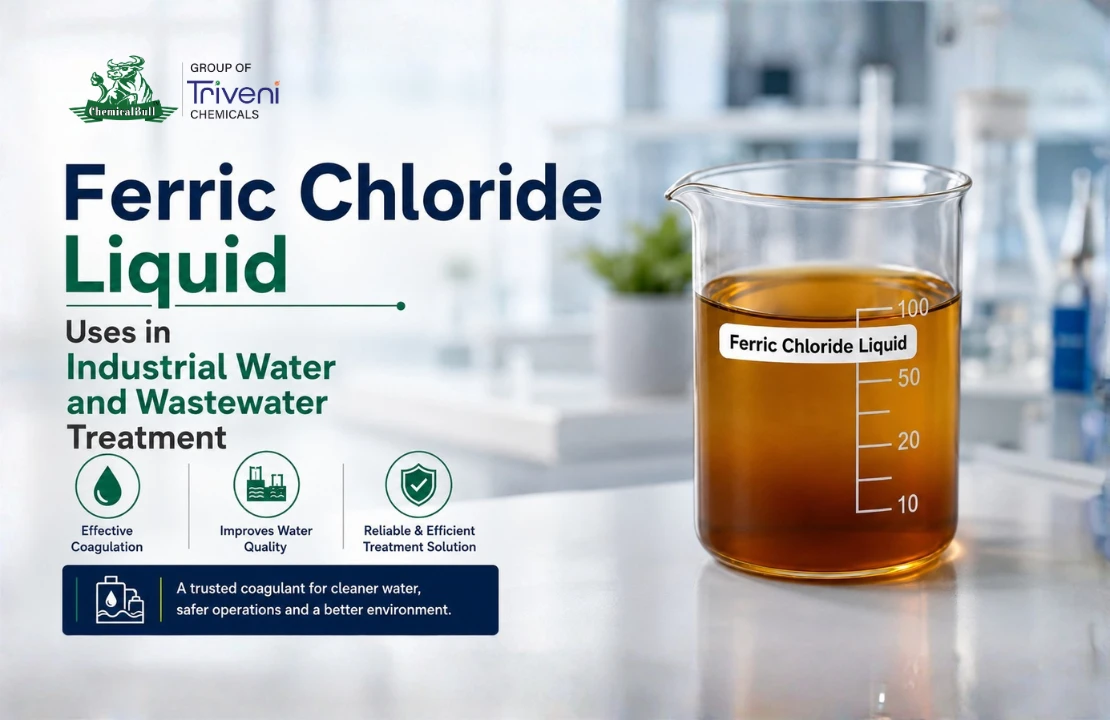
Ferric Chloride Liquid Uses in Industrial Water and Wastewater Treatment
Industrial wastewater is rarely clean enough for direct discharge or reuse. Water generated during chemical processing, equipment washing, textile dyeing, metal treatment, pharmaceutical production and other manufacturing activities may contain suspended solids, colour, phosphates, oils, organic matter and metal contaminants.
Simple filtration may not remove very fine or dissolved impurities. These particles can remain suspended in water, increase turbidity and affect the performance of downstream treatment equipment. This is where Ferric Chloride Liquid plays an important role.
Ferric Chloride Liquid manufacturers supply this widely used inorganic coagulant for industrial water treatment, wastewater treatment plants, effluent treatment plants, sewage treatment plants and municipal water systems. It helps destabilise fine particles, form settleable flocs and improve the separation of contaminants from water.
Water treatment is one of the primary commercial applications of ferric chloride. It is used in both drinking-water and wastewater treatment as a coagulant and sludge-dewatering agent.
Quick Answer: What Is Ferric Chloride Liquid Used for?
Ferric Chloride Liquid is mainly used to improve coagulation and flocculation in water and wastewater treatment. When it is added to contaminated water, it reacts with fine particles and dissolved impurities to form larger flocs.
These flocs can then be removed through sedimentation, clarification, filtration or sludge separation.
The main Ferric Chloride Liquid uses in water treatment include:
-
Removal of suspended solids
-
Reduction of turbidity
-
Colour removal from industrial effluent
-
Phosphate and phosphorus removal
-
Support for heavy-metal precipitation
-
Sludge conditioning and dewatering
-
Hydrogen sulphide and odour control
-
Raw-water clarification
-
Industrial ETP treatment
-
Municipal STP and sewage treatment
Ferric Chloride Liquid is preferred by many treatment plants because its liquid form supports controlled dosing and continuous plant operation.
What Is Ferric Chloride Liquid?
Ferric Chloride Liquid is an aqueous solution of ferric chloride, an inorganic iron salt represented by the chemical formula FeCl₃. Depending on its concentration and manufacturing process, it may appear as a yellow-brown, reddish-brown or dark-brown liquid.
Ferric chloride produces trivalent ferric ions when introduced into water. These ions react with alkalinity and water to form ferric hydroxide flocs. The flocs attract and capture colloidal particles, suspended matter, natural organic material and certain dissolved contaminants.
Iron-based coagulants are used in both industrial and municipal treatment applications and can work across a comparatively broad operating pH range.
Liquid ferric chloride is commonly selected for:
-
Effluent treatment plants
-
Sewage treatment plants
-
Water treatment plants
-
Industrial process-water treatment
-
Sludge-treatment systems
-
Phosphate-removal processes
-
Continuous chemical-dosing systems
How Does Ferric Chloride Work in Water Treatment?
Wastewater may contain microscopic particles that do not settle naturally. These particles normally carry similar electrical charges and repel one another, allowing them to remain dispersed in water.
Ferric Chloride Liquid works by reducing the stability of these particles. After dosing, ferric ions support charge neutralisation and form ferric hydroxide precipitates. Fine contaminants attach to these precipitates and combine into larger flocs.
The general treatment process includes:
-
Ferric Chloride Liquid is dosed into the incoming water.
-
Rapid mixing distributes the coagulant throughout the treatment stream.
-
Fine particles begin losing their stability.
-
Slow mixing allows larger flocs to develop.
-
The flocs settle inside a clarification or sedimentation tank.
-
Clarified water moves to filtration, biological treatment or final polishing.
-
Settled sludge is collected for dewatering and disposal.
This coagulation and flocculation process can improve water clarity and reduce the contaminant load reaching filters, membranes and biological-treatment units.
The correct Ferric Chloride dosage cannot be selected only from a general recommendation. It depends on wastewater pH, alkalinity, turbidity, phosphate level, contaminant type and the required outlet quality.
Major Ferric Chloride Liquid Uses in Water Treatment
1. Coagulation and Flocculation
The most common use of Ferric Chloride Liquid is as a water-treatment coagulant.
Industrial wastewater may contain fine clay, pigments, process residues, organic particles, metal fines and oil-associated solids. Many of these impurities are too small to settle without chemical treatment.
Ferric Chloride Liquid destabilises these particles and promotes the formation of larger flocs. These flocs can then be removed through settling, flotation or filtration.
Effective coagulation can also reduce pressure on downstream equipment by lowering the amount of suspended matter entering sand filters, activated-carbon systems or membrane-treatment units.
2. Turbidity Reduction and Water Clarification
Turbidity is the cloudy appearance caused by fine suspended particles. High turbidity can affect process-water quality, filtration efficiency and final wastewater discharge.
Ferric Chloride Liquid helps collect turbidity-causing particles into settleable flocs. This makes it useful in:
-
Raw-water clarification
-
Industrial process-water treatment
-
Wastewater recycling systems
-
Municipal water treatment
-
Pretreatment before filtration
-
Pretreatment before membrane systems
Its performance depends on proper dosing, mixing and flocculation conditions.
3. Industrial Effluent Treatment
Ferric Chloride Liquid for ETP treatment is an important application across manufacturing industries.
Effluent treatment plants receive wastewater from production, washing, cleaning, cooling, floor drainage and raw-material handling. The wastewater composition can change according to the product being manufactured and the production schedule.
Ferric Chloride may be used during primary chemical treatment to reduce suspended solids, colour and selected contaminants before biological treatment or final polishing.
Industrial sectors using ferric chloride in wastewater treatment include:
-
Chemical manufacturing
-
Pharmaceutical production
-
Textile dyeing and processing
-
Paper and pulp production
-
Paint and pigment manufacturing
-
Metal finishing and electroplating
-
Food and beverage processing
-
Engineering and automotive units
-
Oil and lubricant processing
-
Fertiliser and agrochemical production
Jar testing and plant trials are important because each industrial effluent behaves differently.
4. Phosphate and Phosphorus Removal
Phosphorus may enter wastewater through detergents, fertilisers, cleaning chemicals, food residues, pharmaceutical processes and industrial raw materials.
Excess phosphorus discharged into water bodies can support excessive plant and algae growth. Wastewater-treatment facilities therefore use chemical precipitation to reduce phosphate and total phosphorus levels.
Ferric Chloride reacts with phosphate and forms low-solubility compounds that can be separated with the sludge. Ferric salts are widely used for chemical phosphorus removal because of their precipitation and coagulation performance.
Ferric Chloride for phosphate removal may be dosed:
-
Before primary clarification
-
During biological treatment
-
Before secondary clarification
-
During tertiary treatment
-
Before final filtration
The correct dosing location depends on the plant design and target phosphorus level.
5. Colour Removal from Wastewater
Strongly coloured wastewater is common in textile dyeing, printing, paper, pigment and speciality chemical manufacturing.
Some colour-forming compounds do not settle naturally and may remain after biological treatment. Ferric Chloride Liquid can help destabilise certain colour bodies and bind them into flocs.
The resulting flocs are removed through clarification or filtration. Treatment efficiency varies according to the dye chemistry, pH, organic load and other substances present in the effluent.
Ferric Chloride should therefore be evaluated through laboratory testing rather than treated as a universal colour-removal solution.
6. Support for Heavy-Metal Removal
Electroplating, metal finishing, mining, engineering and pigment industries may generate wastewater containing dissolved metals.
Ferric Chloride can support heavy-metal treatment by improving coagulation and providing precipitates onto which certain contaminants may attach. However, ferric chloride alone may not remove every metal under all conditions.
Successful heavy-metal removal depends on:
-
Type of metal
-
Initial metal concentration
-
Wastewater pH
-
Oxidation state
-
Presence of complexing agents
-
Chemical-treatment sequence
-
Settling and filtration efficiency
pH correction and additional precipitation chemicals may be required. Treatment should be confirmed through wastewater analysis and plant trials.
7. Sewage Treatment and STP Applications
Ferric Chloride Liquid is also used in sewage treatment plants and municipal wastewater facilities.
Depending on the system design, it may be introduced during primary, secondary or tertiary treatment. Its functions can include:
-
Improving suspended-solid removal
-
Reducing phosphorus
-
Supporting sludge settlement
-
Improving clarification
-
Controlling sulphide-related problems
-
Supporting sludge dewatering
In STP treatment, carefully controlled dosing is important because excessive chemical addition may increase sludge volume and operating cost.
8. Hydrogen Sulphide and Odour Control
Hydrogen sulphide is associated with the strong rotten-egg smell found in some drains, sewer networks, sludge tanks and anaerobic wastewater systems.
Ferric salts can react with sulphides and help convert them into less soluble iron-sulphide forms. This can reduce hydrogen sulphide availability and support odour control.
Ferric Chloride Liquid may therefore be considered in:
-
Sewage collection networks
-
Sludge-handling systems
-
Anaerobic wastewater
-
Pumping stations
-
Industrial drains
-
Odour-control treatment programs
The dosage should be based on sulphide level and actual plant conditions.
9. Sludge Conditioning and Dewatering
Wastewater-treatment sludge can contain a high percentage of water. Poorly formed sludge may be difficult to settle, pump or dewater.
Ferric Chloride Liquid can support sludge conditioning by improving floc strength and particle aggregation. Conditioned sludge may perform better in:
-
Filter presses
-
Belt filter presses
-
Centrifuges
-
Vacuum filtration
-
Sludge drying systems
Better sludge dewatering can reduce the volume requiring transport and disposal. However, excessive ferric chloride may increase inorganic sludge generation, so dosage optimisation is essential.
10. Drinking-Water and Raw-Water Clarification
Ferric Chloride is also used as a coagulant in drinking-water treatment to remove suspended particles, turbidity, natural organic matter and colour before filtration and disinfection.
Ferric chloride products are listed for coagulation and flocculation applications in public water systems, but drinking-water use requires an appropriately certified grade and compliance with applicable local standards.
Industrial-grade material should not automatically be considered suitable for potable-water treatment. Buyers must confirm certification, purity, impurity limits and regulatory acceptance before use.
Benefits of Ferric Chloride Liquid in Wastewater Treatment
Ferric Chloride Liquid offers several practical benefits:
-
Strong coagulation and clarification performance
-
Effective reduction of suspended solids
-
Useful for phosphate precipitation
-
Supports colour and turbidity reduction
-
Suitable for industrial and municipal systems
-
Easy integration into liquid-dosing systems
-
Suitable for continuous ETP and STP operation
-
Can support sludge conditioning
-
Useful across multiple treatment stages
-
Available for bulk industrial consumption
The actual benefit depends on water chemistry, plant design and dosage control.
Ferric Chloride Liquid vs Ferric Chloride Anhydrous
Ferric Chloride Liquid and Ferric Chloride Anhydrous contain the same main chemical compound but differ in physical form and handling.
|
Parameter |
Ferric Chloride Liquid |
Ferric Chloride Anhydrous |
|
Form |
Aqueous liquid |
Solid material |
|
Dosing |
Can be pumped directly |
Requires dissolution or preparation |
|
Common application |
ETP, STP and WTP systems |
Chemical processing and specialised applications |
|
Storage |
Chemical-resistant tank |
Dry, moisture-protected area |
|
Handling |
Suitable for automatic dosing |
Additional preparation required |
|
Buyer type |
Treatment plants and industries |
Formulators and process manufacturers |
Water-treatment plants generally select Ferric Chloride Liquid when regular dosing, automation and bulk consumption are involved.
Storage and Handling of Ferric Chloride Liquid
Ferric Chloride Liquid is corrosive and requires compatible storage and dosing equipment.
Storage tanks, pipelines, pumps, valves and seals should be selected according to the supplier’s technical and safety recommendations. Depending on concentration and operating conditions, compatible materials may include approved HDPE, FRP, PVC or suitably lined systems.
Important precautions include:
-
Store in a clearly identified, closed tank.
-
Prevent contact with incompatible materials.
-
Use suitable chemical-resistant gloves and eye protection.
-
Provide ventilation in handling areas.
-
Control leaks and splashes.
-
Review the SDS before unloading or dosing.
-
Train operators in emergency handling.
-
Maintain compatible transfer and dosing equipment.
The specific Safety Data Sheet supplied with the purchased batch should always be followed.
Bulk Procurement Guide for Industrial Buyers
Manufacturers, ETP contractors and water-treatment companies should provide complete application details when requesting Ferric Chloride Liquid in bulk.
Important procurement information includes:
-
Required product concentration
-
Application in ETP, STP or WTP
-
Monthly or annual consumption
-
Trial or commercial quantity
-
Packaging requirement
-
Delivery location
-
Storage and unloading facility
-
Required delivery schedule
-
COA, SDS and TDS requirements
-
Applicable quality or certification needs
Ferric Chloride Liquid may be supplied in drums, IBCs, tankers or other suitable industrial packaging, subject to quantity, supplier capability and transport conditions.
Buyers should compare suppliers based on product consistency, concentration, free-acidity specification, documentation, logistics and delivery reliability—not only the quoted price.
Why Consistent Product Quality Matters
Variation in Ferric Chloride Liquid concentration can disturb established dosing settings and affect treatment performance.
Consistent quality supports:
-
Stable chemical dosing
-
Predictable floc formation
-
Controlled treatment cost
-
Reliable phosphate removal
-
Better clarification
-
Consistent sludge production
-
Reduced process adjustment
-
Improved ETP operating control
Before confirming recurring bulk supply, procurement teams should review the Certificate of Analysis, specification, concentration range, packaging and batch-consistency process.
Frequently Asked Questions
-
Is Ferric Chloride Liquid used in ETP plants?
Yes. Ferric Chloride Liquid is commonly used in ETP plants for coagulation, turbidity reduction, colour removal, phosphate precipitation and suspended-solid separation. -
Is ferric chloride a coagulant or flocculant?
Ferric chloride is primarily an inorganic coagulant. It destabilises fine particles and produces precipitates that support floc formation. A separate polymer flocculant may sometimes be used to improve floc size or settling. -
Does Ferric Chloride Liquid reduce wastewater pH?
Yes. Ferric chloride consumes alkalinity during hydrolysis and may lower the pH. Operators should monitor pH and provide correction where required. -
Which industries buy Ferric Chloride Liquid in bulk?
Chemical, pharmaceutical, textile, paper, metal-finishing, food-processing, engineering and municipal-treatment facilities are common buyers. ETP contractors and water-treatment chemical formulators also procure it regularly. -
What is the purpose of Ferric Chloride Liquid?
Ferric Chloride Liquid is mainly used as a coagulant to remove suspended particles, turbidity, phosphates and selected contaminants from industrial and municipal wastewater. -
What is the price of FeCl₃ liquid?
The price depends on concentration, order quantity, packaging, delivery location and current raw-material and transport costs. -
Is Ferric Chloride Liquid MSDS available?
Yes. Buyers should request the latest MSDS or SDS along with the COA and product specification before handling the chemical.
Conclusion
Ferric Chloride Liquid is an important water-treatment chemical used for coagulation, flocculation, turbidity reduction, phosphate removal, colour control and sludge conditioning.
Its liquid form makes it suitable for controlled dosing in industrial ETPs, municipal STPs, water-treatment plants and continuous wastewater-treatment operations. However, treatment performance depends on correct dosage, pH, alkalinity, mixing and the nature of the contaminants.
Chemical Bull supports industrial buyers, water-treatment companies and procurement teams with bulk Ferric Chloride Liquid supply, suitable packaging and essential product documentation.
Share your required concentration, monthly quantity, application, packaging preference and delivery location to discuss availability and receive a commercial quotation.

Comment Section