Chemical Bull
24
13-Aug-2026
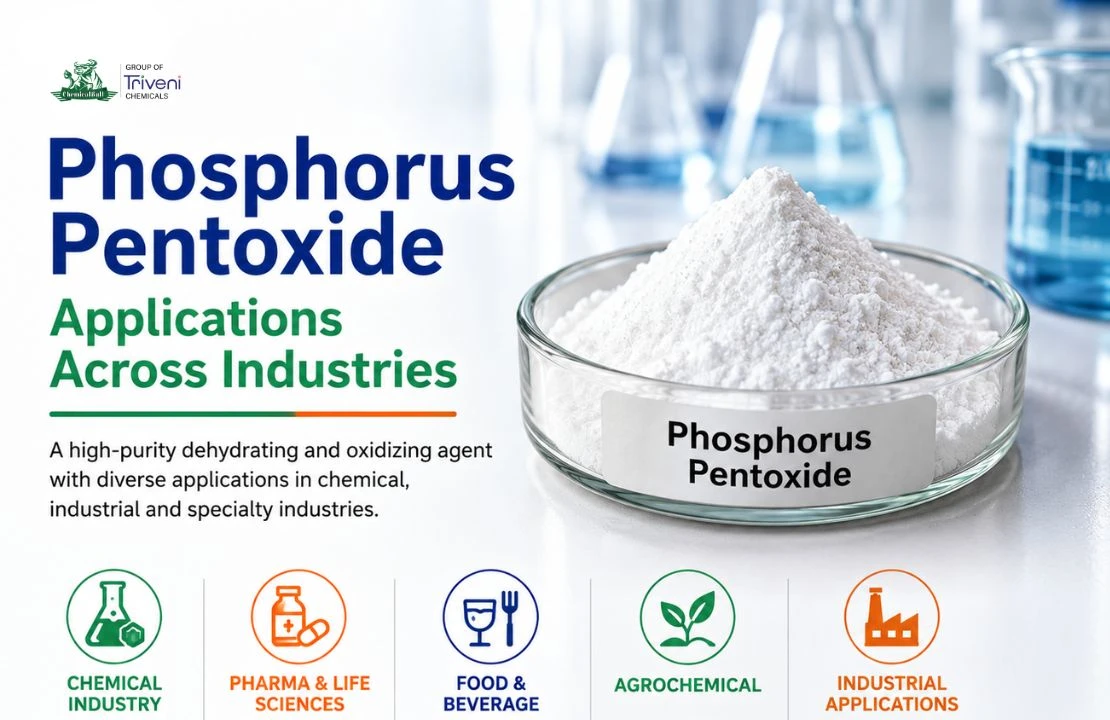
Phosphorus Pentoxide Applications Across Industries
Quick Answer
Phosphorus Pentoxide (P₂O₅), CAS 1314-56-3, is primarily used as a powerful desiccant, dehydrating agent, and chemical reagent. Its strong affinity for water makes it valuable for drying solvents, gases, and reaction systems, while its dehydration and condensation properties make it useful in organic synthesis and the production of phosphoric acid and phosphate derivatives.
Phosphorus Pentoxide also has applications in specialty glass, flame-retardant chemistry, semiconductor processing, petroleum and chemical processing, metal treatment, optical materials, and other industrial applications. Because it reacts strongly and exothermically with water, it requires moisture-resistant storage and careful handling.
What Is Phosphorus Pentoxide?
Phosphorus Pentoxide, commonly written as P₂O₅, is also known as phosphoric anhydride. Although P₂O₅ is the conventional empirical formula, its molecular form is commonly represented as P₄O₁₀.
It is a white crystalline or amorphous solid with an exceptionally high affinity for moisture. This property is responsible for one of its most important industrial functions: removing water from materials and chemical reaction systems. For businesses looking for a reliable Phosphorus Pentoxide supplier, consistent purity, moisture-resistant packaging, and suitable product documentation are important considerations when sourcing this highly hygroscopic material.
Phosphorus Pentoxide therefore serves not only as a drying agent but also as a dehydrating and condensing reagent in chemical manufacturing.
Key Properties of Phosphorus Pentoxide
|
Property |
Details |
|
Chemical Name |
Phosphorus Pentoxide / Phosphoric Anhydride |
|
CAS Number |
1314-56-3 |
|
Empirical Formula |
P₂O₅ |
|
Molecular Form |
P₄O₁₀ |
|
Molecular Weight |
141.94 g/mol on P₂O₅ basis |
|
Appearance |
White crystalline or amorphous solid |
|
Hygroscopicity |
Extremely hygroscopic |
|
Main Functions |
Desiccant, dehydrating agent, condensing agent |
|
Reaction with Water |
Strongly exothermic |
What Are the Main Applications of Phosphorus Pentoxide?
The major Phosphorus Pentoxide applications include:
-
Drying and dehydration
-
Organic chemical synthesis
-
Phosphoric acid production
-
Phosphate derivative manufacturing
-
Flame-retardant chemistry
-
Specialty and optical glass production
-
Semiconductor and electronic applications
-
Petroleum and chemical processing
-
Bitumen and asphalt modification
-
Metal treatment and phosphate chemistry
-
Laser and optical crystal production
-
Production of phosphorus-based industrial chemicals
The exact use depends on the required purity, physical form, process conditions, and downstream product specifications.
1. Phosphorus Pentoxide as a Desiccant and Dehydrating Agent
One of the most important Phosphorus Pentoxide applications is moisture removal.
P₂O₅ has an extremely strong affinity for water, allowing it to remove moisture from solvents, gases, reaction media, and other materials where very dry conditions are required.
It can be particularly useful when conventional drying agents cannot provide the required level of dehydration.
Why Is Phosphorus Pentoxide Used as a Desiccant?
Its strong reaction with moisture makes Phosphorus Pentoxide highly effective at reducing residual water. This property supports applications such as:
-
Solvent drying
-
Gas drying
-
Laboratory and industrial desiccation
-
Moisture-sensitive chemical reactions
-
Controlled-atmosphere processes
-
Chemical synthesis requiring anhydrous conditions
Because P₂O₅ rapidly absorbs moisture from its surroundings, maintaining dry storage conditions is essential for preserving its effectiveness.
2. Phosphorus Pentoxide in Organic Synthesis
Phosphorus Pentoxide is an important dehydrating and condensing reagent in organic chemistry.
Its ability to remove water can facilitate chemical transformations in which dehydration is required. One recognized application is the conversion of certain amides to nitriles.
It can also be involved in the preparation of phosphate esters and other phosphorus-containing intermediates.
This makes P₂O₅ useful in chemical manufacturing processes where controlled dehydration or condensation is required.
3. Phosphorus Pentoxide for Phosphoric Acid Production
Another important application is its role in phosphoric acid production and phosphorus chemistry.
Phosphorus Pentoxide reacts with water to form phosphoric acid while releasing significant heat. This reaction makes P₂O₅ a useful precursor in phosphorus-based chemical production.
Phosphoric acid is subsequently used in numerous downstream processes, including the manufacture of phosphate derivatives and other phosphorus-containing chemicals.
As a result, Phosphorus Pentoxide can occupy an important position further upstream in the phosphorus chemical supply chain.
4. Phosphorus Pentoxide in Phosphate Derivative Manufacturing
Phosphorus Pentoxide can be used as a starting material or reactive component in the manufacture of various phosphate and phosphorus-containing derivatives.
These downstream materials can serve different industrial functions, including:
-
Flame retardants
-
Hydraulic fluid components
-
Surfactants
-
Wetting agents
-
Metal treatment chemicals
-
Extraction agents
-
Specialty phosphorus intermediates
It is important to distinguish between the direct use of P₂O₅ and its downstream applications. In several industries, P₂O₅ is used to manufacture another phosphate compound that provides the final functional performance.
5. Phosphorus Pentoxide in Flame-Retardant Manufacturing
Phosphorus chemistry plays an important role in many flame-retardant systems.
Phosphorus Pentoxide can be used as a raw material in the production of phosphate ester-based flame-retardant compounds. These downstream materials can be incorporated into polymer, textile, and building-material formulations where improved fire resistance is required.
The required P₂O₅ specification can vary depending on the downstream synthesis process, purity requirements, and final application.
6. Phosphorus Pentoxide in Specialty and Optical Glass
Phosphorus Pentoxide is used in selected specialty glass formulations, including optical and heat-resistant glass systems.
Phosphate-containing glass compositions can provide useful optical, thermal, and chemical characteristics. Phosphorus-containing raw materials can therefore be important when manufacturers formulate specialized technical glass.
Potential applications include:
-
Optical glass
-
Specialty glass
-
UV-transmitting glass
-
Heat-resistant glass
-
Technical glass formulations
The required composition and purity depend on the final glass specification.
7. Phosphorus Pentoxide in Semiconductor and Electronics Manufacturing
High-purity phosphorus-containing materials are used in selected semiconductor manufacturing processes.
Phosphorus Pentoxide can serve as a phosphorus source for doping, where phosphorus is introduced into semiconductor materials to modify their electrical properties.
Electronics and semiconductor processes can be highly sensitive to contamination. Therefore, applications requiring high-purity material may have considerably tighter impurity specifications than general industrial applications.
Buyers should confirm the required grade and purity before purchasing material for electronic applications.
8. Phosphorus Pentoxide in Petroleum and Chemical Processing
Phosphorus Pentoxide is associated with the production of polyphosphoric acid and other phosphorus-based acidic materials used in industrial chemical processing.
These downstream materials can have applications in catalyst-related and hydrocarbon-processing processes where acidic conditions are required.
In these applications, the role of P₂O₅ is often related to the production of downstream phosphorus-based processing chemicals rather than direct addition to the final petroleum product.
9. Phosphorus Pentoxide in Bitumen and Asphalt Modification
Phosphorus Pentoxide can be used in selected bitumen and asphalt modification processes, including applications associated with air-blown bitumen.
The purpose is to influence properties such as viscosity and temperature stability of the resulting asphalt or bituminous material.
The suitability of P₂O₅ depends on the specific formulation, processing conditions, and desired final properties.
10. Phosphorus Pentoxide in Metal Treatment
Phosphorus Pentoxide also contributes to the production of phosphate-based metal-treatment chemicals.
Phosphate conversion coatings are widely used in metal treatment to improve properties such as corrosion resistance and adhesion of subsequent coatings.
In this sector, the connection to P₂O₅ is generally through the production of phosphate compounds and treatment formulations rather than the direct use of Phosphorus Pentoxide as the final coating material.
11. Phosphorus Pentoxide in Laser and Optical Crystal Production
High-purity phosphorus-containing raw materials can be used in the production of specialized optical materials and crystals.
Phosphorus Pentoxide is associated with the preparation of materials used for crystals such as KDP, KTP, and DKDP, which have applications in laser and optical systems.
Because optical and electronic applications can be sensitive to trace contaminants, high-purity material and suitable quality documentation can be important purchasing considerations.
12. Phosphorus Pentoxide in Detergent and Water-Softening Chemistry
Phosphorus Pentoxide can contribute indirectly to detergent chemistry through the manufacture of phosphate-based compounds.
Phosphate builders have been used in detergent formulations to improve cleaning performance and water-softening characteristics.
In this case, P₂O₅ is primarily relevant as part of the upstream phosphorus chemistry used to manufacture downstream phosphate materials.
Phosphorus Pentoxide Applications by Industry
|
Industry |
Primary Application |
|
Chemical Manufacturing |
Dehydration, drying, condensation and chemical synthesis |
|
Pharmaceutical Manufacturing |
Chemical synthesis and phosphorus-containing intermediates |
|
Electronics |
Phosphorus source for selected doping processes |
|
Glass Manufacturing |
Specialty and optical glass formulations |
|
Flame-Retardant Industry |
Production of phosphate ester flame retardants |
|
Petroleum & Chemical Processing |
Production of polyphosphoric acid and related materials |
|
Construction |
Selected bitumen and asphalt modification processes |
|
Metalworking |
Production of phosphate-based treatment chemicals |
|
Optical & Laser Industry |
Phosphorus-containing optical crystal production |
|
Detergent Industry |
Downstream phosphate chemistry |
|
Chemical Intermediates |
Production of phosphorus-containing derivatives |
Direct vs. Downstream Applications of Phosphorus Pentoxide
Understanding the difference between direct and downstream applications helps buyers determine where P₂O₅ fits into their manufacturing process.
Direct Applications
Phosphorus Pentoxide itself can function as:
-
A desiccant
-
A dehydrating agent
-
A condensing reagent
-
A chemical synthesis reagent
-
A phosphorus-containing feedstock
Downstream Applications
P₂O₅ can also be used to manufacture other phosphorus-containing chemicals that subsequently find applications in:
-
Flame retardants
-
Metal treatment
-
Lubricant and hydraulic-fluid chemistry
-
Detergent builders
-
Specialty glass
-
Petroleum processing
-
Other industrial formulations
This distinction is important because the required purity and specifications can differ significantly between general dehydration applications and specialized downstream manufacturing.
Why Is Phosphorus Pentoxide Valuable in Industrial Chemistry?
The industrial importance of Phosphorus Pentoxide comes from the combination of several properties.
Extremely Strong Affinity for Water
Its strong reaction with moisture makes it highly effective for dehydration and drying applications.
High Chemical Reactivity
Unlike an inert drying material, P₂O₅ can actively participate in chemical reactions, particularly dehydration and condensation reactions.
Versatility
It can function as both a process reagent and a precursor for downstream phosphorus compounds.
Importance in Phosphorus Chemistry
Phosphorus Pentoxide connects several areas of chemical manufacturing, from dehydration chemistry to phosphate derivatives and specialty materials.
What Grade of Phosphorus Pentoxide Should You Buy?
The correct grade depends on the intended application.
Industrial Grade
Industrial-grade Phosphorus Pentoxide can be suitable for general chemical manufacturing, dehydration, synthesis, and other industrial processes where standard purity specifications are acceptable.
High-Purity Grade
High-purity material may be required for applications where trace impurities can affect process performance, such as selected electronics, semiconductor, optical, or crystal-growth applications.
Physical Form
Phosphorus Pentoxide may be supplied in different physical forms depending on the supplier and application, including:
-
Powder
-
Crystalline material
-
Amorphous material
-
Pressed forms
The appropriate physical form depends on handling requirements and the intended manufacturing process.
What Should Buyers Check Before Purchasing Phosphorus Pentoxide?
For industrial procurement, price should not be the only consideration.
1. Purity
Confirm the required assay and impurity specifications against the intended process.
2. Moisture Content
Because Phosphorus Pentoxide is extremely hygroscopic, moisture control is particularly important.
3. Packaging
The material should be supplied in packaging suitable for protecting it from atmospheric humidity.
4. Certificate of Analysis
Request a Certificate of Analysis (COA) showing relevant quality parameters for the supplied batch.
5. Safety Data Sheet
The Safety Data Sheet (SDS) should be reviewed before handling and storage.
6. Physical Form
Confirm whether your process requires powder, crystalline material, or another available form.
7. Application-Specific Specifications
For electronics, optical materials, pharmaceutical synthesis, or other sensitive applications, communicate the intended use before procurement so the appropriate specification can be evaluated.
Why Choose ChemicalBull for Phosphorus Pentoxide?
Choosing the right Phosphorus Pentoxide supplier is important because product purity, moisture control, packaging, documentation, and supply consistency can directly affect industrial processes.
ChemicalBull provides Phosphorus Pentoxide (CAS 1314-56-3) for businesses evaluating the material for chemical manufacturing, dehydration, synthesis, and other industrial applications.
Why Buy Phosphorus Pentoxide from ChemicalBull?
Application-focused sourcing: ChemicalBull can help buyers evaluate product specifications according to their intended application and purchasing requirements.
Quality and consistency: Consistent specifications are important when Phosphorus Pentoxide is used in moisture-sensitive processes or chemical synthesis. Buyers can request product specifications and batch-related quality documentation for evaluation.
Moisture-controlled packaging: Because P₂O₅ is highly hygroscopic, appropriate packaging and moisture protection are important during storage and transportation.
COA and SDS documentation: Buyers can request relevant documentation, including a Certificate of Analysis (COA) and Safety Data Sheet (SDS), to support technical evaluation and safe handling.
Commercial quantities: ChemicalBull supports businesses looking for commercial quantities of Phosphorus Pentoxide for manufacturing and industrial requirements.
Export-oriented supply: ChemicalBull also works with buyers evaluating chemical sourcing for international markets and export requirements.
Technical and commercial support: Our team can assist with product specifications, packaging requirements, documentation, quantities, and commercial inquiries before order confirmation.
Who Can Source Phosphorus Pentoxide from ChemicalBull?
ChemicalBull can be considered by businesses involved in:
-
Chemical manufacturing
-
Pharmaceutical and intermediate manufacturing
-
Specialty chemical production
-
Flame-retardant manufacturing
-
Glass and optical material production
-
Electronics and semiconductor-related processes
-
Petroleum and industrial chemical processing
-
Metal treatment and phosphate chemistry
-
Research and development
-
Other industrial applications requiring phosphorus-based dehydrating or chemical reagents
Looking for a Phosphorus Pentoxide Supplier?
If you are evaluating Phosphorus Pentoxide (CAS 1314-56-3) for your manufacturing or industrial process, share your required grade, purity, quantity, packaging, application, and delivery location with ChemicalBull.
Our team can help you evaluate the appropriate product specification and provide relevant technical and commercial information for your requirement.
Handling and Storage of Phosphorus Pentoxide
Phosphorus Pentoxide requires careful handling because it reacts strongly with water and atmospheric moisture.
Important precautions include:
-
Store in tightly sealed, moisture-resistant containers.
-
Protect the material from atmospheric humidity.
-
Use dry and clean transfer equipment.
-
Avoid unnecessary exposure to open air.
-
Wear appropriate gloves and eye/face protection.
-
Provide suitable ventilation where dust may be generated.
-
Follow the supplier's SDS and applicable workplace safety procedures.
When P₂O₅ is intentionally reacted with water, the process must be carefully controlled because the reaction is strongly exothermic.
FAQS
-
What is Phosphorus Pentoxide mainly used for?
Phosphorus Pentoxide is mainly used as a desiccant, dehydrating agent, and chemical reagent. It is also used in chemical synthesis and as a precursor for phosphoric acid and various phosphate derivatives. -
What is the CAS number of Phosphorus Pentoxide?
The CAS number of Phosphorus Pentoxide is 1314-56-3. It is commonly represented by the empirical formula P₂O₅, while its molecular form is represented as P₄O₁₀. -
Why is Phosphorus Pentoxide a strong desiccant?
Phosphorus Pentoxide has an extremely strong affinity for water. It reacts with moisture, making it highly effective for drying solvents, gases, and reaction systems where low moisture levels are required. -
Is Phosphorus Pentoxide used in pharmaceutical manufacturing?
Yes. Phosphorus Pentoxide can be used as a dehydrating or condensing reagent in chemical synthesis and in the preparation of certain phosphorus-containing intermediates. Its suitability depends on the specific synthesis and required grade. -
What happens when Phosphorus Pentoxide comes into contact with water?
Phosphorus Pentoxide reacts strongly and exothermically with water to form phosphoric acid. Because substantial heat can be released, uncontrolled contact with water should be avoided.
Related Products
- Phosphoric Acid – Used in fertilizers, food processing, metal treatment, and industrial chemical manufacturing.
- Polyphosphoric Acid – Used in chemical synthesis, petroleum processing, and industrial formulations.
Conclusion
Phosphorus Pentoxide (P₂O₅) is a versatile industrial chemical widely used as a desiccant, dehydrating agent, and chemical reagent. Its applications include chemical synthesis, phosphoric acid production, specialty glass, flame retardants, electronics, and other industrial processes.
For reliable performance, buyers should select the appropriate Phosphorus Pentoxide grade, purity, packaging, and specifications based on their application. Proper moisture protection and safe handling are also essential because P₂O₅ reacts strongly with water.

Comment Section