Chemical Bull
1466
23-May-2026
Introduction
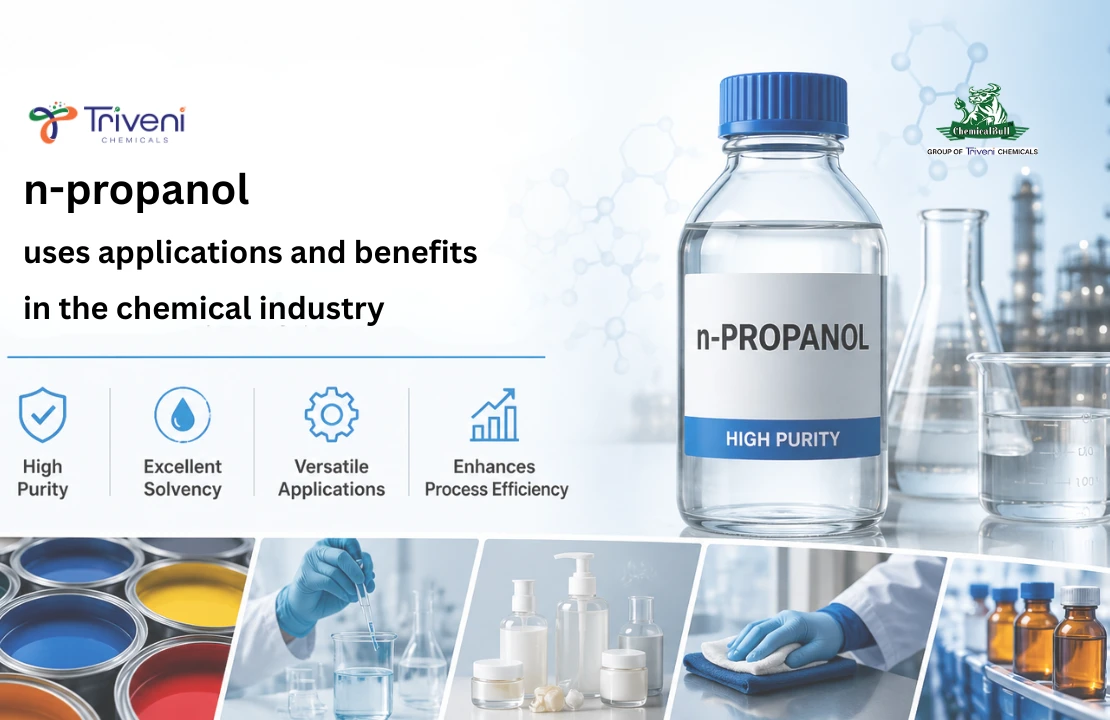
In the modern manufacturing landscape, industrial solvents and blending intermediates serve as the structural backbone for thousands of commercial formulations. Among the diverse spectrum of primary aliphatic alcohols, n-Propanol (also widely referred to as normal propyl alcohol or 1-propanol) stands out as a highly efficient, reliable, and versatile compound. With its unique balance of volatility, structural solubility, and physical characteristics, this chemical intermediate has become indispensable across sectors ranging from advanced structural coatings to premium sensory compounding.
For technical blenders, procurement teams, and downstream plant managers, selecting a high-purity solvent is not just about meeting a basic chemical formula—it is about optimizing production runtimes, ensuring batch safety, and achieving exceptional end-product quality. This definitive guide breaks down the technical parameters, production methodologies, and emerging global shifts that commercial buyers need to navigate when sourcing this essential chemical.
What is N-Propanol?
n-Propanol (C3H8O, CAS No 71-23-8) is a primary, straight-chain aliphatic alcohol containing three carbon atoms, structurally represented as
CH3CH2CH2OH
It appears as a completely clear, colorless, mobile liquid that possesses a characteristically sweet, sharp, alcohol-like odor.
While commodity industries value it purely as an extraction medium or carrier, it plays an incredibly vital role when classified under the Aroma Chemical Category. In fine fragrance compounding and natural volatile synthesis labs, trace amounts of high-purity n-propanol are utilized to refine downstream matrices. At highly diluted, parts-per-million (ppm) levels, its sharp profile transforms into a clean, smooth carrier note, making it a critical choice for balancing top-shelf perfume bases, industrial detergent fragrances, and premium beverage flavors under strict global food-grade standards.
Key Technical Parameters:
-
Molar Mass: 60.1 g/mol
-
Purity Profile: Enterprise-grade material must maintain a continuous purity profile of 99.8%. to eliminate the risk of batch cloudiness or phase separation.
-
Boiling Point: Approximately 97°C (206.6°F) — significantly higher than lighter alcohols like ethanol or methanol, offering a highly controlled evaporation profile.
How is N-Propanol Made?
Understanding how n-propanol is synthesized is essential for procurement heads tracking raw material market stability and feedstock dependencies. On a commercial scale, n-propanol is predominantly manufactured via the hydroformylation (Oxo Process) of ethylene:
-
Oxo Reaction Phase: Ethylene (C2H4), carbon monoxide (CO), and hydrogen (H_2) are reacted under pressure in the presence of a homogeneous rhodium or cobalt catalyst.
-
Intermediate Generation: This step yields propanal (propionaldehyde).
-
Catalytic Hydrogenation Phase: The intermediate propanal is subsequently hydrogenated to produce crude 1-propanol.
-
Fractional Distillation: The crude alcohol undergoes rigorous multi-stage fractional distillation to strip out water traces and impurities, achieving the final industrial-grade 99.8% purity benchmark.
N-Propanol Market Status
The global n-propanol market size has crossed USD 1.8 Billion in 2026, registering a steady compound annual growth rate (CAGR) of approximately 4% to 4.5%. From a macroeconomic perspective, the current market dynamics are heavily driven by two massive global shifts:
-
Infrastructure and Coatings Boom: The rapid expansion of automotive manufacturing and structural urbanization across the Asia-Pacific region has triggered unprecedented consumption of industrial solvents.
-
The Shift in Printing Technology: Because global environmental frameworks are tightening volatile organic compound (VOC) emissions, the flexographic packaging ink sector is aggressively adopting n-propanol to minimize solvent retention in food-grade plastics.
Currently, global supply chains show moderate concentration. Sourcing managers are moving away from volatile spot-market traders to build direct, multi-year volume agreements with integrated N-Propanol manufacturers and reliable domestic stockists to protect their production facilities from logistics bottlenecks.
Core Applications: How Can We Use N-Propanol?
The commercial demand for this flexible intermediate spans across multiple heavy industries, where it serves either as a direct-contact processing solvent or an active chemical block:
1. Advanced Coatings, Paints, and Resins
In surface finish formulations, n-propanol acts as a crucial coupling agent and leveling solvent. It effectively dissolves natural and synthetic resins, architectural cellulose derivatives, varnishes, and protective lacquers. By managing the surface tension of the liquid mix, it prevents structural film defects like pinholing, ensuring coatings cure with an entirely uniform, high-gloss, and weather-resistant layer.
2. High-Speed Flexographic & Gravure Printing Inks
Within automated printing lines, n-propanol is utilized as an evaporation retarder and tail-solvent. It prevents inks from drying prematurely on the printing plates or cylinders during short machine stoppages. Simultaneously, it ensures swift, complete evaporation once stamped onto the flexible paper or plastic substrate, resulting in crisp graphics and zero residual odor retention.
3. Pharmaceutical Processing & Intermediates Synthesis
In strict medical and laboratory settings, n-propanol is widely deployed as an extraction carrier, reaction medium, and crystallization solvent. It plays an active role in synthesizing active pharmaceutical ingredients (APIs) and chemical intermediates, allowing processing plants to maintain strict batch purity standards without risking toxic structural degradation.
Industry Quality Grades & International Standards
When navigating the international procurement market, buyers must understand that different applications demand distinct chemical properties. Tier-1 N-Propanol manufacturers produce multiple grade variations, including Industrial Grade for heavy paint production and high-purity Pharma/Aroma Grade for sensitive compounding. For large-scale manufacturing facilities, sourcing material through tier-1 N-Propanol wholesalers guarantees that each consignment strictly complies with global quality standards such as ASTM D3893 or ISO parameters. This chemical verification process prevents cross-contamination, ensuring that the moisture content, residual acidity, and boiling range remain within acceptable, certified technical specifications.
Bulk Logistics & Material Packaging Options
Operational efficiency in chemical blending depends heavily on secure transit frameworks and predictable delivery formats. Large-scale enterprise buyers generally seek trusted partners who work as professional N-Propanol suppliers to secure continuous, streamlined inventory pipelines. Depending on the size of your plant runs, certified N-Propanol distributors can easily provide customizable packaging solutions, ranging from standard 200 kg HM-HDPE or MS drums for medium-sized factories, up to Intermediate Bulk Containers (IBC totes) and full, insulated tank-container loads for continuous industrial lines. Ensuring correct tank lining material (such as carbon steel or stainless steel) during logistics is vital to prevent trace metallic discoloration.
Related Product Matrices for Industrial Blending
To help chemical engineers and R&D managers cross-reference and optimize their formulation pipelines, look into how n-propanol interacts with or substitutes these related catalog compounds:
-
Propyl Acetate: Manufactured directly through the esterification of n-propanol, this active solvent is frequently paired alongside it in flexographic inks to perfect the drying-rate curve.
-
Isopropanol: The structural isomer of n-propanol. Sourcing heads must note that while Isopropanol flashes off much faster due to its lower boiling point (82.6°C), n-propanol provides the necessary extended "open time" required for proper film leveling in automotive coatings.
-
n-Butanol: A heavier primary alcohol often blended with n-propanol in heavy-duty resin manufacturing to balance solubility scores against solvent evaporation speeds.
-
Ethyl Acrylate: A vital monomer used in acrylic polymers. Blenders utilizing ethyl acrylate often deploy high-purity n-propanol as the base polymerisation solvent carrier to achieve smooth resin viscosity grades.
Essential Benefits of Integrating N-Propanol
-
Enhanced Batch Consistency: Sourcing enterprise-grade material prevents downstream phase separation, cloudiness, and unexpected industrial batch failures.
-
Balanced Evaporation Rates: Compared to highly volatile short-chain solvents, its higher boiling point provides formulation lines with the extended open time necessary for precise layout application and minimized material waste.
-
Robust Safety and Compliance Tracking: Partnering with a dedicated distribution network ensures that every bulk container delivery is accompanied by transparent technical documentation and clear hazard handling standards.
Frequently Asked Questions (FAQs)
-
Is n-propanol identical to 1-propanol?
Yes, n-propanol (normal propyl alcohol) and 1-propanol are entirely identical terms for the same chemical compound. The "1-" indicates that the hydroxyl functional group (-OH) is attached to the primary terminal carbon atom in the chain. -
Can Isopropanol (IPA) seamlessly replace n-propanol in coatings?
Generally, no. Isopropanol has a lower boiling point and evaporates much faster. Substituting it completely can cause the coating to flash off too quickly, creating surface defects like blushing or an uneven "orange-peel" finish. -
Why is n-propanol classified under the Aroma Chemical Category?
While it is heavily used as an industrial solvent, at high dilution levels, its sharp odor turns into a smooth, clean trace carrier note. This makes it highly valued by fragrance and flavor houses for stabilizing synthetic scent profiles and beverage flavor matrices. -
What materials are compatible for bulk n-propanol storage tanks?
Stainless steel (Grade 304 or 316) or high-density carbon steel tanks are highly recommended. Storage operators should completely avoid copper, copper alloys, and aluminum, as prolonged contact can cause trace chemical discolouration.
Comment Section