Chemical Bull
698
25-Jul-2026
Introduction
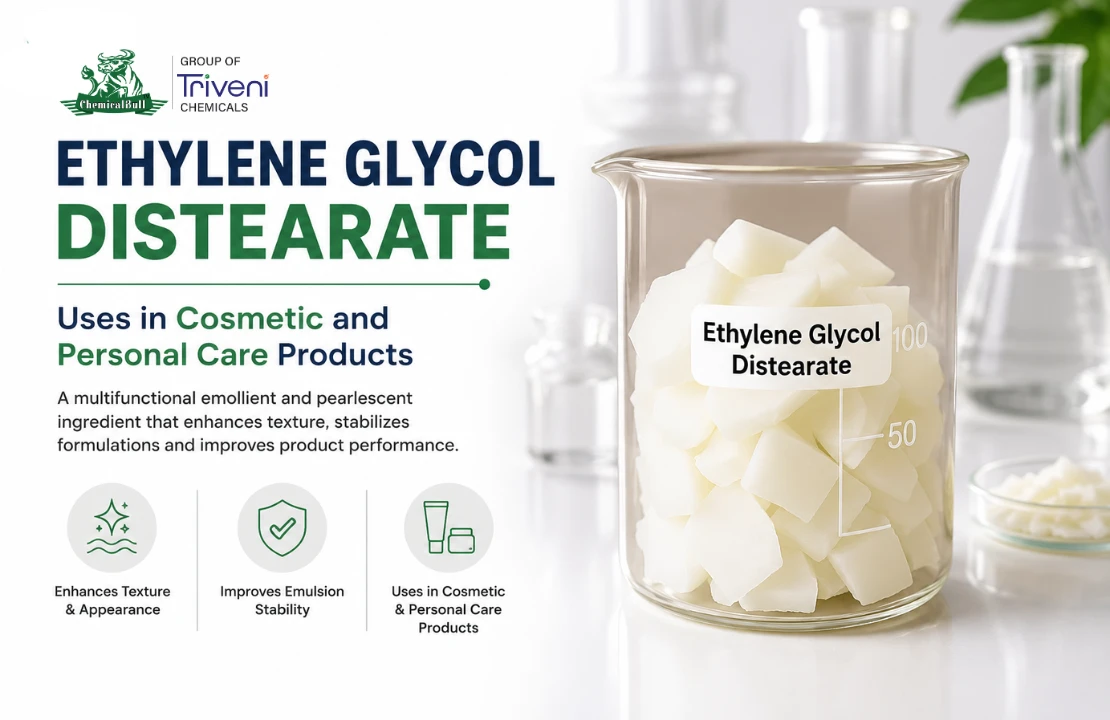
Ethylene Glycol Distearate (EGDS) is a widely used pearlizing and opacifying agent found across the personal care industry. If you have ever noticed the shimmering, pearl-like sheen in a shampoo or body wash, there is a good chance EGDS is responsible for it. This wax-like compound, derived from ethylene glycol and stearic acid, is prized for its ability to transform ordinary formulations into visually appealing, luxury-feeling products.
In this article, we will break down what ethylene glycol distearate in cosmetics does, why formulators reach for it, and where it fits across different product categories. Whether you are a cosmetic chemist, R&D formulator, or procurement manager sourcing raw materials, understanding its function will help you make informed formulation decisions.
For businesses looking to source high-purity material, ChemicalBull is a trusted ethylene glycol distearate supplier offering consistent quality for cosmetic grade applications.
What Is Ethylene Glycol Distearate?
Ethylene Glycol Distearate is a diester formed from the reaction of ethylene glycol with two molecules of stearic acid. It typically appears as a white to off-white waxy solid or flake, insoluble in water but dispersible in oils and surfactant systems. Its molecular structure gives it a unique crystalline behavior. When dispersed properly in a formulation, it reflects light in a way that creates a pearlescent or opalescent visual effect, which is why it plays such a central role across so many personal care categories.
This dual nature, functional and aesthetic, is what makes ethylene glycol distearate uses so broad. It is not just a visual additive; it also contributes measurable improvements to texture, stability, and consistency in the finished product.
CAS Number and Identification
|
Property |
Detail |
|
CAS Number |
627-83-8 |
|
Chemical Formula |
C38H74O4 |
|
Appearance |
White to off white waxy flakes or beads |
|
Solubility |
Insoluble in water; disperses in oil or surfactant phases |
|
Common INCI Name |
Glycol Distearate |
Key Uses of Ethylene Glycol Distearate in Cosmetics
1. Pearlescent and Opacifying Agent
The most recognized among all uses of ethylene glycol distearate is its role as a pearlizing agent. It is added to shampoos, conditioners, body washes, and liquid soaps to give them a glossy, pearl-like appearance that consumers often associate with premium quality. This visual cue has become something of an industry shorthand for a well-formulated, high-end product, even though the pearl effect itself is a functional, controllable outcome of proper EGDS dispersion.
2. Opacifier in Clear Formulations
Beyond pearlescence, EGDS is used to convert transparent or translucent bases into opaque, cream-like formulations. This can be particularly beneficial in creams and lotions where an even, smooth appearance is sought after. Formulators usually prefer EGDS instead of other opacifiers due to the fact that it provides a uniform, even opacity that doesn't compromise the foundation's strength.
3. Viscosity and Texture Modifier
EGDS helps in the stability and thickening of the emulsions. Formulators can achieve an even, more creamy consistency in shampoos, conditioners for hair and body lotions instead of having to rely on thickeners that are typically used. This results in an improved formulation that is balanced and has multiple goals for sensory satisfaction achieved with a single ingredient.
4. Emulsion Stabilizer
In the oil-in-water emulsions that are used, ethylene glycol distearate is used to ensure consistency by strengthening the structure inside the emulsion. It also reduces the chance of phase separation during the product's shelf time. This is particularly important for leave-on products like lotions, in which stability for a long time directly influences consumer satisfaction and product return.
5. Skin Feel Enhancer
Formulators may also utilize it to increase the tactile experience of their products, which contributes to a silky smooth experience that improves the overall experience for the user. The tactile enhancement is usually the same for customers as the pearl effect in visuals, especially in leave-on skin cosmetics, where the after-feel affects customers to purchase more frequently.
Product Categories Where EGDS Is Commonly Used
Ethylene distearate of glycol used in cosmetics is found in a wide variety of formulations, such as:
- Hair Care: Shampoos, conditioners, hair masks
- Body Care: Body washes, shower gels, liquid hand soaps
- Skin Care: Lotions, creams, moisturizers
- Specialty Formulations: Bases for cosmetics with a pearlescent finish, opaque surfactant systems
Each of these types depends on EGDS to serve a variety of reasons. Formulations for body and hair care rely more on its pearlizing ability, and skin care products tend to focus on its function in the form of a texture enhancement.
Formulator's Notes
When adding EGDS into formulations, the proper dispersion of EGDS is crucial. Typically, it is melted and then incorporated into the oil or surfactant phase at high temperatures, and then cooled in a controlled manner so that the crystals with pearlescent properties can develop properly. A lack of control over temperature while cooling could create different effects of pearls or graininess within the finished result.
Formulators must also consider how compatible EGDS is in conjunction with the surfactant systems, as interactions with amphoteric or anionic surfactants may affect the way the pearl effect occurs. Conducting small-scale compatibility tests prior to scaling up production is usually recommended since this allows you to spot problems with formulation early and prevents expensive failures in batches at commercial scale.
Why Ethylene Glycol Distearate Remains a Formulator Favorite
Its versatility, functioning simultaneously as a pearlizer, opacifier, and texture enhancer, makes it a cost-effective, multipurpose ingredient. Rather than using separate additives for each visual and textural effect, formulators can rely on a single ingredient to achieve multiple outcomes, simplifying formulation complexity and reducing raw material costs.
This efficiency is a major reason EGDS continues to hold its place in modern personal care formulations, even as new specialty additives enter the market. Its long track record of reliable performance, combined with well-understood handling and processing requirements, makes it a low-risk choice for both established and emerging brands.
Conclusion
Ethylene Glycol Distearate continues to be one of the most practical and widely relied upon ingredients in personal care formulation. From giving shampoos and body washes their signature pearlescent shine to improving the texture, stability, and skin feel of lotions and creams, its uses span nearly every major product category in the industry. For formulators, its appeal lies in its versatility: a single ingredient that addresses visual appeal, sensory experience, and formulation stability all at once.
As personal care brands continue to compete on both product performance and shelf appeal, ingredients like EGDS that deliver on multiple fronts will likely remain a staple in formulation labs whether you are developing a new pearlescent shampoo or refining the texture of an existing lotion line, understanding how and why ethylene glycol distearate works can help you make better, more informed formulation decisions.
FAQs
Q1. What is ethylene glycol distearate used for in cosmetics?
It is primarily used as a pearlizing and opacifying agent in personal care formulations such as shampoos, body washes, and lotions, while also contributing to texture and viscosity.
Q2. Is ethylene glycol distearate safe for skin and hair care products?
It is widely used across global personal care formulations at standard use levels. Formulators should always refer to supplier documentation and conduct compatibility testing for specific applications.
Q3. Does ethylene glycol distearate dissolve in water?
No, it is insoluble in water. It is dispersed within the oil or surfactant phase of a formulation during processing.


Comment Section