Chemical Bull
77
30-Sep-2026
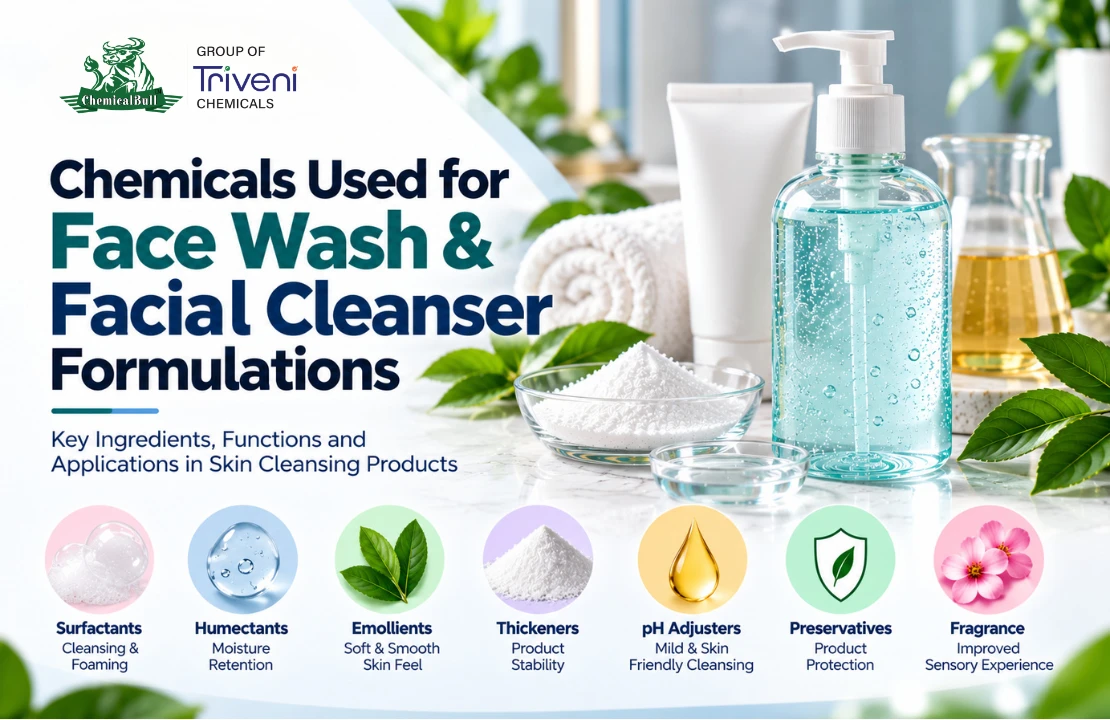
Chemicals Used for Face Wash & Facial Cleanser Formulations
A well-formulated face wash depends on a careful balance of surfactants, conditioning agents, and emulsifiers working together to cleanse effectively without stripping the skin. Getting this balance right is what separates a harsh, drying cleanser from one that leaves skin feeling clean and comfortable.
Primary and Secondary Surfactants for Face Wash
Surfactants are the core cleansing agents in any face wash, responsible for lifting oil, dirt, and makeup from the skin's surface. Milder amphoteric surfactants are commonly paired with a primary cleansing agent to reduce irritation potential.
- Cocamidopropyl Betaine: One of the most widely used secondary surfactants in face wash formulations, valued for boosting foam and reducing the harshness of primary cleansing agents.
- Cocamidopropyl Hydroxysultaine: A mild sultaine surfactant known for good tolerance to hard water and stable performance across a range of pH levels.
- Cocamidopropylamine Oxide: Used as a foam stabilizer and viscosity builder, often paired with betaines for richer lather.
- Cocamide DEA: A foam booster and thickener used to build cleanser viscosity and enhance the sensory feel of the lather.
- Cocamidopropyl Dimethylamine: The precursor amine used in producing betaine-type surfactants, also used directly in some specialty cleansing formulations.
Conditioning Agents for a Non-Stripping Feel
- Polyquaternium-7: A cationic conditioning polymer used in face wash formulations to reduce the tight, stripped feeling that can follow cleansing, particularly in sulfate-based systems.
Emulsifiers and Thickeners for Cream and Gel Cleansers
Cream-based and gel cleansers rely on emulsifiers and thickening agents to achieve the right texture and stability.
- Glycerol Monostearate: A common emulsifier used to stabilize cream cleanser formulations and contribute a smooth, rich texture.
- Sorbitan Monostearate: Often paired with a polysorbate counterpart to create stable oil-in-water emulsion systems in cream cleansers.
- Polysorbate 60: A nonionic emulsifier commonly used alongside sorbitan esters to balance emulsion stability in cleansing creams.
- Stearic Acid: Used as a thickening and emulsifying agent in cream-based cleanser formulations.
- PEG-7 Glyceryl Cocoate: A mild nonionic surfactant and emollient used in facial cleansers for gentle cleansing and a soft skin feel.
Humectants and Emollients
- PEG 400: A humectant used to help retain moisture and improve product spreadability in liquid and gel cleansers.
- Glycerol Monolaurate: Contributes emollient and mild antimicrobial properties in select facial cleanser formulations.
- Ethylhexyl Cocoate: A lightweight emollient ester used to improve the sensory glide and after-feel of cream and lotion-based cleansers.
Typical Formulation Structure for a Basic Face Wash
Understanding how these ingredient categories come together helps clarify why each one earns its place in a formulation:
-
Water Phase Base:
Most face wash formulations start with a water base, into which surfactants and water-soluble actives are dispersed. -
Primary Cleansing System:
A primary surfactant provides the core cleansing action, typically supplemented with a secondary surfactant like Cocamidopropyl Betaine to soften the overall profile. -
Foam and Texture Adjustment:
Foam boosters and thickeners, such as Cocamide DEA or Cocamidopropylamine Oxide, are added to hit the target lather and viscosity. -
Conditioning and Skin Feel:
Conditioning polymers and emollients are incorporated to offset any residual dryness from the cleansing surfactants. -
Preservation and Stability:
A preservative system and pH adjusters round out the formulation to ensure microbial safety and shelf stability, though these fall outside the core cleansing and conditioning categories covered here.
Cream vs. Gel vs. Foaming Face Wash: Ingredient Differences
|
Format |
Primary Formulation Focus |
Key Ingredient Categories |
|
Foaming Gel Cleanser |
High lather, quick rinse-off |
Primary and secondary surfactants, foam boosters |
|
Cream Cleanser |
Rich texture, gentler cleansing |
Emulsifiers, emollients, lower surfactant concentration |
|
Micellar-Style Cleanser |
No-rinse cleansing action |
Mild surfactants, humectants, minimal foam-boosting actives |
Choosing a format upfront helps formulators prioritize which ingredient categories to weight most heavily, since a foaming gel and a rich cream cleanser draw on a different balance of the same broad ingredient toolkit.
Why These Ingredient Categories Matter
|
Category |
Function |
Example Products |
|
Secondary Surfactants |
Boost foam, reduce irritation from primary surfactants |
Cocamidopropyl Betaine, Cocamidopropylamine Oxide |
|
Conditioning Agents |
Reduce post-cleansing tightness and dryness |
Polyquaternium-7 |
|
Emulsifiers |
Stabilize cream and gel formulation texture |
Glycerol Monostearate, Sorbitan Monostearate, Polysorbate 60 |
|
Humectants/Emollients |
Support moisture retention and smooth skin feel |
PEG 400, Glycerol Monolaurate, Ethylhexyl Cocoate |
Formulation Considerations for Face Wash Manufacturers
-
Balance Cleansing with Mildness:
Pairing a primary surfactant with a mild amphoteric like Cocamidopropyl Betaine helps maintain cleansing power while reducing irritation potential. -
Consider Skin Type Positioning:
Formulations targeting sensitive or dry skin often lean more heavily on conditioning agents and emollients relative to foam-boosting actives. -
Test Viscosity and Stability:
Cream and gel cleansers require emulsifier and thickener combinations validated through stability testing across temperature ranges and shelf life. -
Confirm Regulatory Compliance:
Ingredient concentration limits and labeling requirements vary by target market, so confirm compliance for each region you sell into.
What to Look for in a Personal Care Chemical Supplier
-
Cosmetic-Grade Purity:
Confirm each raw material meets relevant cosmetic ingredient standards for your target market. -
Batch Documentation:
Request a Certificate of Analysis (CoA) and Safety Data Sheet (SDS) for every ingredient. -
Broad Product Range:
A supplier carrying surfactants, emulsifiers, conditioning agents, and emollients simplifies sourcing across your full formulation. -
International Supply Capability:
For brands selling across multiple markets, confirm the supplier can support consistent documentation and export requirements internationally. -
Sample Availability:
Request trial quantities of new ingredients to validate performance in your specific formulation before bulk ordering. -
Consistent Lead Times:
Since finished product manufacturing often runs on fixed production schedules, confirm the supplier's track record for reliable, on-time bulk delivery.
Chemical Bull supplies personal care chemicals in bulk quantities with competitive pricing across international markets, and working with a supplier who carries relevant personal care chemical products across every formulation category simplifies sourcing for face wash and facial cleanser manufacturers.
Frequently Asked Questions
-
What are the main types of chemicals used in face wash formulations?
Face wash formulations typically combine surfactants for cleansing, secondary surfactants for mildness and foam, conditioning agents to reduce dryness, and emulsifiers for cream or gel textures. -
Why are secondary surfactants like Cocamidopropyl Betaine used in face wash?
They boost foam and reduce the harshness of primary cleansing surfactants, helping create a milder, more skin-friendly formulation. -
What role does Polyquaternium-7 play in a facial cleanser?
It's a conditioning polymer that helps reduce the tight, stripped feeling that can follow cleansing, particularly in formulations built around stronger primary surfactants. -
What ingredients are used in cream-based facial cleansers?
Cream cleansers typically use emulsifiers like Glycerol Monostearate and Sorbitan Monostearate, often paired with Polysorbate 60, along with Stearic Acid for thickening. -
Does Chemical Bull supply personal care chemicals internationally?
Yes, Chemical Bull supplies personal care chemicals in bulk quantities with competitive pricing across international markets, supporting face wash and facial cleanser manufacturers.
Conclusion
Formulating an effective face wash comes down to balancing cleansing surfactants, mild secondary surfactants, conditioning agents, and emulsifiers to achieve both performance and a comfortable skin feel. Sourcing these raw materials from a supplier who carries relevant personal care chemical products across every category, with consistent documentation and international supply capability, helps manufacturers build reliable, well-performing formulations.

Comment Section