Pyrrole | 109-97-7
Cas No :
109-97-7
Synonyms :
Form :
Liquid
Molecular Weight :
67.09 G/mol
Molecular Formula :
C4H5N
Boiling Point :
128 °c
Melting Point :
-60 °c
Flash Point :
-20 °c
Solubility :
Soluble In Water And Many Organic Solvents
Description :
Overview of Pyrrole
Pyrrole is a colorless to yellowish volatile liquid heterocyclic aromatic compound that darkens on exposure to air, forming the core of many natural products and pharmaceuticals.
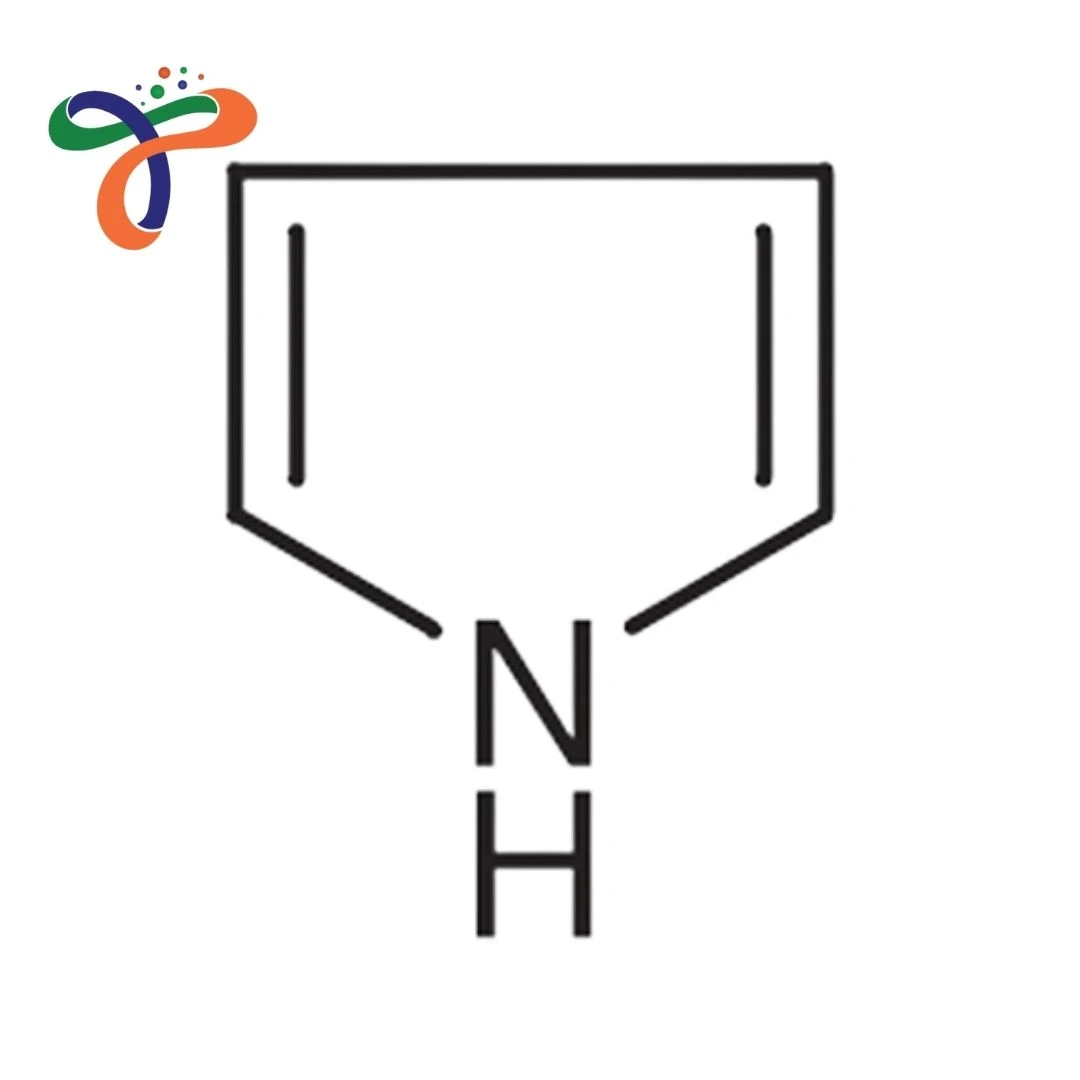
Chemical Formula: C4H5N Pyrrole formula: C4H4NH (often written as such) Pyrrole structure: Five-membered ring with four carbons and one nitrogen, aromatic with 6 π-electrons Functional properties: Weakly basic and acidic, highly reactive toward electrophilic substitution at α-positions
Application of Pyrrole
Organic Synthesis as well as Materials
- What is Pyrrole used for? The building block used to make porphyrins, chlorophyll-like analogs, conductor polymers (polypyrrole), and pharmaceuticals.
- Pyrrole can be used as a solvent in Agrochemicals, dyes, and as an intermediate.
Industrial Use
- It is used to synthesize fine chemicals and heterocyclic derivatives
- Sometimes used in reaction with esters, such as Diethyl Maleate, to make Diels-Alder, or in condensate products
Safe Handling and Safety Guidelines
- Use protective glasses, gloves, and other appropriate attire
- Avoid contact with the skin or breathing (volatile as well as toxic)
- Make use of it only in an area that is well ventilated, such as a fume hood
- Store in sealed, cool, dark containers to prevent darkening/resinification
- Use MSDS guidelines and safety guidelines
Where can I buy Pyrrole?
Pyrrole Manufacturer
- High-purity Pyrrole Suppliers for industrial and research synthesizing
Pyrrole Supplier & Distributor
- Bulk supply complete with COA, TDS, MSDS, and COA. MSDS available
Pyrrole MSDS
Offers information on dangers, handling, storage, as well as emergency measures.
Frequently Asked Questions (FAQs)
-
What is the Pyrrole formula and structure?
C4H5N; five-membered aromatic heterocycle with nitrogen and conjugated double bonds. -
What are the uses of Pyrrole?
As a precursor to polymers, pharmaceuticals, dyes, and natural product analogs, such as heme/chlorophyll. -
What is Pyrrole used for in synthesis?
Key intermediates in heterocyclic chemistry, porphyrins, and conducting materials.
ChemicalBull supplies Pyrrole across India, serving customers in Andhra Pradesh, Arunachal Pradesh, Assam, Bihar, Chhattisgarh, Goa, Gujarat, Haryana, Himachal Pradesh, Jharkhand, Karnataka, Kerala, Madhya Pradesh, Maharashtra, Manipur, Meghalaya, Mizoram, Nagaland, Odisha, Punjab, Rajasthan, Sikkim, Tamil Nadu, Telangana, Tripura, Uttar Pradesh, Uttarakhand, and West Bengal, as well as the Union Territories of Andaman & Nicobar Islands, Chandigarh, Dadra & Nagar Haveli and Daman & Diu, Delhi, Jammu & Kashmir, Ladakh, Lakshadweep, and Puducherry. We serve pharmaceutical, chemical, research, academic, laboratory, manufacturing, and industrial customers with reliable nationwide delivery.