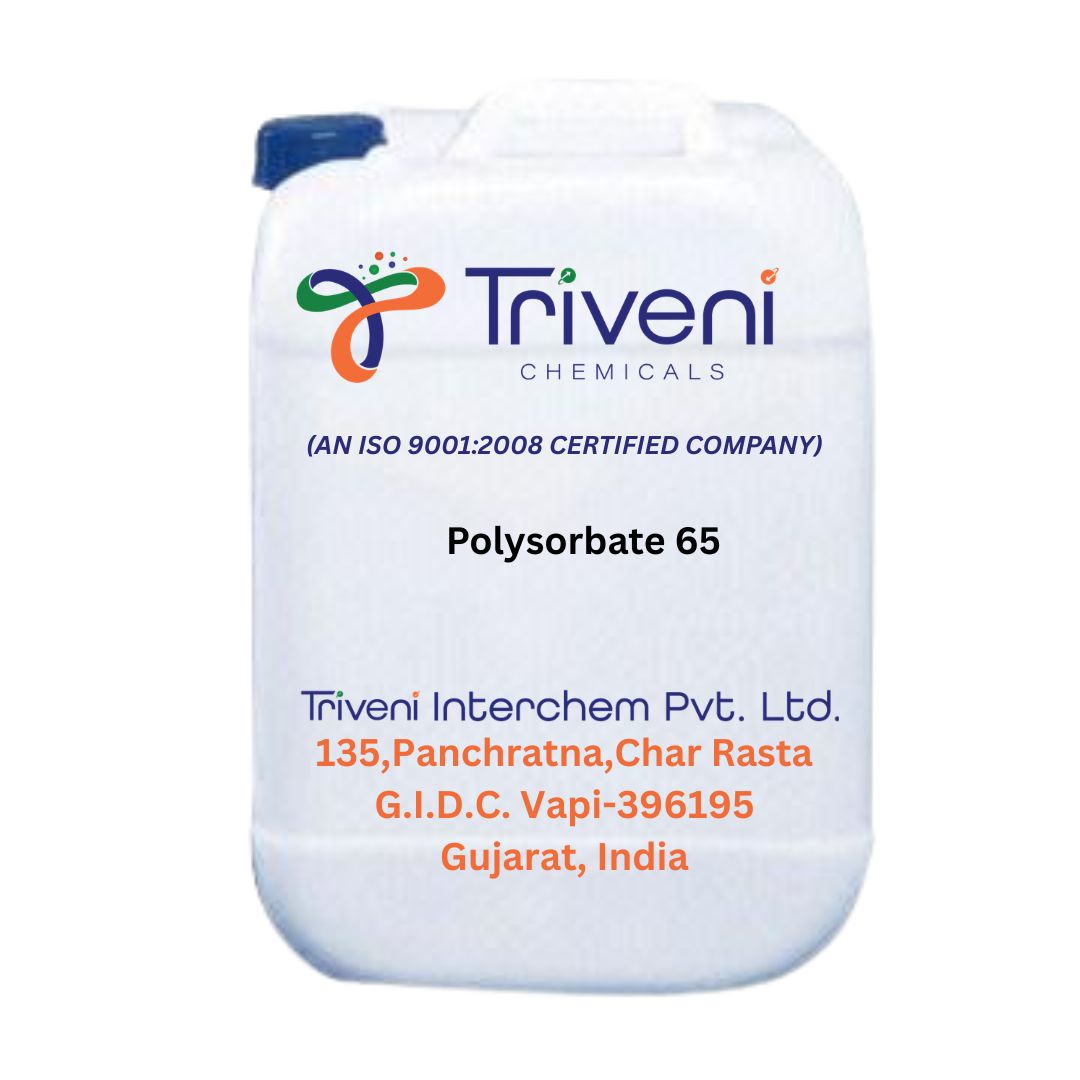

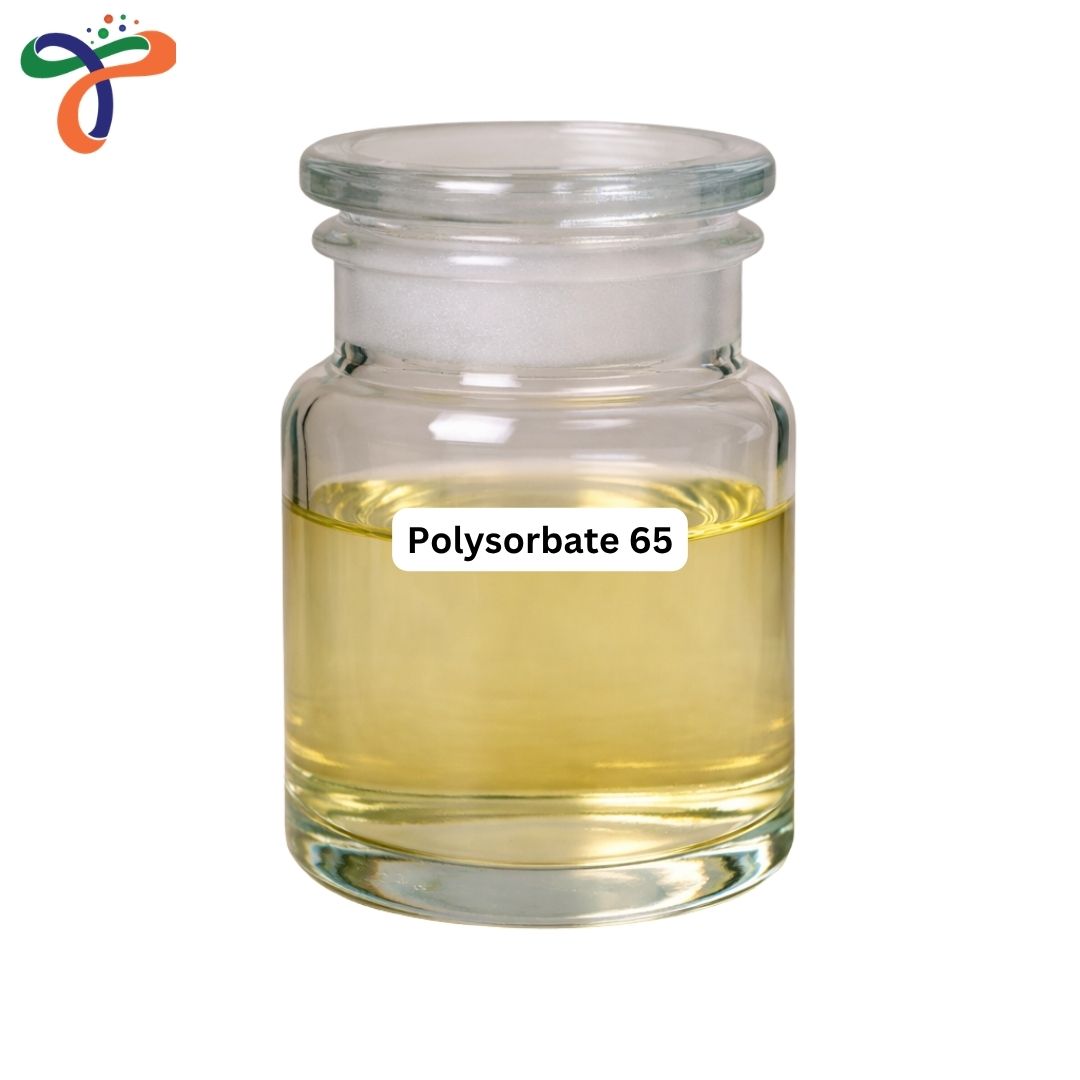
Polysorbate 65
Form :
Liquid
Molecular Weight :
1317.6 g/mol
Boiling Point :
260 °C
Melting Point :
-5 °C
Flash Point :
200 °C
Solubility :
Water soluble
Description :
Polysorbate 65 Suppliers and Manufacturers
What is Polysorbate 65?
Polysorbate 65, also known as polyoxyethylene (20) sorbitan tristearate, is a non-ionic surfactant and emulsifier with CAS No. 9005-71-4. It belongs to the polysorbate family and is valued for its ability to help stabilize mixtures containing oil- and water-based ingredients.
Polysorbate 65 is generally supplied as a solid material and is used in selected food, confectionery, dairy, cosmetic, personal care, and industrial formulations. Its emulsifying and stabilizing properties make it useful in applications where formulation consistency, dispersion, texture, and stability are important.
Polysorbate 65 is also identified by INS 436 and is commonly associated with the alternative chemical name polyoxyethylene (20) sorbitan tristearate.
Chemical Bull supplies Polysorbate 65 (CAS 9005-71-4) in bulk quantities for commercial and industrial requirements, subject to applicable product specifications, grades, documentation, and destination requirements.
Polysorbate 65 Properties
Polysorbate 65 is a non-ionic surfactant containing polyoxyethylene groups and fatty-acid-derived stearate components. Its amphiphilic structure allows it to interact with both oil and water phases, making it suitable for emulsification and stabilization in different formulation systems.
The material is generally recognized as a solid polysorbate and differs from liquid polysorbates such as Polysorbate 20 and Polysorbate 80. Polysorbate 65 has an HLB value of approximately 10.5, although the reported value may vary depending on the reference and measurement method.
Its functional characteristics can make it useful when formulators require improved dispersion, emulsion stability, texture control, or compatibility between otherwise difficult-to-mix ingredients.
Polysorbate 65 Uses and Applications
Food and Confectionery
Polysorbate 65 is used as an emulsifier and stabilizer in selected food and confectionery formulations. It can help improve the interaction between fat and aqueous components and contribute to formulation consistency.
Chocolate and Fat-Based Products
Polysorbate 65 can be used in selected chocolate and fat-based formulations where control of texture, dispersion, and surface characteristics is required.
Dairy and Frozen Desserts
Polysorbate 65 may be used in dairy and frozen-dessert formulations as an emulsifying and stabilizing ingredient. It can help maintain consistent texture and distribution of ingredients in suitable formulations.
Bakery Applications
In selected bakery formulations, Polysorbate 65 can contribute to emulsification and ingredient dispersion, supporting consistent product texture and formulation stability.
Cosmetics and Personal Care
Polysorbate 65 is used in certain cosmetic and personal-care formulations as an emulsifier, dispersing agent, and stabilizer. It can be incorporated into creams, lotions, and other formulations containing oil- and water-based components.
Industrial Formulations
Polysorbate 65 can function as a non-ionic surfactant, emulsifier, or dispersing agent in industrial formulation systems where stabilization of different phases is required.
Polysorbate 65 as an Emulsifier
Polysorbate 65 is valued for its emulsifying characteristics because its molecular structure contains both hydrophilic and lipophilic components. This allows it to assist in the formation and stabilization of mixtures containing ingredients with different polarities.
Its performance depends on factors such as formulation composition, concentration, processing conditions, temperature, and the other surfactants or emulsifiers used in the system.
Polysorbate 65 vs Polysorbate 60
Polysorbate 65 and Polysorbate 60 are both members of the polysorbate family and are associated with stearate-based fatty-acid components. However, their ester structures are different.
Polysorbate 65 is commonly identified as polyoxyethylene (20) sorbitan tristearate, whereas Polysorbate 60 is polyoxyethylene (20) sorbitan monostearate.
Because of their different molecular structures, they can provide different emulsification and formulation characteristics. The appropriate material depends on the required HLB, formulation composition, processing conditions, and final application.
Polysorbate 65 vs Polysorbate 80
Polysorbate 65 and Polysorbate 80 are both non-ionic surfactants, but they are based on different fatty-acid components.
Polysorbate 65 is associated with stearate, while Polysorbate 80 is associated with oleate. This structural difference gives the two materials different physical and functional characteristics.
The selection between Polysorbate 65 and Polysorbate 80 should therefore be based on the required emulsification behavior, formulation compatibility, HLB requirements, processing conditions, and intended application.
To streamline your broader factory procurement, you can seamlessly cross-source from our extensive catalog of high-performance chemical solutions, which are frequently used in tandem with Polysorbate 65 for industrial manufacturing and food processing:
-
GMS (Glyceryl Monostearate): Often formulated alongside Polysorbate 65 to provide synergistic emulsification and texture stabilization in dairy and bakery applications.
-
Sorbitan Tristearate: A common co-emulsifier used in confectionery to provide additional control over fat crystallization and product sheen.
-
Stearic Acid: A foundational fatty acid utilized as a building block in the synthesis of various high-performance emulsifiers.
-
Polysorbate 80: A related surfactant often sourced by manufacturers looking for a wider range of HLB (Hydrophilic-Lipophilic Balance) options for complex formulations.
Polysorbate 65 Safety and Regulatory Information
Polysorbate 65 is used in specific food, cosmetic, personal-care, and industrial applications subject to applicable regulations and product specifications. Its permitted use depends on the intended application, formulation, concentration, and regulatory requirements of the destination market.
For food applications, buyers and formulators should verify the applicable food regulations and permitted use conditions for their specific product and market before commercial production.
Always review the manufacturer's current SDS/MSDS, technical data sheet, certificate of analysis, and applicable regulatory documentation before handling or incorporating Polysorbate 65 into a commercial formulation.
Polysorbate 65 Storage and Handling
Polysorbate 65 should be stored in a cool, dry, and well-ventilated area in tightly closed original or suitable containers. Protect the material from excessive heat, moisture, contamination, and incompatible materials.
During handling, appropriate personal protective equipment should be used according to the product's current SDS/MSDS. Avoid unnecessary generation of dust or particles and maintain good industrial hygiene practices.
Storage and handling requirements should always be confirmed against the supplier's current technical and safety documentation.
Polysorbate 65 Supplier
Chemical Bull supplies Polysorbate 65 (CAS 9005-71-4) for bulk commercial and industrial requirements. We support procurement requirements for industries such as food processing, confectionery, dairy, cosmetics, personal care, and industrial formulation.
Customers can contact Chemical Bull to enquire about Polysorbate 65 availability, specifications, grades, packaging, documentation, bulk quantities, and commercial quotations.
Our supply support is designed for businesses requiring consistent sourcing of specialty and industrial chemicals for manufacturing and formulation requirements.
Bulk Polysorbate 65 Supply
For commercial procurement, buyers can enquire about:
- Bulk quantities
- Available product specifications
- Applicable grades
- Packaging options
- Certificate of Analysis (COA)
- Safety Data Sheet (SDS/MSDS)
- Technical documentation
- Export requirements
- Delivery destinations
- Bulk pricing and quotations
Product availability, specifications, packaging, and commercial terms may vary according to quantity, application, destination, and current supply conditions.
Polysorbate 65 MSDS / SDS
Request the latest Polysorbate 65 MSDS/SDS for information relating to product identification, hazard classification, handling, storage, personal protection, transportation, and emergency measures.
For commercial procurement, customers can also enquire about the applicable Certificate of Analysis (COA) and technical documentation.
Frequently Asked Questions (FAQ)
-
What is Polysorbate 65 used for?
It is primarily used as an emulsifier, anti-blooming agent, and stabilizer. It is essential in the production of chocolate, ice cream, whipped toppings, and cosmetic lotions. -
Is Polysorbate 65 safe to use?
Yes, it is widely recognized as safe (GRAS) for food-grade applications and is highly stable in a variety of industrial formulations. -
How is Polysorbate 65 stored?
It should be stored in a cool, dry, and well-ventilated area in tightly sealed containers to prevent moisture absorption and maintain product quality.
ChemicalBull supplies Polysorbate 65 across India, serving customers in Andhra Pradesh, Arunachal Pradesh, Assam, Bihar, Chhattisgarh, Goa, Gujarat, Haryana, Himachal Pradesh, Jharkhand, Karnataka, Kerala, Madhya Pradesh, Maharashtra, Manipur, Meghalaya, Mizoram, Nagaland, Odisha, Punjab, Rajasthan, Sikkim, Tamil Nadu, Telangana, Tripura, Uttar Pradesh, Uttarakhand, and West Bengal, as well as the Union Territories of Andaman & Nicobar Islands, Chandigarh, Dadra & Nagar Haveli and Daman & Diu, Delhi, Jammu & Kashmir, Ladakh, Lakshadweep, and Puducherry. We serve pharmaceutical, chemical, research, academic, laboratory, manufacturing, and industrial customers with reliable nationwide delivery.