Chemical Bull
665
08-Jul-2026
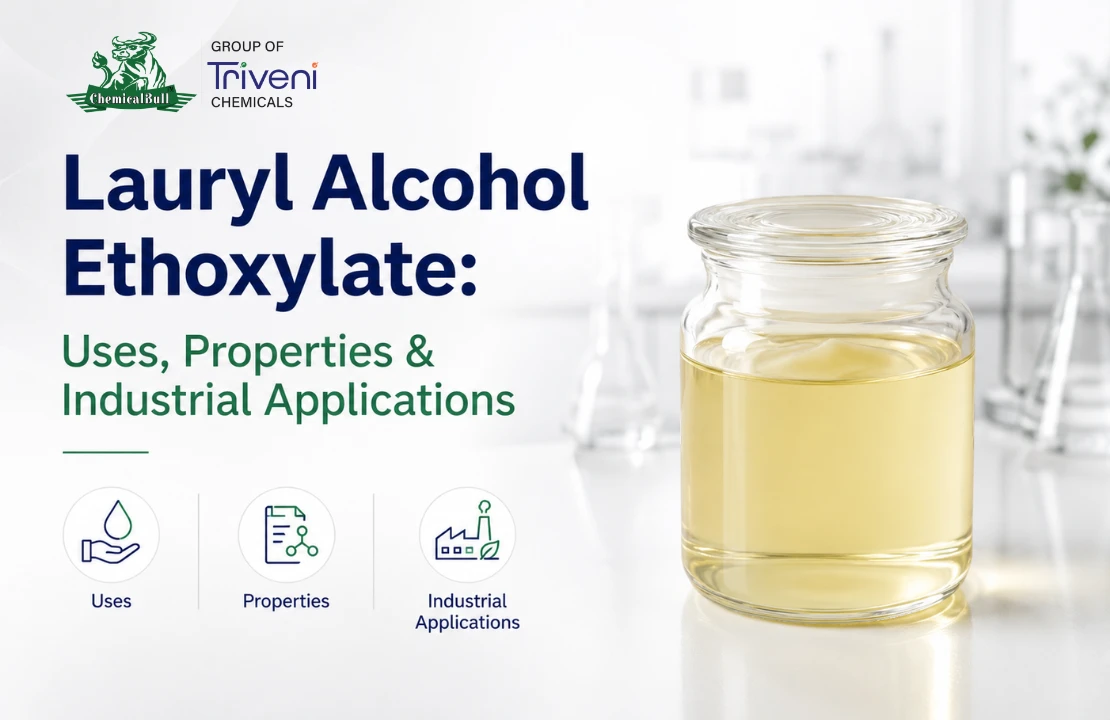
Lauryl Alcohol Ethoxylate: Uses, Properties, and Industrial Applications
What is Lauryl Alcohol Ethoxylate?
Lauryl Alcohol Ethoxylate (LAE) is a non-ionic surfactant produced by reacting lauryl alcohol (a C12 fatty alcohol) with ethylene oxide under controlled conditions. The resulting molecule has a hydrophobic lauryl alcohol tail and a hydrophilic polyethylene oxide chain, giving it the amphiphilic structure that makes it effective as an emulsifier, wetting agent, dispersant, and detergent ingredient.
What is ethoxylated lauryl alcohol?
It is the same compound, just named from the reverse direction: lauryl alcohol that has been ethoxylated. Both names refer to the same non-ionic surfactant family used across personal care, home care, industrial cleaning, textile, agrochemical, and coating applications. For bulk industrial-grade supply with COA, MSDS, and grade-specific documentation,
ChemicalBull is a trusted lauryl alcohol ethoxylate manufacturer supporting formulators and manufacturers across India and global export markets.
Chemical Identity and Physical Properties:
|
Property |
Details |
|
Chemical Name |
Lauryl Alcohol Ethoxylate |
|
Synonyms |
Ethoxylated Lauryl Alcohol, LAE, Polyethylene Glycol Monododecyl Ether |
|
Base Raw Material |
Lauryl Alcohol (C12 fatty alcohol) |
|
Surfactant Type |
Non-ionic |
|
Molecular Weight |
506.69 g/mol (varies by EO grade) |
|
Physical Form |
Clear to pale yellow liquid |
|
Boiling Point |
260°C |
|
Flash Point |
150°C |
|
Solubility |
Water-soluble |
|
HLB Value |
Varies by EO mole grade (low EO = low HLB, high EO = high HLB) |
|
Available Grades |
LAE 2, LAE 3, LAE 5, LAE 7, LAE 9 and others |
How EO Mole Grade Affects Performance
Lauryl Alcohol Ethoxylate is available in multiple grades based on the number of moles of ethylene oxide (EO) reacted with lauryl alcohol. The EO count directly determines the HLB value, solubility, and the most suitable application.
|
Grade |
EO Moles |
HLB Range |
Typical Use |
|
LAE 2 |
2 |
Low |
Oil-in-water emulsification, agrochemical emulsions |
|
LAE 3 |
3 |
Low to medium |
Emulsifiers, textile wetting |
|
LAE 5 |
5 |
Medium |
Detergent blends, dispersants |
|
LAE 7 |
7 |
Medium to high |
Laundry detergents, liquid cleaners |
|
LAE 9 |
9 |
High |
Personal care, hard surface cleaners |
|
LAE 12 and above |
12+ |
High |
Solubilizers, foam boosters, clear formulations |
Selecting the correct EO grade is critical for achieving the desired balance of wetting, emulsification, foam, and cleaning performance in a formulation.
Lauryl Alcohol Ethoxylate Uses and Applications:
1. Personal Care Products
Uses of Lauryl Alcohol Ethoxylate for personal care cover a vast variety of leave-on and rinse-off formulations. It is used as an emulsifier, wetting agent, and foam stabilizer, and also as a co-surfactant
- Hair shampoos as well as liquid cleaners
- Body washes
- Cleansers for the face and cleansing milks
- Hand soaps that are liquid, along with bath items
- Lotions and creams (emulsification help)
Higher EO grades (LAE 7 to LAE 12) are typically preferred in personal care for their better water solubility, mildness, and clarity in aqueous formulations.
2. Home Care and Laundry Detergents
Lauryl alcohol ethoxylate applications in home care and cleaning are one of its largest volume uses globally. It delivers soil removal, grease cutting, and formulation compatibility across:
- Liquid laundry detergents and fabric softeners
- Dishwashing liquids (hand wash and auto-dish)
- Hard surface cleaners and bathroom cleaners
- Floor cleaners and multi-purpose spray cleaners
- Degreasers and household disinfectant formulations
LAE grades in the medium HLB range (LAE 5 to LAE 9) are most commonly used in laundry and general household cleaning products. Its biodegradability profile is an advantage in products marketed with environmental credentials.
3. Industrial Cleaning and Institutional Products
In industrial and institutional cleaning, lauryl alcohol ethoxylate application focuses on its wetting and soil-penetrating efficiency in concentrated and dilutable cleaning systems:
- Metal surface cleaning and degreasing
- Industrial parts washing systems
- Institutional kitchen and food plant cleaners
- Janitorial cleaning concentrates
- Tank and equipment cleaning formulations
Its compatibility with anionic, cationic, and amphoteric surfactants allows it to be used in complex industrial cleaning blends where surfactant synergy is required.
4. Textile Processing
In textile processing, LAE serves as a wetting agent and scouring auxiliary that helps chemical auxiliaries penetrate fiber structures more efficiently. Key lauryl alcohol ethoxylate applications in textiles include:
- Pre-scouring and scouring of cotton and synthetic fibers
- Wetting and rewetting agents in dyeing and finishing baths
- Emulsifier for lubricants and softening agents in fiber processing
- Dispersing agent in dye baths for level dyeing
Lower to medium EO grades (LAE 3 to LAE 7) are commonly used in textile applications where oil compatibility and penetrating efficiency are prioritized.
5. Agrochemical Formulations
In agrochemicals, ethoxylated lauryl alcohol is used to improve the wetting, spreading, and emulsification of active ingredients on plant and soil surfaces:
- Emulsifier in emulsifiable concentrate (EC) formulations
- Wetting agent in wettable powder (WP) and suspension concentrate (SC) formulations
- Spreader-sticker in spray formulations to improve leaf coverage
- Dispersing agent in liquid herbicide and pesticide products
Low EO grades (LAE 2 to LAE 5) are preferred in agrochemical emulsifier systems where oil compatibility and HLB-matching to the active ingredient are important formulation parameters.
6. Paints, Coatings, and Pigment Dispersions
Application of lauryl alcohol ethoxylate for coatings and paints concentrates on its dispersing and wetting purposes for pigment particles and pigment concentrates
- Dispersing and wetting agent for organic and inorganic pigments
- Formulation assists in waterborne coatings and paints
- Stability enhancement agent used in pastes, pigment concentrates, and powders
- Emulsifier in water-reducible coating systems
Higher and medium grades offer the water-compatibility required for coatings with aqueous materials and also aid in ensuring stability of dispersion, as well as reducing the risk of foam-related damage.
7. Emulsion Systems and Specialty Surfactant Blends
Beyond these sectors, Lauryl Alcohol Ethoxylate's uses can be extended to:
- Emulsions made of water and oil are used in industrial and lubricant applications
- Specialty surfactant blends when the non-ionic compatibility of the blend is essential in conjunction with anionic or cationic surfactants.
- Formulations for metalworking fluids that serve to act as an emulsifier in cutting oil
- Processing of paper and wood equipment, as well as auxiliaries
- Oil field and petroleum chemical formulas
Is Ethoxylated Lauryl Alcohol Toxic?
At standard industrial and formulation usage levels, Lauryl Alcohol Ethoxylate is considered to have low toxicity and is widely approved for use in consumer personal care and cleaning products. Key safety context:
- It is used in rinse-off personal care products globally, including products approved for use by regulatory bodies in the EU, the US, and India.
- At high concentrations, it can cause mild skin and eye irritation, which is typical of most surfactants.
- Ingestion of concentrated product should be avoided.
- Workplace handling of bulk material requires standard PPE: gloves, eye protection, and adequate ventilation.
- It is not classified as a carcinogen, mutagen, or reproductive toxin under standard regulatory frameworks.
- Always review the product MSDS for the specific grade being used before industrial handling or formulation use.
Does Ethoxylated Lauryl Alcohol Damage Clothing?
No, at the concentrations used in laundry detergent and fabric care formulations, ethoxylated lauryl alcohol does not damage clothing. It is one of the standard non-ionic surfactants used in liquid laundry detergents precisely because it is effective at removing soil and grease from fabric fibers without causing fiber damage, colour fading, or structural degradation at normal wash concentrations and temperatures. At very high concentrations or with prolonged undiluted contact, surfactants can affect delicate fabrics, but this is not a concern under normal washing conditions.
Grades and Quality Parameters
When sourcing Lauryl Alcohol Ethoxylate for industrial formulation use, confirm the following parameters from your supplier:
|
Quality Parameter |
Relevance |
|
EO mole grade |
Determines HLB, solubility, and application fit |
|
Active matter content |
Confirms surfactant concentration in the supplied product |
|
Colour (APHA) |
Important for personal care and clear formulation products |
|
pH (1% solution) |
Confirms formulation compatibility |
|
Cloud point |
Relevant for performance at elevated temperature |
|
Moisture content |
Storage and formulation stability |
|
Heavy metals |
Required for personal care and food-contact adjacent applications |
Always request COA, MSDS, and Technical Data Sheet before procurement and formulation use.
Frequently Asked Questions
1. What is Lauryl Alcohol Ethoxylate?
It is a non-ionic surfactant made by ethoxylating lauryl alcohol, used as an emulsifier, wetting agent, dispersant, and detergent ingredient across multiple industries.
2. What is ethoxylated lauryl alcohol used for?
It is used in personal care, laundry detergents, industrial cleaners, textile processing, agrochemical emulsions, paints, and specialty surfactant blends.
3. Does ethoxylated lauryl alcohol damage clothing?
No. At normal laundry detergent concentrations, it is safe for fabrics and is a standard ingredient in liquid laundry formulations globally.
4. Is ethoxylated lauryl alcohol toxic?
At standard use levels, it is of low toxicity and widely approved for consumer products. Bulk handling requires standard PPE and MSDS review.
5. What EO grade should I use for personal care products?
LAE 7, LAE 9, or LAE 12 are most commonly used in personal care applications for their higher water solubility, clarity, and mildness.
6. What is the HLB value of Lauryl Alcohol Ethoxylate?
HLB varies by EO grade. LAE 2 has a low HLB suitable for oil-phase emulsification; LAE 9 and above have higher HLB values suitable for water-phase and detergent applications.
7. How do I choose between LAE grades for my formulation?
Match the EO grade to the required HLB for your oil phase or application type. Lower EO grades suit agrochemical and emulsifier uses; higher EO grades suit detergent, personal care, and aqueous cleaning applications.
Conclusion
Lauryl Alcohol Ethoxylate is one of the most widely used non-ionic surfactants in industrial formulation chemistry. Its tunable HLB value across EO grades, broad compatibility with other surfactant types, water solubility, and effective performance across wetting, emulsification, dispersion, and detergency make it a foundational ingredient across personal care, home care, textile, agrochemical, coating, and industrial cleaning sectors.
Selecting the correct EO grade for the specific application is the most important formulation decision. For expert-grade guidance, bulk supply, COA, MSDS, and technical documentation for all LAE grades, connect with Chemical Bull, a trusted lauryl alcohol ethoxylate manufacturer serving personal care brands, detergent producers, textile chemical companies, and industrial formulators across India and global export markets.
Comment Section