Chemical Bull
34
27-Aug-2026
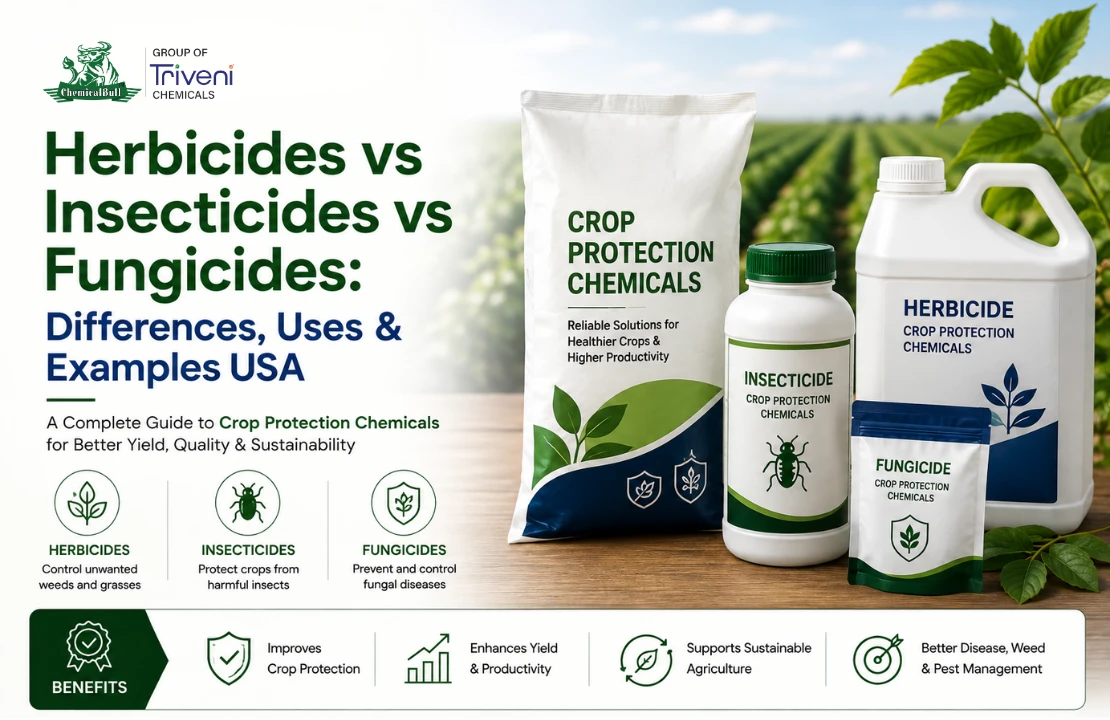
Herbicides vs Insecticides vs Fungicides: Differences, Uses & Examples USA
Herbicides, insecticides and fungicides are major types of pesticides used to protect crops from different threats. Herbicides control weeds, insecticides target damaging insects and related arthropods, and fungicides help prevent or control fungal diseases. In the United States, all three belong to the broader pesticide category.
For growers, crop-protection formulators and agricultural chemical buyers, understanding pesticides, herbicides, insecticides and fungicides helps match the correct product with the actual field problem. Product selection depends on the crop, target pest, application timing, formulation type and registered use.
For B2B companies serving the U.S. agricultural sector, these differences also matter when selecting active ingredients, formulation materials, adjuvants and other crop-protection raw materials for commercial production.
Herbicides vs Insecticides vs Fungicides: Quick Answer
|
Category |
Controls |
Main Agricultural Role |
Chemical Examples |
|
Herbicide |
Weeds and unwanted plants |
Weed control |
Glyphosate, Atrazine, 2,4-D, Dicamba |
|
Insecticide |
Insects and related arthropods |
Insect pest control |
Bifenthrin, Imidacloprid, Spinosad, Chlorantraniliprole |
|
Fungicide |
Fungi and fungal diseases |
Disease control |
Azoxystrobin, Propiconazole, Copper compounds, Sulfur |
In simple terms: herbicides control weeds, insecticides control insects, and fungicides control fungal diseases. All three are pesticides, but each is designed for a different agricultural problem.
What Are Pesticides?
A pesticide is a substance or product intended to prevent, destroy, repel or control a pest.
Some common pesticides used in agriculture include:
-
Herbicides for weeds
-
Insecticides for insect pests
-
Fungicides for fungal diseases
-
Miticides for mites
-
Nematicides for nematodes
-
Rodenticides for rodents
This explains why pesticides, herbicides, insecticides and fungicides are often discussed together. Pesticide is the broad term, while the other terms identify the type of pest being targeted.
For a broader understanding of crop-protection products and their functions, read our guide on types of agrochemicals used in agriculture. You can also explore the Chemical Bull U.S. agrochemicals range for related product categories.
What Are Herbicides Used for?
Herbicides are pesticides used to control weeds and unwanted vegetation. The use of herbicides in agriculture helps reduce competition between crops and weeds for water, nutrients, sunlight and growing space.
Effective weed control is important in U.S. crops such as corn, soybean, wheat, cotton, fruits and vegetables because heavy weed pressure can affect crop establishment, field operations and potential yield.
Buyers and formulators working on weed-control products can explore our range of herbicides for agricultural applications.
Examples of Herbicide Chemicals
Common herbicide active ingredients used in agricultural weed-management programs can include:
-
Glyphosate – a non-selective systemic herbicide
-
Atrazine – widely associated with weed control in crops such as corn
-
2,4-D – a selective herbicide commonly used against broadleaf weeds
-
Dicamba – a systemic herbicide used for certain broadleaf weeds
-
Paraquat – a non-selective contact herbicide
-
Pendimethalin – commonly used as a pre-emergent herbicide
-
Metolachlor / S-metolachlor – used in pre-emergence weed-management programs
-
Glufosinate – a non-selective herbicide used in certain crop systems
These are general chemical examples only. The permitted crop, rate, timing and application requirements depend on the specific registered pesticide product.
How Do Herbicides Increase Crop Yield?
Herbicides do not directly make a crop produce more. Instead, they can protect yield potential by reducing competition from weeds.
When weeds compete for moisture, sunlight, nutrients and space, fewer resources may be available to the crop. Timely control during important growth stages can therefore support more uniform crop development and easier harvesting.
The actual benefit depends on weed species, weed density, crop stage, weather and overall field management.
Pre-Emergent vs Post-Emergent Herbicides
Application timing is an important part of herbicides use.
Pre-Emergent Herbicides
Pre-emergent herbicides are generally applied before target weeds emerge. They can help reduce early weed establishment during critical stages of crop development.
Examples may include pendimethalin, S-metolachlor and certain atrazine-based programs, depending on the crop and registered use.
Post-Emergent Herbicides
Post-emergent herbicides are applied after weeds have emerged.
Examples of active ingredients used in some post-emergence programs include glyphosate, dicamba, 2,4-D and glufosinate, depending on the crop, weed and label.
Successful post emergent weed control depends on weed species, weed size, crop stage, weather and application timing.
Selective vs Non-Selective Herbicides
Selective herbicides are designed to control certain weeds while allowing a labeled crop or desired plant to remain when used correctly.
Examples include 2,4-D, atrazine and certain grass- or broadleaf-selective herbicides.
Non-selective herbicides can affect a broader range of vegetation. Examples include glyphosate, paraquat and glufosinate.
There is no universal best herbicide or best herbicide weed killer for every situation. Selection depends on the crop, weed species, mode of action, resistance concerns, timing and registered use.
What Does a Surfactant Do in Herbicide Application?
A surfactant for herbicide application is an adjuvant that can help certain spray solutions wet and spread more effectively across plant surfaces.
Depending on the formulation, surfactants or adjuvants may include materials from categories such as:
-
Non-ionic surfactants
-
Organosilicone surfactants
-
Crop oil concentrates
-
Methylated seed oils
-
Ammonium sulfate-based adjuvant systems
However, not every herbicide application requires an additional surfactant. The pesticide label should always determine whether an adjuvant is required, allowed or unsuitable.
What Are Insecticides?
Insecticides are pesticides used to control insects and certain related arthropods that can damage agricultural crops.
Insecticides in agriculture may help manage pests that:
-
Feed on leaves
-
Damage roots
-
Bore into stems
-
Feed on plant sap
-
Damage fruits or seeds
-
Reduce marketable crop quality
-
Transmit some plant diseases
Different insecticide chemicals have different modes of action.
Businesses evaluating products for insect-control formulations can explore our insecticides for agricultural applications.
Examples of Insecticide Chemicals
A list of insecticides used in agriculture can include active ingredients from several chemical groups.
Examples include:
-
Bifenthrin – pyrethroid insecticide
-
Lambda-cyhalothrin – pyrethroid insecticide
-
Permethrin – pyrethroid insecticide
-
Imidacloprid – neonicotinoid insecticide
-
Thiamethoxam – neonicotinoid insecticide
-
Acetamiprid – neonicotinoid insecticide
-
Chlorantraniliprole – diamide insecticide
-
Spinosad – spinosyn insecticide
-
Malathion – organophosphate insecticide
-
Carbaryl – carbamate insecticide
These are insecticides examples, not recommendations for a particular U.S. crop.
A buyer searching for the name of insecticides used in agriculture should confirm the specific product registration, crop label and target pest before use.
Are Insecticides and Pesticides the Same Thing?
No. Insecticides and pesticides are related, but they are not the same thing.
A pesticide is the broad category, while an insecticide is specifically intended to control insects.
All insecticides are pesticides, but not all pesticides are insecticides.
Herbicides and fungicides are also pesticides.
This distinction helps explain searches involving insecticides & pesticides, insecticides pesticides and insecticides and pesticides examples.
How Insecticides Protect Crops
The purpose of insecticides and pesticides for crop protection is to reduce damaging pest pressure.
Insect pests can cause:
-
Leaf loss
-
Root damage
-
Fruit damage
-
Stem boring
-
Sap loss
-
Reduced crop quality
-
Lower yield potential
The correct insecticide decision should start with pest identification and an understanding of the insect's life stage.
What Are Fungicides Used for?
Fungicides are pesticides used to prevent, suppress or control diseases caused by fungi and certain fungus-like pathogens.
The main use of fungicides is to protect crops against problems that can affect leaves, stems, roots, seeds, flowers and fruits.
Common disease problems may include:
-
Rust
-
Mildew
-
Mold
-
Blight
-
Certain rots
Fungicides in agriculture may be used as seed treatments, soil treatments or foliar applications depending on the disease, crop and product.
For disease-control product requirements, explore our range of fungicides for agricultural applications.
Examples of Fungicide Chemicals
Common examples of fungicides used in agriculture include:
-
Azoxystrobin – strobilurin fungicide
-
Pyraclostrobin – strobilurin fungicide
-
Propiconazole – triazole fungicide
-
Tebuconazole – triazole fungicide
-
Difenoconazole – triazole fungicide
-
Mancozeb – dithiocarbamate fungicide
-
Chlorothalonil – contact fungicide
-
Copper hydroxide – copper-based fungicide
-
Copper oxychloride – copper-based fungicide
-
Sulfur – widely used fungicidal active ingredient
These are general chemical examples. The suitable fungicide depends on the crop, target disease, resistance-management program and registered product label.
Types of Fungicides Used in Agriculture
The types of fungicides used in agriculture can be grouped according to chemistry, mode of action and how they behave on or within a plant.
Contact Fungicides
Contact fungicides remain mainly on treated surfaces and act where the spray is deposited.
Examples may include:
-
Mancozeb
-
Chlorothalonil
-
Sulfur
-
Certain copper compounds
Systemic or Locally Systemic Fungicides
These products can move to some degree within treated plant tissues.
Examples may include:
-
Azoxystrobin
-
Propiconazole
-
Tebuconazole
-
Difenoconazole
The exact movement and mode of action differ between active ingredients.
Advantages of Fungicides in Crop Protection
The main advantages of fungicides relate to protecting crop health and marketable quality where fungal disease pressure exists.
Appropriate disease management can help:
-
Reduce disease development
-
Protect healthy leaf area
-
Maintain crop quality
-
Protect yield potential
-
Support plant establishment
-
Reduce losses during disease-favorable conditions
Fungicides work best as part of an integrated disease-management strategy.
Herbicides, Insecticides and Fungicides: Detailed Comparison
|
Factor |
Herbicides |
Insecticides |
Fungicides |
|
Main target |
Weeds |
Insects and arthropods |
Fungal pathogens |
|
Primary use |
Weed management |
Insect pest management |
Disease management |
|
Example chemicals |
Glyphosate, Atrazine, 2,4-D |
Bifenthrin, Imidacloprid, Spinosad |
Azoxystrobin, Propiconazole, Mancozeb |
|
Example field problem |
Weeds competing with corn |
Insects damaging soybean |
Fungal disease in wheat |
|
Timing |
Pre-emergent or post-emergent |
Based on pest monitoring |
Often disease-risk based |
|
Selection depends on |
Crop, weed and stage |
Pest, life stage and crop |
Disease, crop and risk |
Which Pesticide Type Is Used for Different Crop Problems?
The first step is identifying the actual crop problem.
|
Field Problem |
Product Category |
Example Active Ingredients |
|
Weeds competing with crops |
Herbicide |
Glyphosate, Atrazine, 2,4-D |
|
Insects feeding on crops |
Insecticide |
Bifenthrin, Imidacloprid, Spinosad |
|
Fungal crop disease |
Fungicide |
Azoxystrobin, Propiconazole, Sulfur |
For example:
Weeds in corn → evaluate herbicide options
Damaging insects in soybean → evaluate insecticide options
Fungal disease in wheat → evaluate fungicide options
Correct diagnosis matters because poor crop growth can also result from nutrient deficiencies, drought, excessive moisture, soil problems or previous pesticide injury.
Active Ingredients vs Finished Pesticide Formulations
A commercial pesticide generally contains an active ingredient responsible for pesticidal activity along with other formulation ingredients.
For example:
Glyphosate can be an herbicide active ingredient.
Bifenthrin can be an insecticide active ingredient.
Azoxystrobin can be a fungicide active ingredient.
The finished product may also contain formulation materials that support:
-
Wetting
-
Dispersion
-
Emulsification
-
Suspension
-
Stability
-
Spray performance
-
Delivery of the active ingredient
This distinction is especially important for B2B agricultural chemical buyers because purchasing an active ingredient or formulation raw material is different from buying a finished registered pesticide product.
Contact vs Systemic Pesticides
Contact pesticides mainly work where the material reaches the target.
Examples can include paraquat among herbicides and chlorothalonil among fungicides.
Systemic pesticides can be absorbed and move to some extent within the plant or target organism.
Examples can include glyphosate among herbicides, imidacloprid among insecticides and certain triazole fungicides such as propiconazole.
The exact behavior depends on the chemistry and formulation.
Why Pesticide Resistance Matters
Repeated reliance on the same pesticide mode of action can select for pest populations that become less sensitive over time.
Resistance can develop in:
-
Weeds
-
Insects
-
Fungal pathogens
Resistance-management programs may include rotating modes of action, monitoring fields, integrating non-chemical practices and avoiding unnecessary applications.
What Should B2B Agricultural Chemical Buyers Check?
Agricultural formulators and crop-protection businesses should evaluate more than price when sourcing raw materials for herbicide, insecticide or fungicide formulations.
Important factors include:
Product identity: Confirm the exact active ingredient or formulation raw material required for the intended application.
Specification: Review purity, assay, moisture, active content and other relevant technical parameters according to the formulation requirement.
Formulation compatibility: Ensure the material is suitable for the intended herbicide, insecticide or fungicide system and compatible with other formulation ingredients.
Batch consistency: Commercial manufacturing requires consistent raw-material quality and reliable performance from one batch to another.
Documentation: Depending on the requirement, buyers may request a Certificate of Analysis (COA), Safety Data Sheet (SDS), Technical Data Sheet (TDS), product specification and batch details.
Packaging and quantity: Confirm suitable packing options for formulation trials, pilot-scale production or regular bulk requirements.
Supply reliability: U.S. agricultural demand can be seasonal, making dependable sourcing, material availability and procurement planning important for uninterrupted production.
Buyers can browse the Chemical Bull U.S. agrochemicals catalogue to explore herbicide, insecticide, fungicide and related crop-protection product categories.
For products intended for the U.S. market, buyers should also ensure that the finished pesticide product meets applicable registration and labeling requirements for the intended crop, target pest and use.
Businesses searching for a trusted supplier of agrochemical products for the U.S. market can explore herbicide, insecticide, fungicide and related crop-protection categories through Chemical Bull.
Frequently Asked Questions
What are some examples of herbicide chemicals?
Common herbicide active ingredients include glyphosate, atrazine, 2,4-D, dicamba, pendimethalin and glufosinate. Their approved crop uses, application rates and timing depend on the registered product label.
What are common insecticides used in agriculture?
Examples include bifenthrin, lambda-cyhalothrin, imidacloprid, chlorantraniliprole and spinosad. The appropriate product depends on the crop, insect species and registered use.
What are common fungicides used in agriculture?
Examples include azoxystrobin, propiconazole, tebuconazole, mancozeb, sulfur and copper-based fungicides. Selection depends on the crop, target disease and resistance-management requirements.
Are insecticides and pesticides the same thing?
No. An insecticide is one type of pesticide. Pesticides also include herbicides, fungicides, miticides, nematicides and other pest-control categories.
What is post-emergent weed control?
Post-emergent weed control means managing weeds after they have emerged. Product selection depends on the weed species, crop stage, application timing and label.
Is there one best herbicide for all weeds?
No. The best herbicide depends on the crop, weed species, growth stage, mode of action, resistance status and registered use.
Why are surfactants used with some herbicides?
A suitable surfactant may improve wetting and spreading of certain herbicide sprays. However, it should only be added when permitted or required by the specific herbicide label.
Conclusion
Understanding herbicides vs insecticides vs fungicides helps growers and agricultural businesses select the correct crop-protection category. Herbicides such as glyphosate, atrazine and 2,4-D are associated with weed control; insecticides such as bifenthrin, imidacloprid and spinosad target damaging insects; and fungicides such as azoxystrobin, propiconazole and sulfur are used for fungal disease management.
These chemical examples help explain the practical difference between the three pesticide groups, but final product selection must always consider the crop, pest, application timing and current U.S. registration and label requirements.
For B2B companies serving the U.S. agricultural market, sourcing decisions should also consider technical specifications, formulation compatibility, documentation, quality consistency and dependable bulk supply.
Looking for a product catalogue, MSDS/SDS, technical specifications or bulk supply details for herbicides, insecticides, fungicides or related crop-protection materials? Explore our U.S. agrochemicals catalogue or contact Chemical Bull USA with your product name, required quantity, application and delivery location for sourcing support. Chemical Bull is one of the leading agro chemicals suppliers in the USA and accross the globe.
Comment Section